Downers Grove Epoxy Flooring has spent more than 20 years installing epoxy flooring in Worth and across the southwest suburbs, and the floors we think hardest about here are the ones people dance on. A room full of guests in dress shoes is a different load from a car or a cart, and it wears a coating in a different way. We plan a floor for the traffic it will actually see, not for a generic brochure picture of it.
Most of what fails on an event floor is not a dent or a crack. It is a dull, scuffed path where hundreds of people walked the same line from the door to the bar and back. That is an abrasion problem, and it has abrasion answers: the right resin, the right topcoat, the right texture and a little discipline at the entrances.
This page walks through how we think about that kind of floor, whether it belongs to a banquet business or to a homeowner finishing a basement party room. Every proposal we write names the product line, the number of coats and the finished thickness, so the owner can hold the completed floor up against the quote.
Two banquet rooms, a dance floor and the force under a heel
Worth is a village in Cook County, a suburb of Chicago with 10,970 residents at the 2020 census, and it supports a real banquet trade. The clearest example sits at 11000 S. Ridgeland Avenue, an address that geocodes inside the village in Worth Township, Cook County. That is a useful place to start, because it shows what an event floor in this town is asked to do on a Saturday night.
Garden Chalet on Ridgeland Avenue
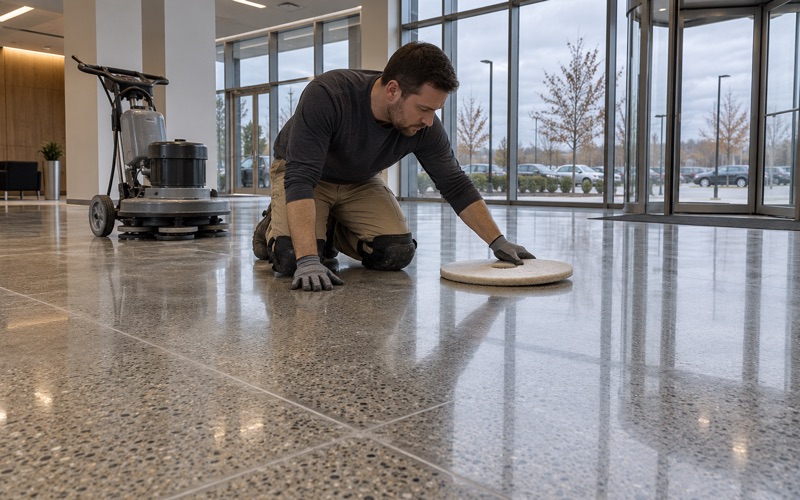
Garden Chalet is a family-owned and operated hall with two rooms. The Chalet Room is listed as accommodating anywhere from 130 to 250 guests, and the Garden Room is described as a more intimate space that holds up to 100 guests. A dance floor appears among the event items, and a listing photo is captioned with the Garden Room dance floor.
The venue lists open bar service, a champagne toast and buffet, plated and family-style catering. We have no relationship with the hall or its caterer, and the listings do not describe what its floors are made of. We use it here only because it is the plainest picture in Worth of a room where a few hundred people stand, walk and dance for hours.
How much a heel presses on a floor
A person in flat shoes spreads their weight across a large footprint. Put the same person on a narrow heel and the load concentrates on a tiny patch, which is why heels mark soft floors that survive heavy furniture. The Physics Factbook gathered textbook and classroom estimates that put the pressure under a high heel at roughly 1,700 to 11,000 kPa, depending on how large the heel tip is assumed to be.
One worked example from that compilation takes 65 kg on 2 square centimeters and gets 3,250,000 Pa, or about 470 psi. Another source in the same set notes that stiletto heels have an area of about 1/16 of a square inch. These are estimates, not measurements of any floor in Worth, but they explain why a dance floor full of heels deserves more thought than its square footage suggests.
Why that number matters for finish choice
Several hundred pounds per square inch, repeated thousands of times in one evening, is enough to leave crescents in vinyl, soft wood finishes and some thin paint-grade coatings. A floor finish that dents under that load starts to look tired after a single wedding season. The goal is a surface that sits comfortably above the load, so the heel is not the thing that decides how the floor ages.
Looking for epoxy-flooring closer to Palos Heights? See Epoxy-Flooring in Palos Heights.
Why a hard resin shrugs off heels but not grit
A properly installed resin floor answers the heel problem almost by default. What it does not answer by default is the sand and grit that guests carry in from the parking lot, and that is where most of our planning goes on a floor like this.
Compressive strength against a point load
Compressive strength describes how much squeezing a material takes before it gives. For comparison, one 100% solids floor epoxy data sheet lists a compressive strength of 12,000 psi under ASTM D695, along with a Shore D hardness of 89. That is one product, not a promise for every epoxy, but it shows how far a good hard resin sits above the few hundred psi estimated under a heel tip.
That gap is why heels on their own do not mark a well-bonded resin floor the way they mark softer finishes. The resin is not soft enough to take a dimple. Strength in the cured film only counts, though, if the film is firmly attached to sound concrete underneath it.
Bond and preparation come first
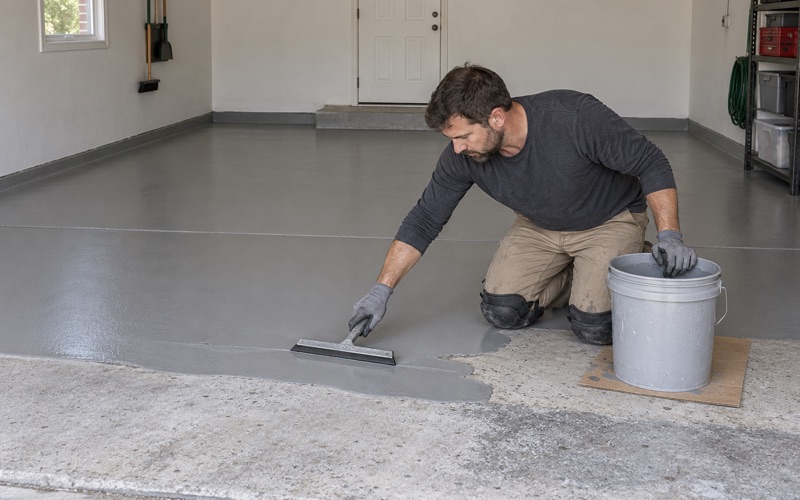
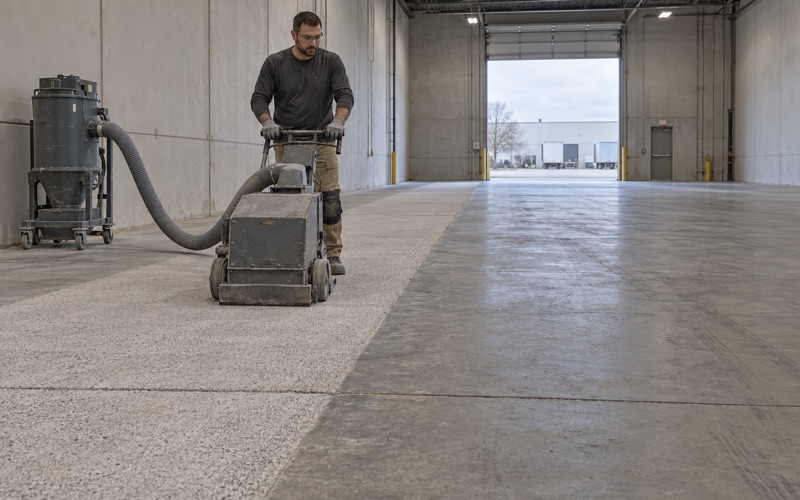
A hard coating over a weak or poorly profiled slab can chip or peel at the edges, and no topcoat fixes that. We open every slab with diamond grinding or shot blasting rather than an acid etch, aiming for the ICRI concrete surface profile the chosen system calls for. Grinding dust is pulled into a vacuum at the machine instead of being rinsed toward a floor drain.
Before the price is final we map cracks, spalls and any old coatings on the slab. If a section needs repair or replacement before it should be coated, we say so in writing rather than burying the problem under a fresh color.
Grit is the real abrasive
Sand and fine gravel are harder than most floor finishes. When a heel or a hard sole drags a grain of grit across the surface, the grain does the cutting, and the result is a field of fine scratches that dulls the gloss along the busiest paths. The same data sheet lists a Taber abrasion loss of 0.10 g, a lab test that grinds the surface with an abrasive wheel, which gives a sense of how a resin stands up to that kind of wear.
No floor is immune to grit, so we treat scratch tolerance as a design choice. The finish and texture should hide light scratching well, and the room’s routine should keep as much grit as possible from ever reaching the dance floor.
Finish, texture and mats for a night of dancing
Once the base coat is right, the visible decisions are the ones that control how the floor looks after a hundred events. Gloss level, color, broadcast and topcoat all change how forgiving a floor is.
Topcoats chosen for scratch tolerance
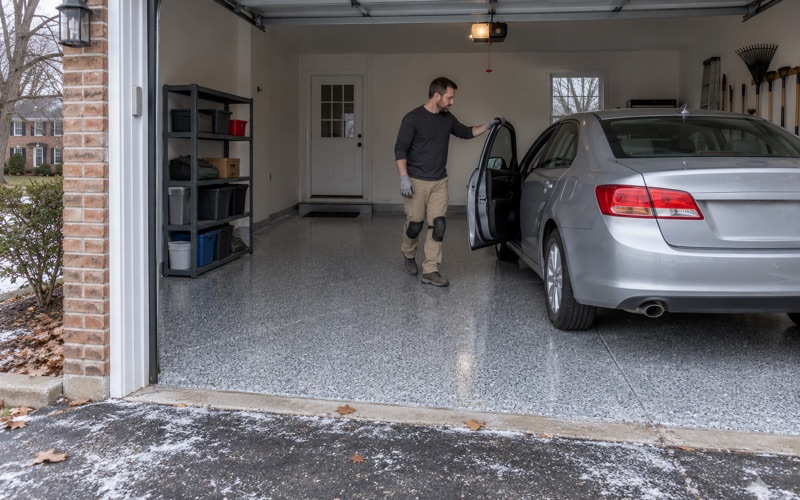
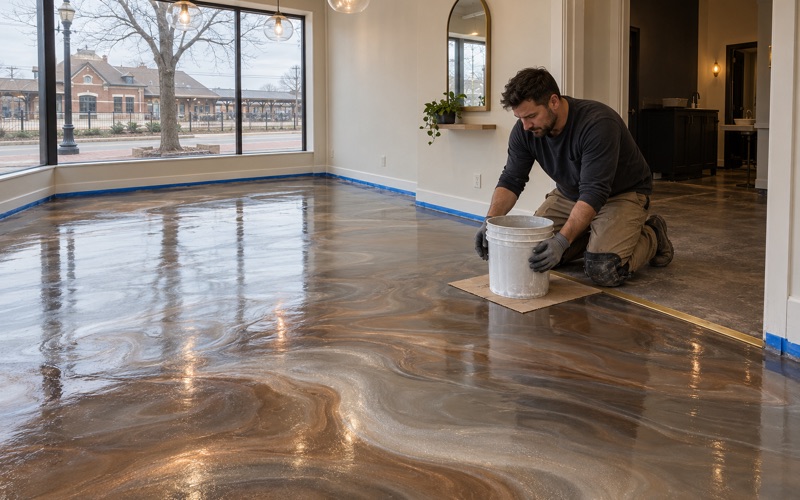
A high-gloss, solid dark color shows every fine scratch under banquet lighting. A lower sheen, a mid-tone color or a vinyl flake broadcast breaks up the surface so light scuffing blends in. We often finish event floors with a polyaspartic or polyurea topcoat over the epoxy base, because the topcoat is the wear layer and it can be renewed later without grinding the whole system off.
We write the topcoat product and the number of coats into the proposal. When the floor starts to dull along the busiest path, the owner knows exactly what was applied and what a recoat involves.
Texture that grips without grabbing
A dance floor has to let a shoe turn, while the rest of the room should not turn slick when a drink spills near the bar. We specify slip resistance by the broadcast and topcoat used, such as a fine quartz aggregate or a grit additive in the final coat, rather than promising it as a slogan. A dance area can carry a lighter texture than a service lane or a bar front.
Too much texture traps dirt and makes mopping harder, and too little lets spills turn into a hazard. We walk the owner through samples so the texture is matched to each zone of the room.
Entry mats, sweeping and scheduling
The cheapest protection an event floor ever gets is a good mat at every entrance and a dry sweep or dust mop before the doors open. Grit removed at the door is grit that never reaches the dance floor. Long walk-off mats at the main entry and the kitchen door catch most of what rides in on shoes.
Commercial rooms rarely close for long, so we phase the work around bookings with overnight and weekend windows. Cure schedules follow slab temperature and dew point, not the calendar, so the room reopens when the coating is ready rather than when a date on a calendar says so.
Basement party rooms and home bars in Worth
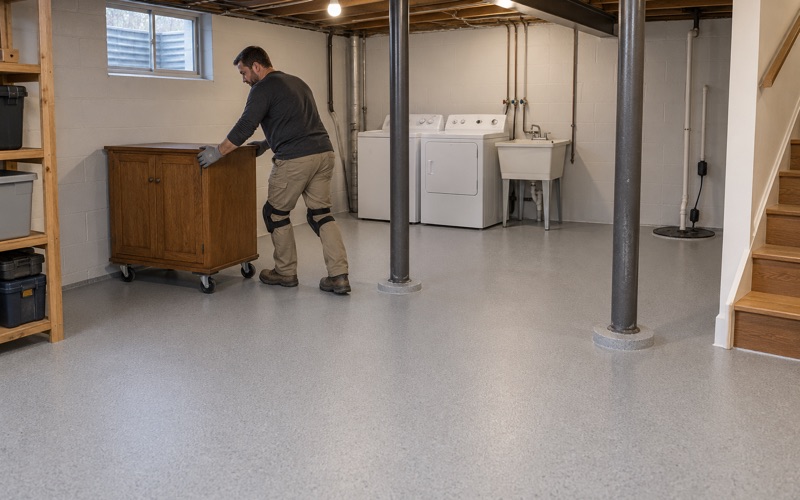
The same logic carries into Worth homes, where a finished basement often doubles as the family’s party room. Heels, dancing and a home bar put the same scratch and spill demands on a floor, just on a smaller scale.
Mid-century slabs under most houses
About three-quarters of the houses in Worth date from 1950 to 1979, and fewer than 1 in 10 were built after 1990. That means nearly every basement or garage floor we coat here is a retrofit over a slab 45 to 75 years old. Older slabs may carry paint, adhesive, patches or settlement cracks, and each one changes the preparation plan.
A moisture test is part of the written scope before the price is set, on a basement slab and a garage slab alike. We may use ASTM F2170 in-situ relative humidity probes, ASTM F1869 calcium chloride testing or a simple ASTM D4263 plastic sheet test as a first look, depending on the floor.
Moisture and the warranty
Moisture rising through an old basement slab is the most common reason a party room floor lets go, and it is the first warranty exclusion we name. When readings call for it, a moisture-mitigation primer goes down before the decorative system. We explain what any coating warranty leaves out before the job is sold, not after a bubble appears.
We also never describe a floor coating as radon reduction. In Illinois that is licensed mitigation work, and a basement owner with radon concerns should hire for it separately.
Condominiums, licensing and contracts
Worth has a sizable condominium layer, with 340 owner-occupied units in buildings of 10 to 19 units. In those buildings a shared garage, storage room or laundry floor is usually decided by the association rather than one owner, so we confirm who signs off before we quote.
The village licenses contractors who work in Worth, with a $110 registration, a certificate of insurance naming the village and a $10,000 surety bond. The building department’s permit list names many remodeling projects but does not mention flooring either way, so we ask before starting rather than assume. Home jobs over the state threshold get a written contract and the Illinois consumer-rights pamphlet before any grinding begins.
- 20+ Years of Floor Work
- Moisture Tested in Writing
- Free Written Quotes