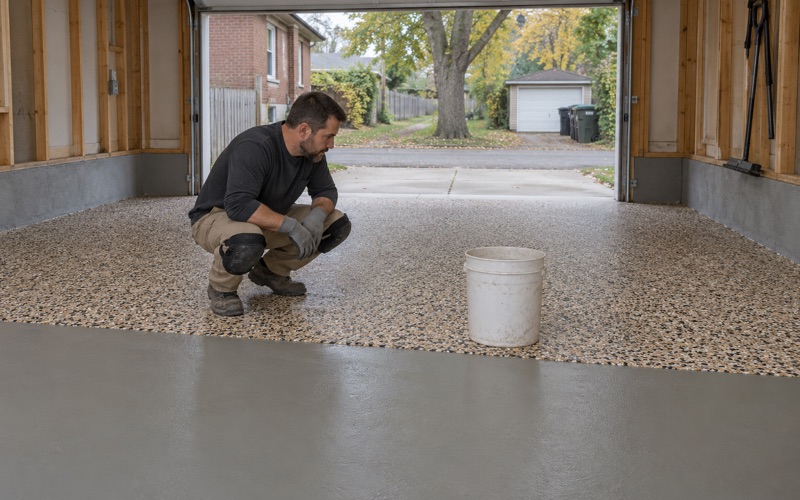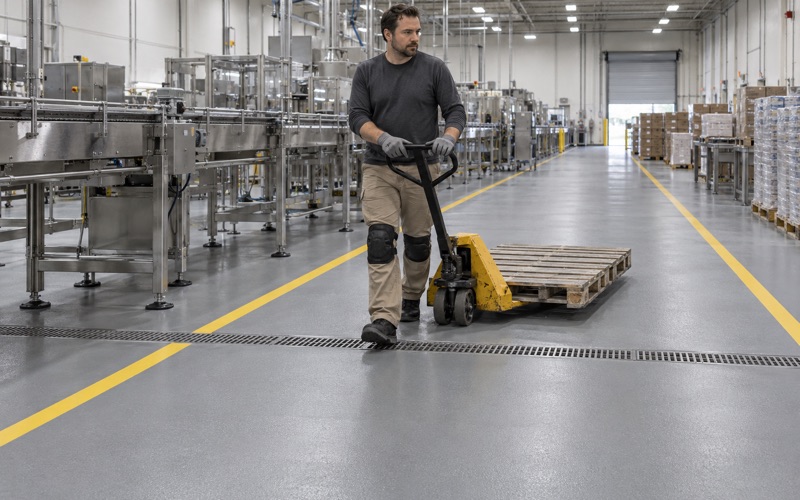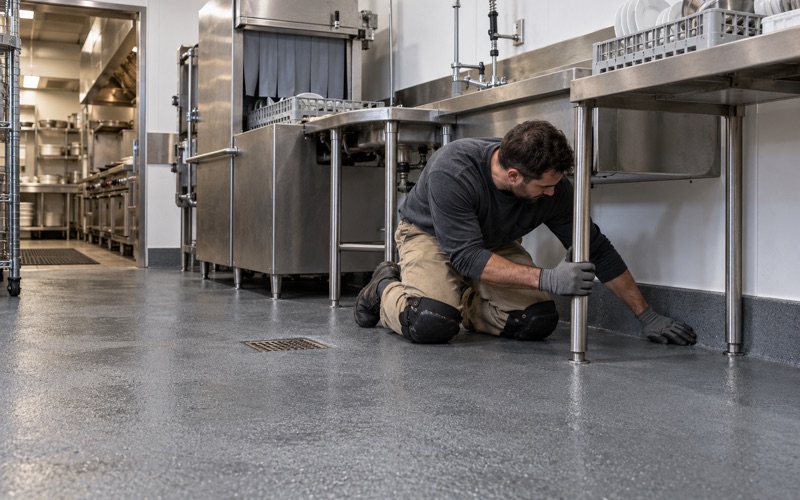
Downers Grove Epoxy Flooring has spent more than 20 years putting epoxy flooring in Winfield clinics, kitchens, garages and basements, and the rooms we think hardest about are the ones that get washed every single day. A floor in an exam suite, a food-prep room or a household where one child cannot touch peanut butter is judged less by its color than by how completely a mop and a bucket of detergent water can return it to clean, bare surface. A seamless resinous floor does that job well when it is built right and badly when it is rushed.
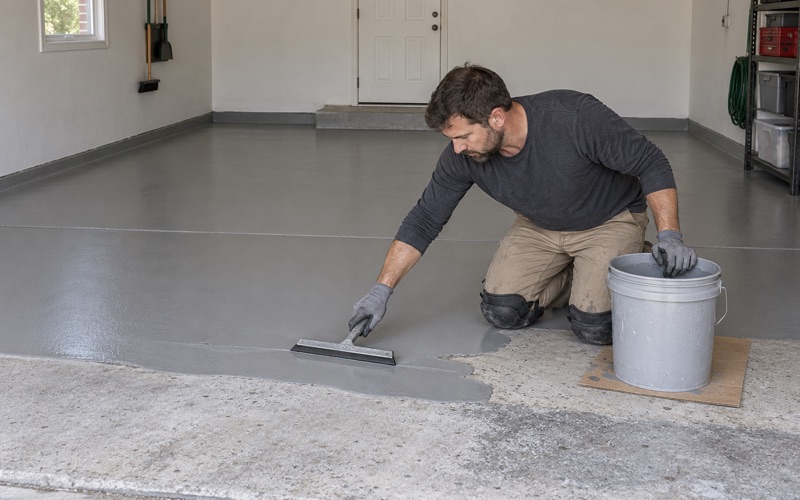
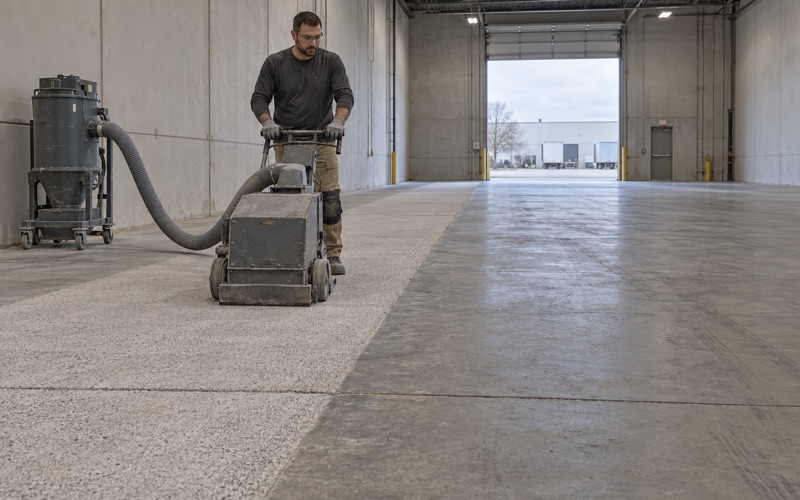
Our work starts with the slab, not the sample board. Every floor is opened with a diamond grinder or a shot blaster rather than an acid wash, because a coating that lets go at the edges leaves exactly the kind of lifted seam that collects grime. Cracks, spalls and old coatings are mapped before we price anything, and when a slab needs repair or replacement before it should be coated, we say so plainly.
Commercial rooms get one more consideration: the people who use them. Exam suites, offices and food-service spaces are phased into overnight and weekend windows when a practice cannot close its doors for a week, so patients and staff never walk through wet resin.
Food Challenges on Church Street, and Why Cleaning Beats Sanitizing
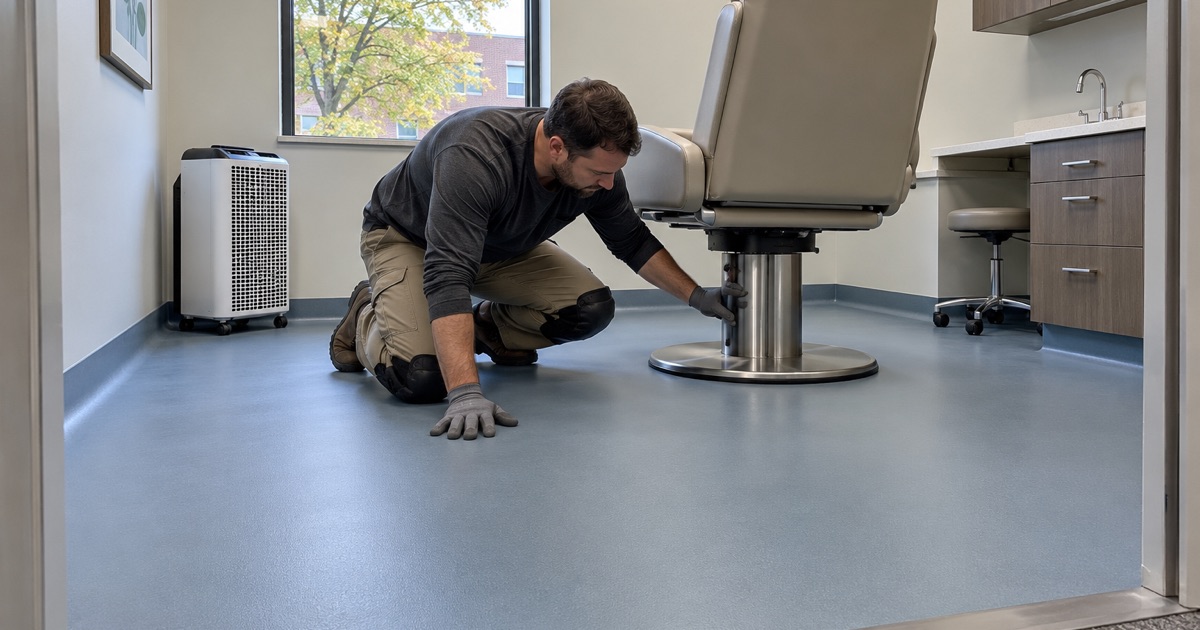
In Winfield Town Center, across the street from Central DuPage Hospital, Northwestern Medicine opened a three-story, 51,000-square-foot medical office building on January 30, 2023. Its location page gives the address as 0S036 Church Street. The allergy practice there has eight exam rooms and six observation bays for allergy testing, food challenges and nurse-administered injections, and it shares the building with ophthalmology and urology suites.
We have no relationship with that practice and have never seen its floors. We mention it because it describes, better than any brochure could, a kind of room where choosing a floor is really a cleaning decision.
What happens in an observation bay
A food challenge brings a suspected trigger food, such as peanut, egg or milk, into the room on purpose. Crumbs fall, a cup tips, a cracker ends up underfoot. The next patient in that same bay may be the one who is allergic to exactly what was spilled, which is why the surfaces in a room like this have to come clean quickly and completely between visits.
What the 2004 peanut study found
Research by Perry and colleagues, published in the Journal of Allergy and Clinical Immunology in 2004, looked at how peanut allergen, Ara h 1, spreads and how it comes off. Common household cleaning agents removed it from tabletops, with one exception: dishwashing liquid left it on 4 of 12 tables. Washing with liquid soap, bar soap or commercial wipes left Ara h 1 undetectable on hands, while plain water left it on 3 of 12 hands and antibacterial hand sanitizer left it on 6 of 12.
The allergist answering for the AAAAI drew a reassuring conclusion from that work: routine cleaning procedures are highly effective. The catch is in the word cleaning.
Cleaning and sanitizing are separate jobs
Hand sanitizer is not a cleaner, and neither is a disinfectant spray. Those products are meant to act on germs; they are not designed to lift food protein off a surface. Removing residue is mechanical work, in which a detergent loosens it and a wipe or mop carries it away. A clinic floor gets both treatments, and each has to be done as its own step.
The study tested tables and hands, not floors, so carrying it to a floor is our inference rather than its finding. The inference points one way, though. A floor in a room like this should give residue back to ordinary wet cleaning, and it should never make the cleaning crew’s job harder. No floor prevents an allergic reaction; a good one simply leaves residue nowhere to hide.
Looking for epoxy-flooring closer to Lemont? See Lemont Epoxy-Flooring.
A Sealed, Grout-Free Floor With Nowhere for Residue to Hide
The surfaces that frustrate a detergent wash are the ones with somewhere to hold on: grout joints, open pores, seams between vinyl sheets, chipped tile and the gap where floor meets wall. A resinous floor removes most of those hiding places by being one continuous, nonporous film from wall to wall.
Nonporous starts with the concrete
Bare concrete is porous. Spilled milk or oil wicks into it, and a mop pushes surface residue around rather than lifting it out. A 100% solids epoxy body coat, applied over a slab ground to the right ICRI concrete surface profile, fills that porosity and bonds into it. The bond depends entirely on preparation, which is why we grind or shot blast instead of etching, and why a peeling edge is treated as a defect rather than a cosmetic flaw: every lifted edge is a new crevice.
Moisture is tested before the price is final
A coating that blisters from vapor pushing up through the slab turns a smooth floor into one full of bubbles and lifted edges, the opposite of what a wet-cleaned room needs. Moisture testing is written into our scope before the number is settled, using ASTM F2170 in-situ relative humidity probes or ASTM F1869 calcium chloride testing depending on the slab. When readings run high, a moisture-mitigation primer goes into the system.
We also explain what a coating warranty leaves out before the job is sold. Moisture vapor transmission is the first exclusion we name, because it is the one owners are least likely to expect.
Coved edges where the floor meets the wall
Where floor meets wall, a coved base carries the coating up the wall in a rounded profile, so there is no right-angle corner for a mop head to skip. In food-service rooms, DuPage County Health Department food plan review looks for that coved juncture with a 3/8-inch radius and does not accept sheet vinyl, in line with FDA Food Code 6-201.13. An exam room is not a food-service room, but the logic of a sealed, coved edge carries over directly.
Choosing a Topcoat That Takes Daily Detergent Cleaning
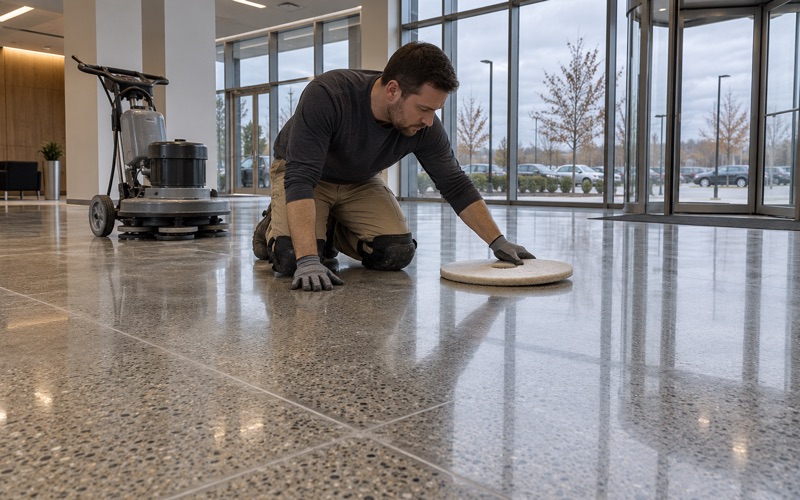
The body coat makes a floor seamless; the topcoat decides how it looks after a year of daily mopping. Detergent solutions, scrubber pads, rolling carts and exam stools slowly wear a soft finish dull, and a dull finish is a micro-scratched one that holds a film of whatever was last spilled.
Polyaspartic, polyurea and urethane cement
For exam and observation rooms we usually look at polyaspartic or polyurea topcoats over the epoxy body, because they resist abrasion and chemical staining well and hold their gloss under routine wet cleaning. Where a room sees hot-water washdown or heavy food spills, urethane cement is the tougher answer. Either way, the proposal names the product line, the number of coats and the finished thickness, so a facility manager can hold the installed floor up against the quote.
Texture that grips without trapping
Slip resistance in a wet-cleaned room is a balance. A heavy quartz aggregate broadcast grips well but gives residue more surface to cling to, while a fine texture locked under a sealing topcoat mops clean more easily. We specify the texture by the broadcast and topcoat we will actually install rather than promising a non-slip floor as a slogan. FDA Food Code 6-201.11 makes room for antislip floors in food areas, and the same thinking guides how we finish a clinic.
Cure timing in an occupied building
Cure schedules follow slab temperature and the dew point spread at the surface, not the calendar, because a topcoat laid over a cold, damp slab can develop amine blush and a cloudy, tacky finish. Products are chosen inside the Illinois VOC limits under 35 Ill. Adm. Code Part 223, which matters when the suite next door stays open. Grinding dust is captured at the machine with a vacuum instead of being rinsed toward a floor drain.
For a commercial room in the village, building permits run through the Village of Winfield Building Department at 27W465 Jewell Road, and fire code questions go to the Winfield Fire Protection District, a separate special district rather than a village department.
Winfield Mudrooms, Basements and Garages in a Food-Allergy Household
The same reasoning comes home with families. Winfield is a village of owners, with 3,695 of its 4,019 occupied homes owner-occupied, and when a household is managing a child’s food allergy, the question we hear is a practical one: which floor makes cleanup easiest after snack time?
Resinous coatings go on concrete, so in a house that usually means the lower level, the mudroom off the garage, a basement play area or kitchenette, and the garage itself. A coated floor does not replace the plan a family’s allergist sets. It only gives the mop a surface with no grout and no pores for crumbs to work into.
Mudrooms and garage entries
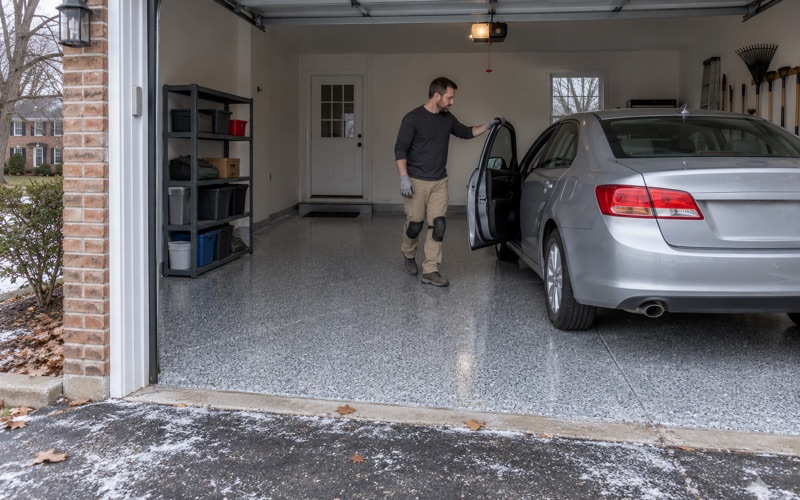
Lunch boxes, team snacks and grocery bags come in through the garage, and that is where a lot of food first touches the floor. A garage system with a vinyl flake broadcast under a polyaspartic topcoat wipes clean with a detergent mop, and it is chosen to stand up to the brine and rock salt that ride in on tires all winter.
Basement play areas and kitchenettes
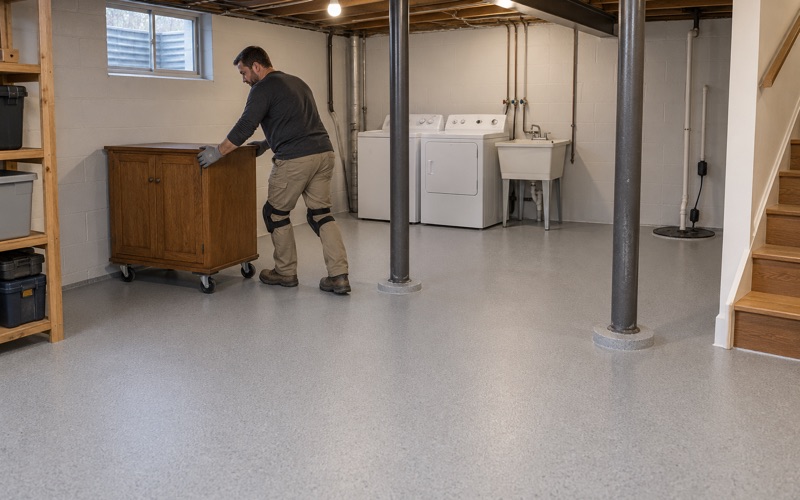
About two-thirds of the village’s housing, 67.6 percent, was built in 1980 or later, and the 1980s are the largest single decade. A typical Winfield lower level is therefore a 35-to-45-year-old builder-grade slab rather than a prewar basement. We start with an ASTM D4263 plastic sheet test as a quick screen and follow with probes where the slab calls for them, since a basement that will be mopped often needs a coating that stays bonded.
Paperwork before any grinding
Home jobs over the state threshold get a written contract and the Illinois Home Repair: Know Your Consumer Rights pamphlet before the first pass of the grinder. In a garage that sits below living space, cure timing still follows the slab and the dew point, and an unheated garage in deep winter is told to wait for warmer weather.
- 20+ Years of Floor Work
- Moisture Tested in Writing
- Free Written Quotes