Downers Grove Epoxy Flooring has spent more than 20 years installing epoxy flooring in Western Springs and the surrounding suburbs, and the question we ask first on almost every floor here is not about color or flake. It is about joints: where the concrete underneath is allowed to move, and where it is not.
A resin floor looks like one continuous sheet, but the slab under it rarely is. Additions, patches, old trenches and saw cuts all break a floor into pieces, and some of those pieces shift with the seasons. A coating that ignores that cracks in a straight line that traces the joint underneath, often within the first year.
So before we price a job, we walk the slab and map every crack, spall, patch, old coating and joint. The written proposal names the product line, the number of coats and the finished thickness, and it says how each joint will be treated. When a slab needs repair or replacement before it should be coated at all, we tell you that instead of selling a coating over it.
One Store, Several Buildings on Burlington Avenue

The clearest local example of a floor made from more than one slab is a business most residents have walked through. Village True Value Hardware sits at 835 Burlington Avenue in Western Springs, in Lyons Township, Cook County, and its history shows how a single store floor gets assembled over decades rather than poured at once.
Four steps from 1,976 square feet
According to the Western Springs Historical Society, the store was renamed Village Hardware in 1954, when it covered 1,976 square feet. In 1959 it expanded to take in the corner of Lawn and Burlington. In 1965 it took over the space vacated by the Western Springs State Bank, and a 1999 expansion added warehouse and retail space that brought the total to 12,500 square feet.
The store was Bigler’s hardware before the 1954 renaming, and a 2011 Patch history adds that the corner once held an A&P, Bigler’s and a Jewel side by side. Three neighboring storefronts on one stretch of Burlington Avenue eventually answered to one hardware business, which is about as plain an illustration of an assembled building as the village offers.
That is one business on one sales floor, spread across space that began as separate buildings with separate histories. We have not inspected the store and say nothing about its floor. The pattern is what matters: whenever a building grows by joining onto its neighbors, the slabs underneath were placed at different times, on different bases, by different crews.
Where one slab meets the next
The line where two slabs meet is a joint whether anyone designed it as one or not. Each side expands and contracts on its own schedule, settles on its own base and carries its own load. The seam between them is where that difference shows up.
The same thing happens at a much smaller scale in homes and small commercial spaces across the village. A storefront that absorbed the unit next door, a back room added onto a shop, or a garage extended by a few feet all leave a seam in the concrete. Our job is to find those seams before the coating hides them.
Looking for epoxy-flooring closer to La Grange? See Epoxy-Flooring in La Grange.
Moving Joints and Still Joints: Which Gets Saw-Cut and Which Gets Filled
Not every joint behaves the same way, and treating them all alike is how floors fail. Resin-flooring manufacturers split them into two groups, and the treatment for each is different.
Dynamic joints are honored, not buried
A dynamic joint is a moving joint, built to allow horizontal and vertical movement. The guidance from Sherwin-Williams for resin-floor contractors is direct: these joints must be honored by saw cutting through the finished floor system and filling with a flexible joint sealant. Not honoring them, the same guidance warns, can lead to cracks in the surface.
In practice that means we coat the floor, then saw-cut back through the cured system along the line of the joint below, and fill the cut with a flexible sealant that can stretch and compress as the slabs move. The joint stays visible as a thin, neat line. That line is the price of a floor that does not split on its own.
A flexible sealant is also a maintenance item rather than a permanent part of the slab. It can be cut out and replaced along the joint years later without touching the coating on either side, which is far simpler than patching a crack that has wandered across a finished floor.
Static joints are cleaned out and filled
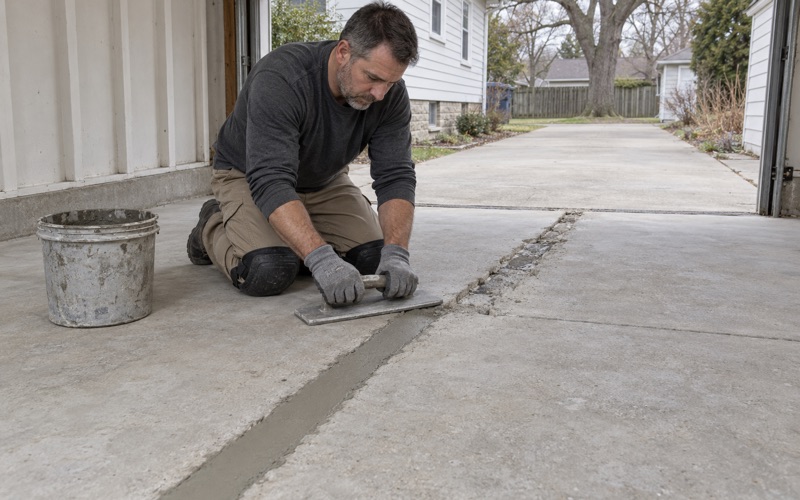
A static joint does not move in service. It is there to relieve shrinkage and internal stress while the concrete cures, and once that work is done, it stays put. Manufacturer guidance says these can be cleaned out with a 1/4-inch diamond blade and filled with a compatible joint filler before the coating goes on.
Filled static joints disappear under the finished floor. That is where most of the seamless look comes from, and it is legitimate there because the concrete on both sides is not going anywhere.
Telling one from the other
The hard part is deciding which is which, especially in a floor that was added onto rather than planned. A seam between two buildings, a joint that already shows a crack running through an old coating, or a line that opens and closes between summer and winter is treated as moving. A sawn control joint in a single slab that shows no signs of movement is usually treated as static. Where we are not sure, we treat the joint as moving, because a sealant line costs little and a crack across a finished floor costs a recoat.
Why a Coating Run Straight Across a Joint Cracks on the Line
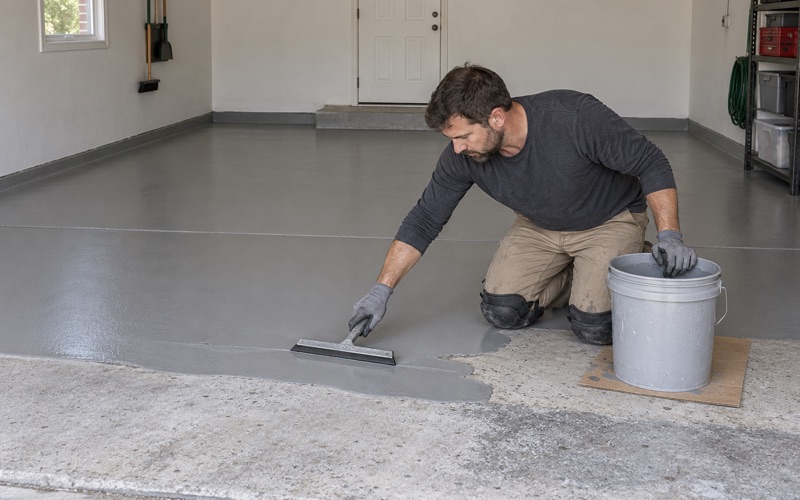
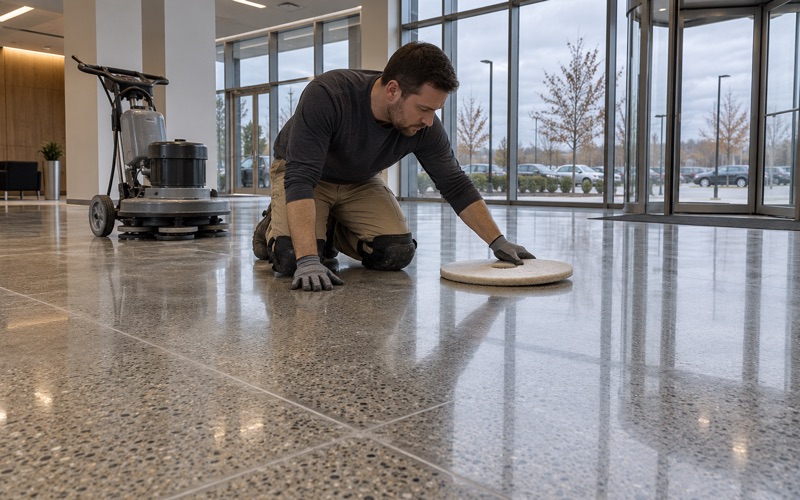
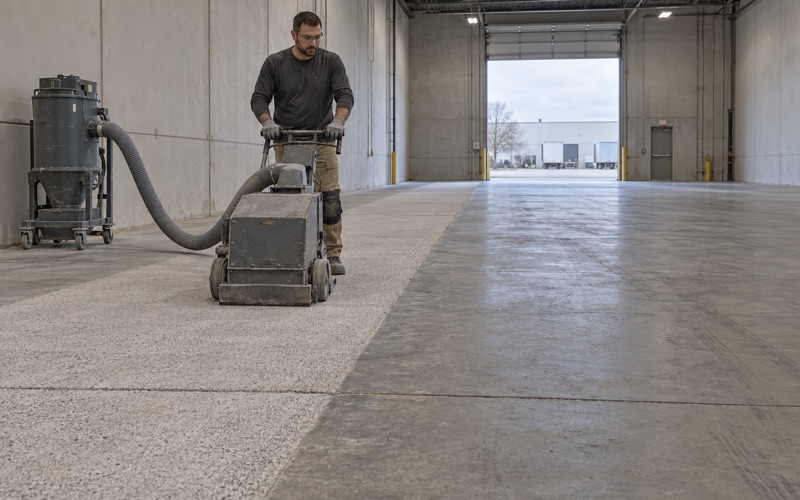
A cured epoxy or polyaspartic system is rigid and bonded tightly to the concrete under it. That bond is the point of the system, and it is why we open every slab with a diamond grinder or a shot blaster, never an acid etch, to give the resin a real profile to grip.
The bond carries the movement up
The same grip that keeps the coating on the floor means it moves with the floor. When two slabs pull apart even a fraction of an inch at a moving joint, a coating bridged rigidly across that line has nowhere to go. It tears, and the tear follows the joint exactly, because that is where the movement is concentrated.
Once that crack opens, water and cleaning chemicals get under the edges, the coating starts to lift along the line, and a floor that looked finished for a season now needs a repair that will always show.
A seamless look is not a reason to bridge
There is steady pressure on any installer to make a floor look like one uninterrupted surface. A Sika white paper on resin floors states plainly that a joint designed for significant movement should not be rigidly bridged simply to create a seamless appearance. We agree, and we put that conversation in front of you before the job starts rather than after the first crack.
What you get instead is a floor where the still joints vanish and the moving ones show as clean, sealed lines laid out to follow the slab underneath. On a floor assembled from several pours, that is how a seamless-looking surface survives a building that was put together piece by piece.
What the proposal says about joints
Joint treatment is written into the scope, not decided on the day of the install. The proposal lists which joints will be filled before coating, which will be saw-cut and sealed afterward, and what filler and sealant will be used in each, alongside the product line, coat count and finished thickness for the floor itself.
That gives you something to check the finished floor against. If a moving joint was listed for a saw cut and sealant, you should be able to walk to it and see a clean sealed line. If a crack or old coating edge was mapped during the walk-through, the proposal says how it was repaired, so nothing that was found gets quietly buried under the new surface.
Garage Additions and Patched Slabs in Western Springs Homes
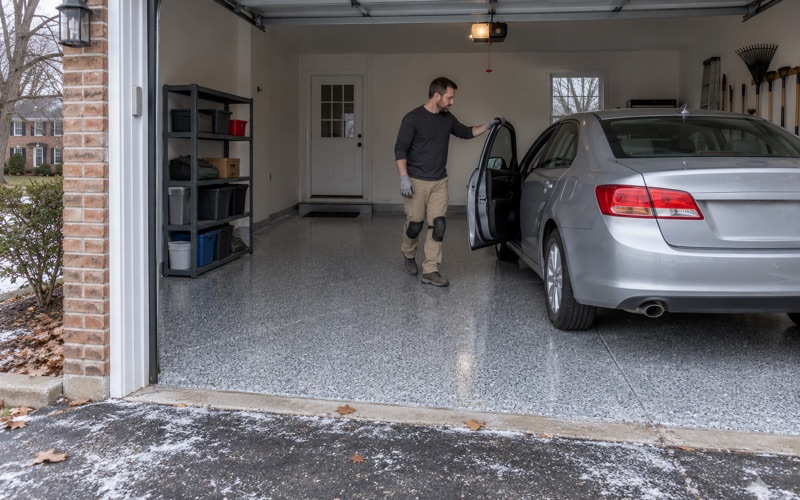
The homes we work in raise the same question at a smaller scale. A garage lengthened to fit a bigger vehicle, a workshop bay added to the side, or a slab section replaced after a repair all leave concrete of different ages meeting at a line.
Additions and replaced sections
Where an addition was poured against an existing garage slab, the seam is almost always a moving joint, and we treat it that way with a saw cut and flexible sealant after coating. Where a damaged section was cut out and replaced, the edges of the new piece get the same scrutiny, along with a check for settlement on either side.
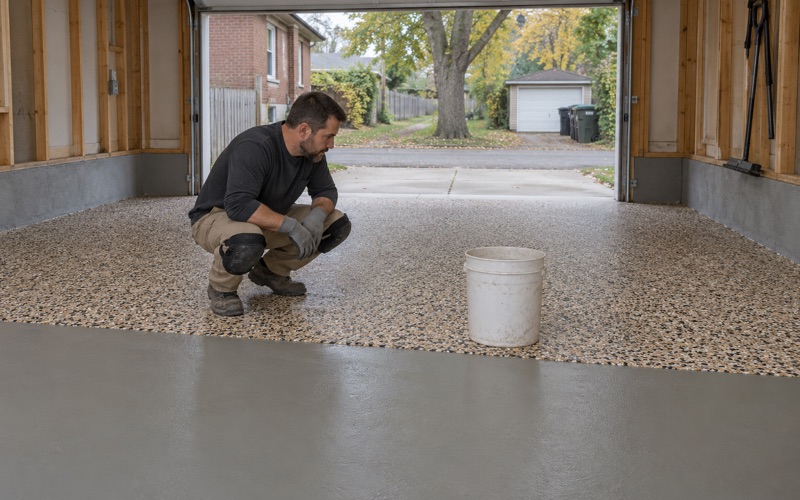
The sawn control joints inside a single garage slab are a different matter. Most were cut to control shrinkage when the concrete was young, and if they show no cracking or edge movement, we clean them out and fill them so they disappear under the flake or quartz broadcast. If one has already cracked through or shows a lip where one side has dropped, it gets the moving-joint treatment instead.
If a slab is being replaced rather than coated, we point you to the Village of Western Springs Community Development department at 708-246-1800 before anyone quotes a coating on the new pour. The village requires registered contractors and a permit for that work, and the new concrete has to be in place and accepted before a floor system belongs on it.
Patches, trenches and the moisture question
Trench patches over a plumbing or drain repair, and old patches over spalled areas, are mapped and sounded before grinding. A patch that is hollow or loose is cut out and repaired, because a coating will only be as sound as whatever sits under it.
Every written scope also includes a moisture test before the price is final, on a garage slab and a basement slab alike, and the proposal explains what the coating warranty excludes, with moisture vapor named first. Grinding dust is captured at the machine with a vacuum, never rinsed toward a floor drain. The result is a floor whose joints were planned for, not discovered later as cracks.
- 20+ Years of Floor Work
- Moisture Tested in Writing
- Free Written Quotes