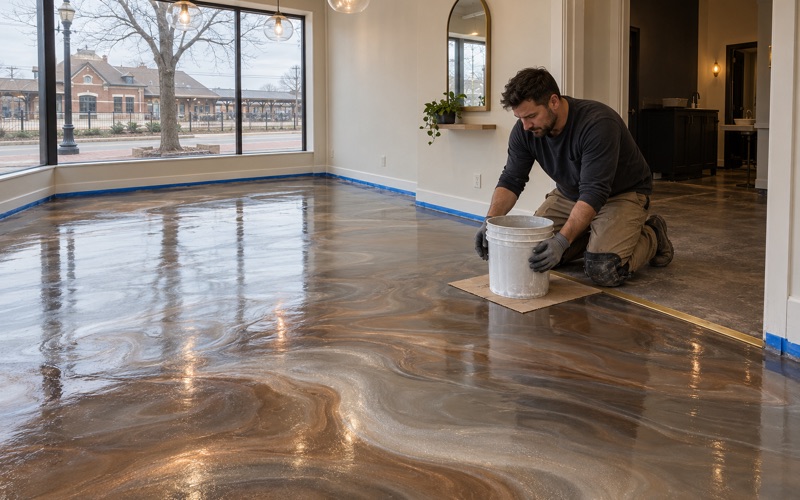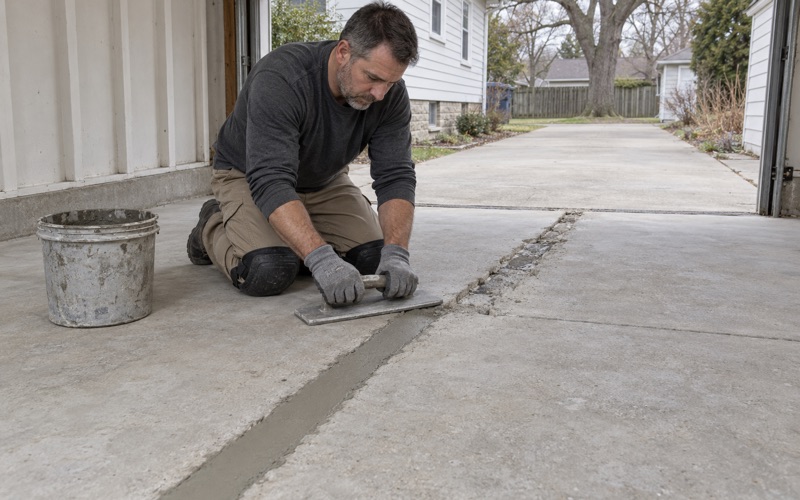
Downers Grove Epoxy Flooring brings more than 20 years of epoxy-flooring in Westchester to a question most coating quotes never ask: what does the finished floor look like to the person walking on it? For most owners the answer is about taste. For a household or a care building where someone lives with memory loss, the answer changes which system belongs on the slab.
The two finishes our trade sells most are a high-gloss topcoat and a dense flake broadcast. Both are durable and easy to clean, and both can be the wrong choice where perception matters as much as wear. We plan those floors around sheen, pattern and tone first, then pick the chemistry that delivers that look.
The groundwork does not change. Every slab is mechanically opened with a diamond grinder or a shot blaster before anything is applied, and moisture is tested and written into the scope before we put a final number on the job. What follows explains how the look of a floor gets planned when the people using it see it differently.
Dementia and Alzheimer’s Care on Wolf Road
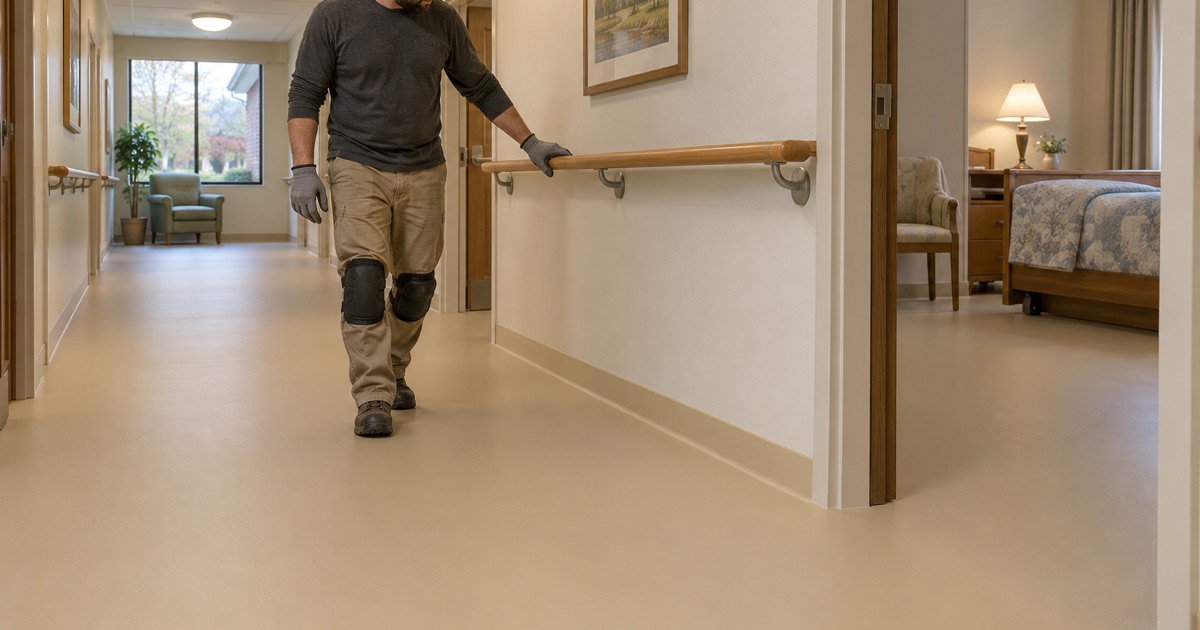
Westchester is a village in Cook County, a western suburb of Chicago that counted 16,892 residents at the 2020 census. It sits in Proviso Township and shares its western border with DuPage County. Most of what it holds is housing, and most of that housing is owner-occupied.
A care building inside the village
Aperion Care Westchester, at 2901 South Wolf Road, is a short-term rehabilitation and long-term care facility. Its own location page lists dementia and Alzheimer’s care among its services, alongside physical, occupational and speech therapy, post-stroke rehab and hospice care. CMS data from August 2026 shows 120 certified beds and an average of 115 residents a day.
We have no relationship with that facility, and nothing we read describes its floors, a dedicated unit or any renovation there. We name it for a simpler reason. It shows that people living with dementia, and the families who visit them, are part of daily life on Wolf Road, and that the questions on this page are local ones.
Why this changes the coating conversation
Most floor decisions weigh durability, cleanability and cost. Where a person with dementia walks, a fourth factor joins them: whether the floor reads as a floor. A finish that looks striking in a showroom can read very differently to someone whose eyes and brain no longer agree on what they are seeing.
That applies to a care setting, to an adult day space and to a family home where a parent has moved in. In each case the owner is choosing a surface for someone who may not be able to explain why a stretch of floor makes them stop.
Where this guidance comes from
The perception points below come from Forbo, a flooring manufacturer, in its dementia-design guidance. They are manufacturer guidance, not a building code, an Illinois requirement or a clinical study. We use them as a design checklist and present them that way, and we never promise a medical outcome from a floor finish.
Looking for epoxy-flooring closer to La Grange Park? See La Grange Park Epoxy-Flooring.
What a Person with Dementia May See in an Epoxy Floor
The same guidance describes how surfaces can be misread, and it lines up uncomfortably well with the defaults of the resin trade. Three of its points map directly onto choices we make on almost every residential and commercial coating.
Dark areas that read as holes
Forbo warns that dark matting can be perceived as a hole when it presents too much contrast against the flooring around it. The same logic applies to a coating plan. A dark border band, a dark accent stripe or a black logo at an entry can stop someone in their tracks or prompt a big step over nothing.
On a coated floor that means avoiding sharp dark-on-light layouts at doorways and along walking routes. If a contrast is needed to mark a hazard, we discuss with the owner where it serves a purpose and where it only adds visual noise.
Sheen that reads as water
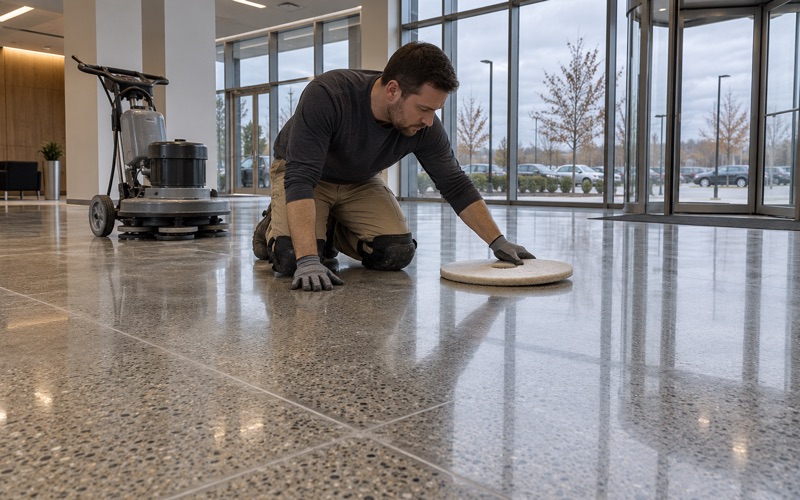
The guidance states that highly reflective or sparkly flooring is most likely to be perceived as water. A fresh high-gloss epoxy or polyaspartic topcoat is exactly that kind of surface, especially under overhead lights or a bright window. Someone who believes the floor is wet may hesitate, shuffle or try to walk around it.
The reflection is also not constant. A gloss floor can look dull at noon and like a sheet of water in late afternoon light, which makes the effect harder for families and staff to anticipate.
Flecks that read as litter
Forbo also says flecked, striped and patterned flooring is not recommended for a dementia-friendly environment. A vinyl flake broadcast is a flecked floor by design. Its scattered chips are what hide dirt and give the floor its texture, and to some viewers they can look like crumbs, debris or objects to pick up or step around.
Quartz aggregate broadcast carries the same risk when it is blended from contrasting colors. A single-tone broadcast locked under a clear coat reads far more calmly.
Matte Topcoats and Even Tone Across Every Threshold
The guidance points toward matte floor finishes without speckle or sparkle, and toward close tonal matching between neighboring floors. Both are achievable in a resin system, but they have to be specified on purpose rather than left to the default product.
Matching light reflectance value at doorways
Light reflectance value, or LRV, measures how much light a surface returns. Forbo recommends that adjacent floors differ by no more than 10 degrees of LRV, because a larger contrast makes a person with dementia more likely to perceive a step and high-step at a doorway.
In practice that means the coated garage, laundry or hallway has to be chosen against the floors it meets, not on its own. We look at what sits on the other side of every threshold, whether that is sheet vinyl, tile, carpet or wood, and pick a coating color that stays within that narrow band. Manufacturer color charts often publish LRV, and where one is missing we compare samples on site under the room’s own lighting.
Choosing a matte finish
Most epoxy, polyurea and polyaspartic lines offer a satin or matte topcoat, and some reach a lower sheen with a flattening additive. We name the topcoat and its sheen in the written proposal along with the product line, the number of coats and the finished thickness, so an owner can check the floor against what was promised.
Matte finishes behave differently over time. They can show scuffs sooner and may need a different cleaning routine than gloss. We explain those tradeoffs before the job is sold so the owner is choosing with the full picture.
Solid color instead of a flake broadcast
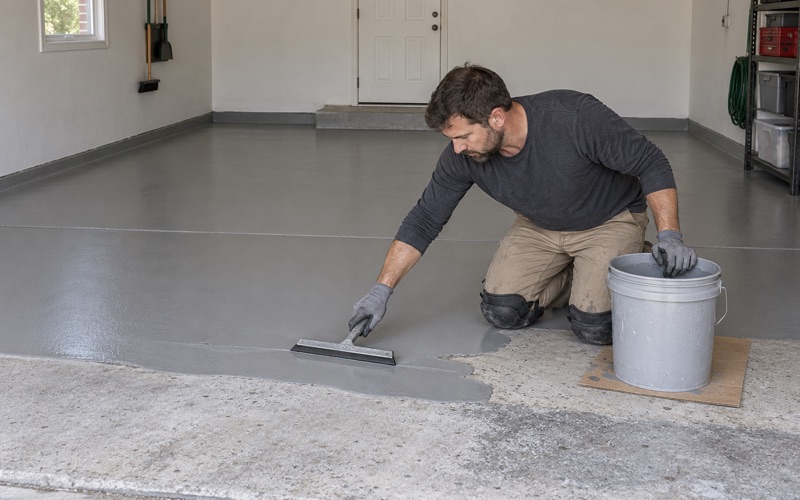
Where people with dementia walk, we steer toward a solid-color system: a pigmented 100% solids epoxy body coat under a matte topcoat. If texture is wanted, it comes from a fine aggregate in the topcoat rather than a contrasting chip, and the texture we specify is stated by the broadcast and topcoat used, not offered as a slogan.
The prep is identical either way. A solid color shows defects a flake floor would hide, so cracks, spalls and old coatings are mapped first. If a slab needs repair or replacement before it should be coated, we say so before quoting.
Westchester Homes Where a Parent with Memory Loss Lives
Most of the coated floors we see in this village are in houses, not institutions. Westchester’s housing stock grew fast after the war, with 48.4 percent of its homes built in the 1950s, and 90.8 percent of occupied units are owner-occupied. Many of those owners are now arranging care for a parent, or for each other, in the home they already know.
Garages and basements as living routes
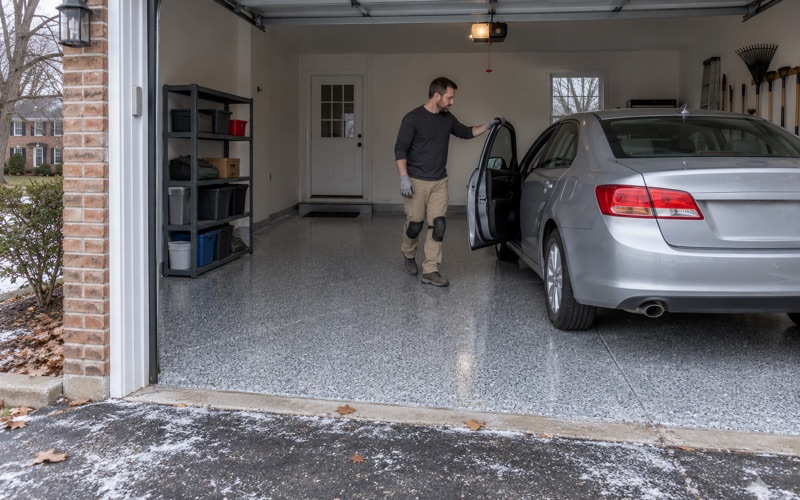
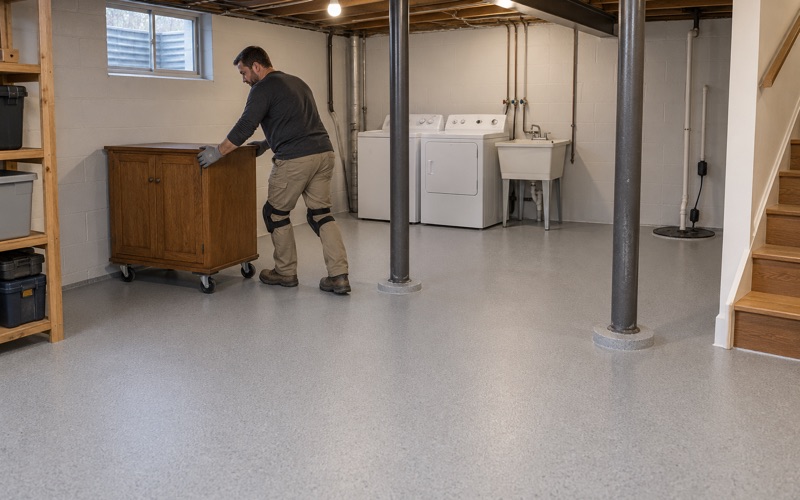
In many houses the attached garage is the everyday door. A parent with memory loss may cross it daily to reach the car, and a basement may hold the laundry they still want to do. Those floors are where a gloss topcoat or a busy flake is most likely to be installed, and where a calmer finish does the most good.
The village’s basement build-out sheet does not permit basement bedrooms, so a finished basement here is a recreation, laundry or storage floor. A thin coating leaves the finished-floor heights that sheet measures from where they are, and the floor drain beside the water heater stays open and draining after the job.
Planning the whole house, not one room
We ask families to walk us through the route a parent takes on an ordinary day. That shows which thresholds matter, which rooms meet the coated floor and where a contrast already exists. Sometimes the best answer is a color that disappears into the adjoining floors rather than one that stands out.
We also talk about mats. A dark mat on a light coated floor can recreate the very hole effect the floor was designed to avoid, so a mat in a tone close to the floor is usually the better choice.
Practical scheduling at home
A house with a person who has dementia often cannot simply empty out for several days. We plan the work in stages where possible and explain the cure window plainly. Cure schedules follow slab temperature and dew point rather than the calendar, and an unheated garage in deep winter is told to wait for warmer conditions.
Grinding dust is captured at the machine with a vacuum instead of being washed toward a drain, which keeps the house cleaner during the work. For jobs above the state threshold, a written contract and the Illinois consumer-rights pamphlet come before any grinding begins.
- 20+ Years of Floor Work
- Moisture Tested in Writing
- Free Written Quotes