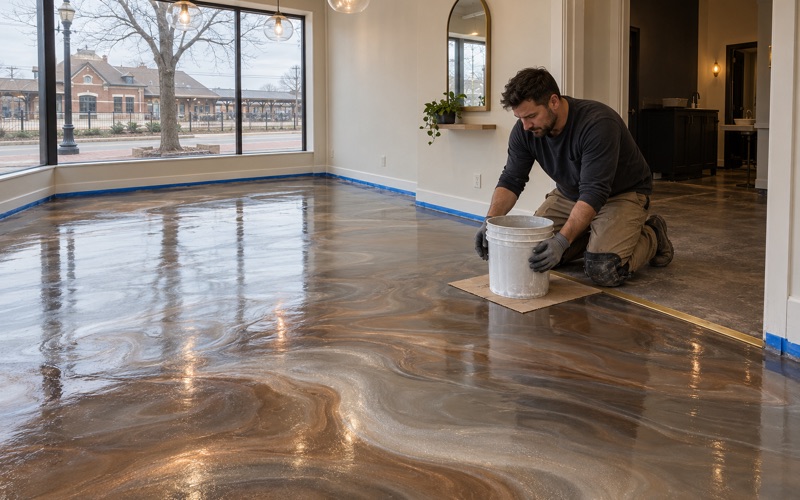
Downers Grove Epoxy Flooring has spent more than 20 years on epoxy-flooring in Warrenville and across the western suburbs, and the question we hear least is the one that ruins the most new floors: what is going to roll across this coating in its first month? Foot traffic and parked cars are easy to plan for. The heavy, narrow-footprint equipment that shows up for ceiling work, lighting swaps and sign changes is not, and it tends to arrive right after a floor looks finished.
This page is about that equipment. We cover what a slab scissor lift actually puts on a finished floor, why its tires matter as much as its weight, how we sequence high work around a coating, and what the same logic means for a car lift or a set of jack stands in a home garage.
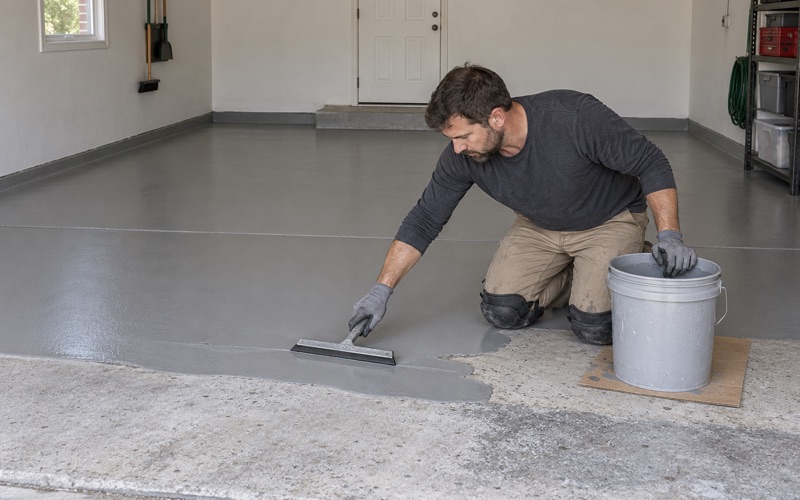
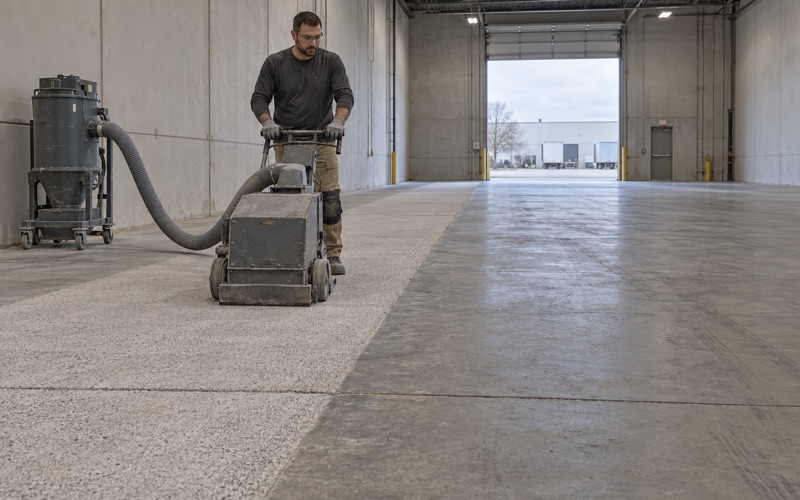
Every floor we coat starts the same way. The slab is opened with a diamond grinder or a shot blaster rather than an acid etch, cracks and old coatings are mapped before we price anything, and the proposal names the product line, the coat count and the finished thickness so you can hold the finished floor to the paper.
A Borrowed Lift Between the Library and City Hall
The Warrenville Public Library District, at 28W751 Stafford Place, put a small but telling line in its 2024 report to the decennial committee on local government efficiency. Among its intergovernmental agreements with the City of Warrenville is one for equipment sharing, which lets the city and the library borrow needed equipment from each other for free, with permission. The reason given is plain: renting lifts for high spaces can cost about $500 a day, or $1,000 a week.
The two governments already share ground. Bob Walters Commons, the common area between the library and City Hall, hosts summer concerts that draw 200 to 450 people. An agreement to lend a lift across that space is the kind of practical arrangement that saves a public budget real money every time a light fixture, a ceiling tile or a high sign needs attention.
Why a lift is a floor question
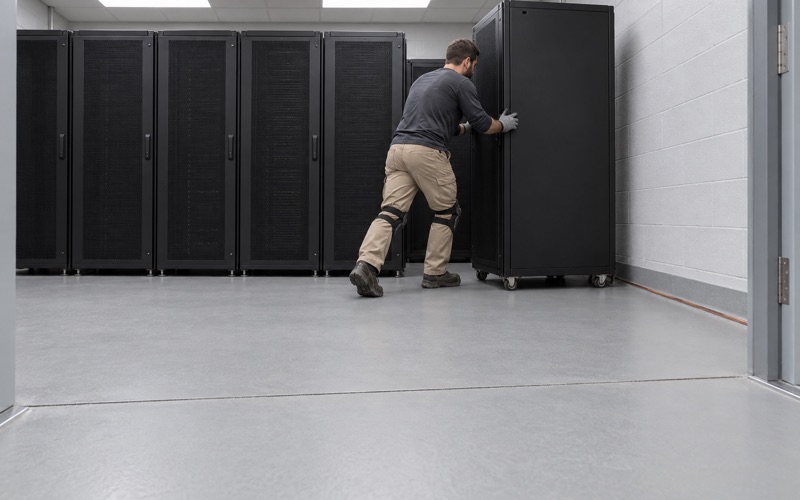
From where we stand, a borrowed lift is a reminder of something building owners rarely consider when they schedule a coating. The heaviest thing most finished floors ever carry, measured by load per square inch, is not a pallet or a parked vehicle. It is a lift resting on four small tires with a worker and tools in the basket, often turning in place to reach the next fixture.
We have no knowledge of how the library’s floors are finished or which lift the city lends, and we have no relationship with either government. What the agreement illustrates is general: a building that needs high work will sooner or later roll a lift across its floor, and the coating has to be ready for it when that day comes.
The same visit happens in private buildings
Offices, showrooms, warehouses, fitness spaces and clinics all bring in a lift for lighting retrofits, HVAC service, sprinkler work and signage. Warrenville sits north of I-88 in the Illinois Technology and Research Corridor, and its commercial floors face the same sequence as any public building. When we phase a commercial floor around opening hours, with overnight and weekend windows for spaces that cannot close, the lift schedule is one of the first things we ask about, because it often decides which night the coating goes down.
Looking for epoxy-flooring closer to Winfield? See Epoxy-Flooring Services in Winfield.
What a Slab Scissor Lift Puts on a Coating
Lift loads are model-specific, so the honest way to talk about them is with one example. A reseller specification for the Genie GS-1930, one common electric slab scissor, lists a maximum tire load of 1,460 pounds and a tire contact pressure of 162 pounds per square inch. Those figures come from one machine on one sheet, not from the maker’s current documentation and not from any lift used in Warrenville, but they show the scale of what a floor is asked to carry.
Tire load versus contact pressure
Occupied floor pressure spreads the machine’s weight over the whole area it stands on, so measured that way the load looks modest. Tire contact pressure is the number that matters to a coating. At 162 psi, a few square inches of hard rubber carry well over half a ton, and they keep carrying it for as long as the lift sits parked at a fixture.
A fully cured 100% solids epoxy or a polyaspartic topcoat is built to take that kind of point load. A coating that is only dry enough to walk on is a different material. Its film is still soft enough to print, and a tire that sits for twenty minutes can leave a dimple or a gloss change that never buffs out.
Turning scrub
Static load is half the story. A slab scissor steers by turning its tires against the floor, and when it pivots in place to line up under the next fixture it scrubs the tread sideways across the surface. That shearing motion is what tears vinyl flake out of an undercured broadcast coat, smears a fresh topcoat and polishes dull arcs into a satin finish. The turning points, not the straight runs, are where the damage shows up.
Non-marking tires
The solid tires on many slab scissors are sold as non-marking, and used-unit listings for the GS-1930 describe solid non-marking tires. That label means the rubber is not supposed to leave a black transfer stripe. It does not mean the tire is light, and it does not protect the floor from load or scrub. We ask whoever is bringing in a lift to confirm the tires are non-marking, because a gray epoxy with a black arc across it is a call nobody wants to make, but we treat that check as the minimum rather than the whole plan.
High Work First, Coating Second, or Wait for Full Cure
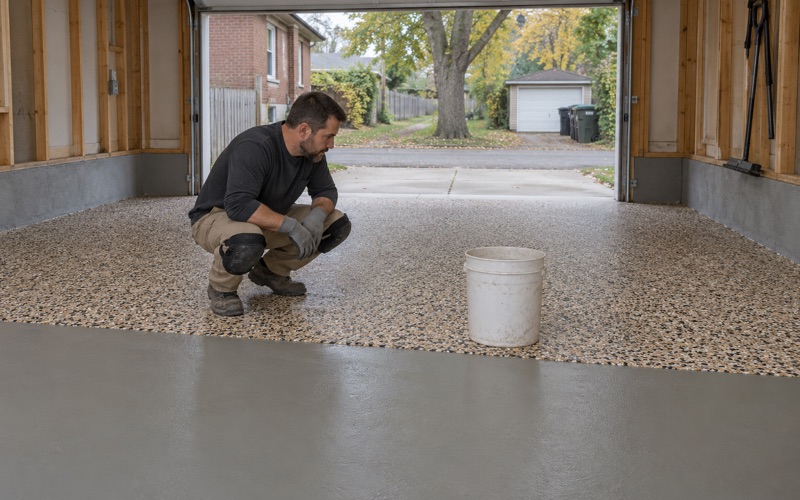
The simplest fix is order of operations. If ceiling work, lighting or HVAC changes are coming, we want them done before the slab is ground and coated. The lift can run on bare concrete, the dust from the ceiling settles before we start, and nobody is scheduling around a floor that is still curing.
Walk-on time is not full cure
When the high work has to come after the coating, the gate is full cure, not walk-on time. Most systems take foot traffic within hours and light carts within a day or so, but full chemical cure takes longer, and it stretches when the slab is cold. Our cure schedules follow slab temperature and dew point rather than the calendar, so the date we give for heavy equipment is a measured date, not a guess written into a contract.
Rushing that window is where good coatings fail. A parked tire on an undercured film can print a permanent tread mark, and a pivot can peel a broadcast layer that never finished bonding to the coat below it. Neither repair is a spot touch-up; both usually mean grinding back and recoating a section.
Boarding the travel path
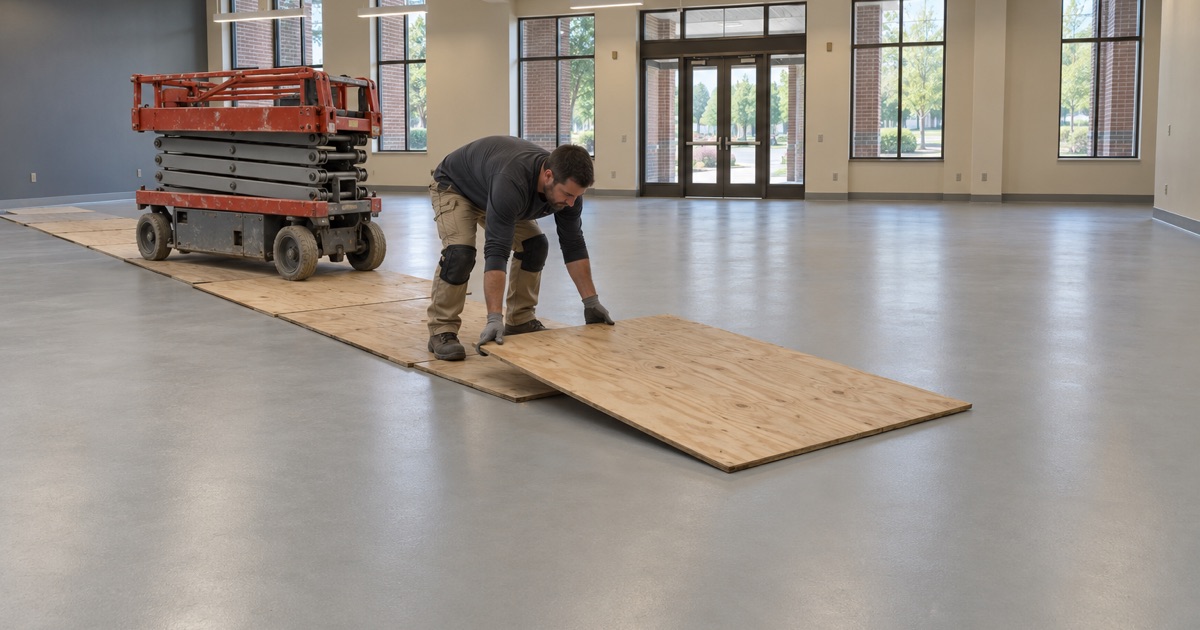
Even on a fully cured floor, we recommend protecting the route. Hardboard or plywood laid along the travel path and doubled under each turning point spreads the tire load and takes the scrub instead of the topcoat. Seams should be taped so a tire does not catch an edge, and the boards come up as soon as the work is done so moisture and grit are not trapped underneath.
Writing it into the scope
On a commercial job we put this in writing. The proposal notes the full-cure date for heavy equipment, the boarding we expect for any lift and the tire check. If a tenant or a property manager already knows a lift is coming for a fixture swap, we would rather move the coating by a week than have a fresh floor become the staging area for the electrician.
Lifts, Ladders and Jack Stands on a Home Garage Coating
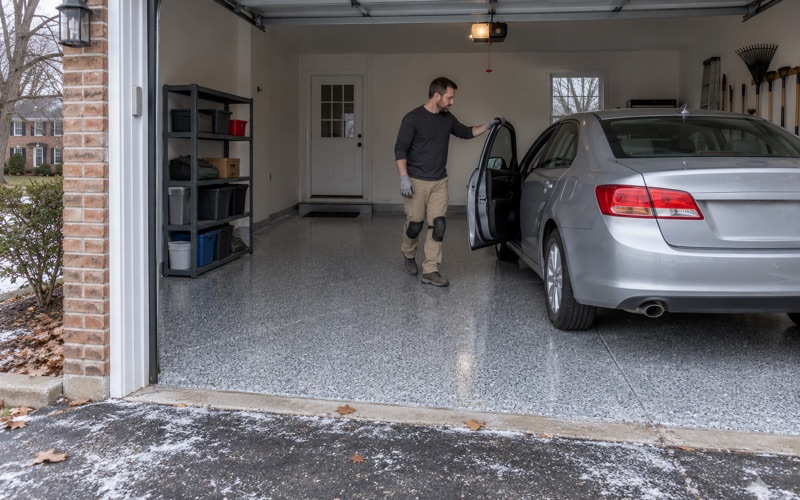
Most coated floors we install are garages, and the same physics applies at a smaller scale. A home garage in Warrenville is more likely to see a stepladder, a floor jack and a set of jack stands than a scissor lift, but each one concentrates weight on a small footprint.
Jack stands and floor jacks
A jack stand puts a corner of a vehicle onto narrow steel feet. On a properly cured 100% solids epoxy or a polyurea and polyaspartic system that load is fine, but a stand set down on a coating that is only days old can dent the film, and a floor jack rolled under load drags its small steel casters across the surface. A square of plywood under each stand and a sheet of hardboard for the jack to roll on cost almost nothing and remove the risk.
Ladders and overhead projects
Ladder feet are rubber, but the load sits on a few square inches and a ladder tends to walk as you climb. If you plan to change garage lighting, paint the ceiling or install overhead storage, do it before we coat. Paint drips and drywall dust on a fresh topcoat are harder to clean than a bare slab, and a ladder foot pivoting on a new coat can leave the same scuff a lift turn does.
Two-post and four-post car lifts
Car lifts are the largest load a home coating sees. A post lift anchors into the slab through the coating, and the column base concentrates the vehicle’s weight onto bolts and a base plate. We want to know about a planned lift before we grind, because anchor locations, slab thickness and whether the concrete under the posts needs repair are questions to settle before a coating goes over them. When a slab needs repair or replacement first, we say so.
Salt, moisture and the rest of the job
The load question sits alongside the usual garage concerns. Garages here carry brine and rock salt in on tires every winter, so we choose systems built to hold up to it, and a moisture test is part of the written scope before the price is final. What the warranty leaves out is explained before the job is sold, starting with moisture vapor transmission, and grinding dust is captured at the machine with a vacuum rather than washed toward a drain.
- 20+ Years of Floor Work
- Moisture Tested in Writing
- Free Written Quotes