Downers Grove Epoxy Flooring has spent more than 20 years on epoxy-flooring in Summit and the rest of the area, and the floors that teach us the most are the ones where something cured on the surface that was never supposed to be there. A coffee spill wipes up. A drip of adhesive that sets overnight does not, and the way a floor is built decides whether that drip costs a minute or a patch repair.
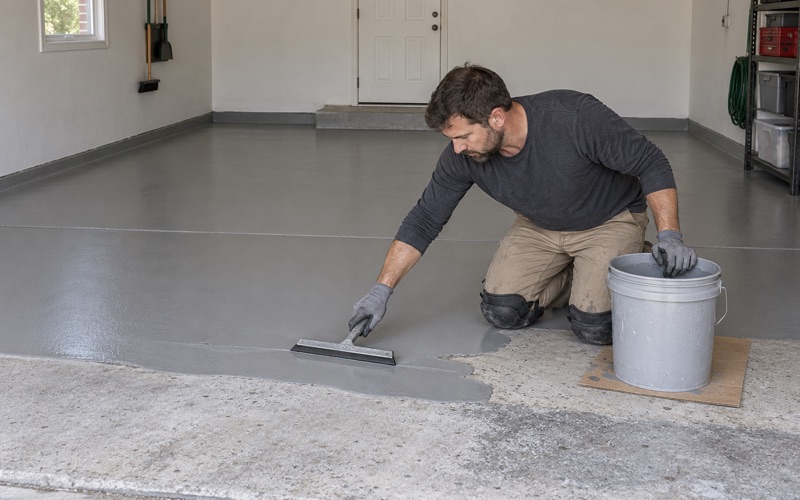
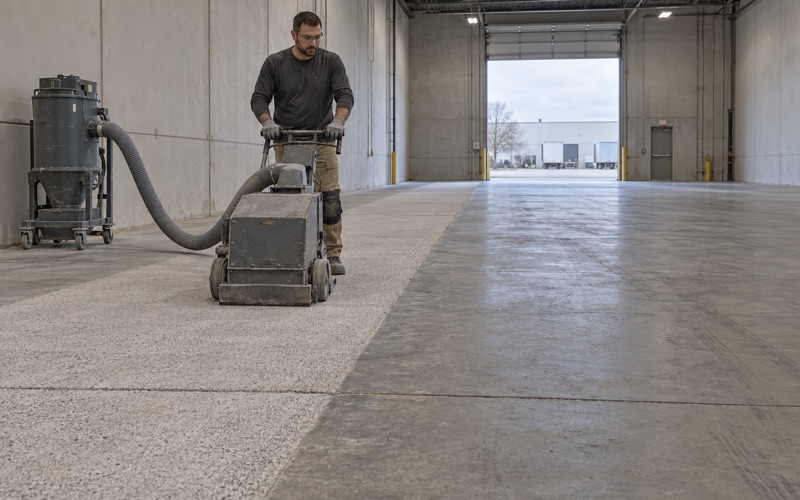
Every job we take starts the same way. The slab is opened with a diamond grinder or a shot blaster, never an acid etch, so the coating has a real profile to bite into. Cracks, spalls and any old coating get mapped before a price is final, and a moisture test sits in the written scope for a garage slab as much as for a basement one. If a slab needs repair or replacement before it should be coated, we say so up front.
Our proposals name the product line, the number of coats and the finished thickness, so you can hold the finished floor up against the quote. That matters most on floors that see hard use, and in Summit some of the hardest use comes from a source most people never think about: the glue that holds a windshield in place.
Auto-Glass Shops on Archer Road
Archer Road carries a run of auto businesses through Summit, and windshield work is one of them. Chicago Auto Glass is listed in business directories at two South Archer Road addresses with the mailing name Summit Argo: 6156 S. Archer Rd and 6254 S. Archer Rd. Those listings are all we have read. We have not seen the shop’s floor, we do not know what adhesive it uses, and we have no working relationship with it.
Which side of the village line
The address matters more than it looks. The US Census geocoder places 6156 S. Archer Rd inside Summit village, in Lyons Township, Cook County, on the Summit side of the Archer Road village line. A little farther down the same road, 6401 S. Archer Rd geocodes to Bedford Park. A business with a Summit mailing address can sit in either village, so before we assume which building desk will see a commercial floor job, we geocode the address.
For a site that does fall in Summit, the permit and inspection questions go to the Village of Summit building and public works department at 7321 W 59th Street, the Strzelczyk Municipal Center. The fire department, a village department at 7339 W 59th Street, sits next door.
Why a glass bay is a floor problem
Broken glass is the obvious hazard in a windshield bay, and it is also the easy one. It sweeps up, and a tough topcoat shrugs it off. The lasting damage comes from the material used to bond the new glass to the car. It goes on as a thick bead, it skins quickly, and a drip that lands on the floor and gets missed turns into a hard, rubbery lump welded to the coating.
That is a different kind of trouble from a solvent that softens a floor. A urethane adhesive does not attack an epoxy or polyaspartic topcoat. It bonds to it, which is exactly what it was designed to do to glass and paint, and that bond is the whole problem.
Looking for epoxy-flooring closer to Hickory Hills? See Epoxy-Flooring in Hickory Hills.
The Adhesive, Not the Glass: Moisture-Curing Urethane
A windshield is typically set in a one-component polyurethane. There is no second part to mix in; the bead cures by reacting with the moisture already in the air. To show how that plays out, we use one published example: the technical data sheet for the Bondloc WSPU Windscreen Installation Kit, revision 2, dated September 26, 2023. It is one maker’s kit, not a statement about what any Summit shop uses, and not a figure every windshield adhesive shares.
How fast it sets
That sheet describes the base as a one-component polyurethane, rapid curing by reaction with moisture, black in color. It lists a tack-free time of 15 minutes and a cure depth of 3 mm on the first day. In plain terms, a drip on the floor has a short window when a rag will lift it cleanly. After that, the surface skins over, and the material underneath keeps curing from the outside in.
The same sheet warns against direct contact with isocyanate-reactive substances, especially alcohols such as spirit, dilutions and cleaning compounds, until the adhesive has reached full cure. So the wrong cleaner on a fresh drip is its own mistake, and the maker’s recommended cleaner is the one to keep at the bench.
Once cured, only a blade removes it
The line on that data sheet that matters most for a floor is this one: clean tools immediately after use, because once cured, the material can only be removed mechanically. Mechanically means cutting, scraping or grinding. There is no solvent that loosens cured urethane and leaves the floor under it untouched.
On a coated floor, that has a direct cost. A razor scraper run under a cured lump takes the gloss with it, and often a layer of topcoat film. On a vinyl flake broadcast system, a deep scrape can reach the flake. The spot then needs to be sanded, cleaned and recoated so it blends, which is a small repair done many times a year in a busy bay.
No coating we install makes cured urethane wipe off, and we will not sell a floor as if it did. What a floor system can do is make catching and cleaning a drip easier, and make a scraped spot simpler to repair and recoat.
Drop Sheets, Wet Wipe-Up and the Old Bead
Because nothing reverses a cured drip, the real defense in any glass-setting area is housekeeping before the bead sets. The floor we would recommend for a shop like that is built to support that routine, not replace it.
A sheet under the setting area
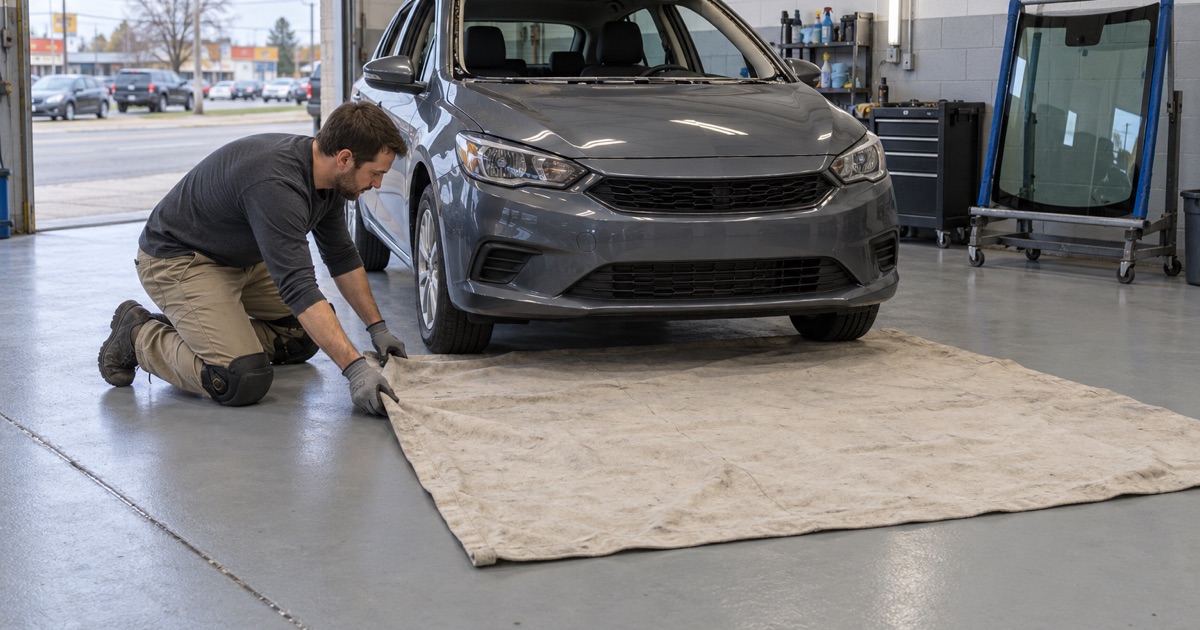
The simplest habit is a drop sheet laid on the floor under the area where the windshield is set and the bead is run. A drip lands on the sheet instead of the coating, and the sheet goes out with the trash at the end of the job. It costs little and prevents most of the scraping a bay would otherwise need.
When a drip does reach the floor, it gets wiped while it is still wet, inside that short window before it skins, using the cleaner the adhesive maker names. A gun nozzle or cutting tool wiped off over the floor rather than over a rag is the most common way a bay ends up with a trail of hard spots.
The old bead cut from the pinch weld
Removing a damaged windshield means cutting out the old urethane bead along the pinch weld. That cured material comes off in strips and crumbs, and if it falls to the floor it gets stepped on and pressed into the surface or carried across the shop. Collecting it into a bin as it is cut keeps it from being trodden into the coating.
How we would build a bay floor
For a working shop, we lean toward a system that stands up to scraping and can be repaired in sections. A quartz aggregate broadcast gives grip, and we name the broadcast and topcoat used to set the slip-resistant texture in the proposal rather than promising one as a slogan. We pick a topcoat that can be lightly sanded and recoated in place when a spot does get cut.
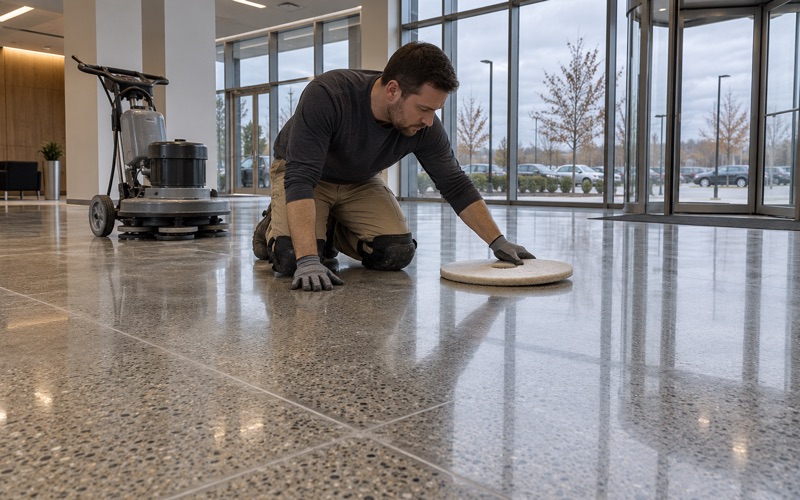
Commercial floors like this are phased around opening hours, with overnight and weekend windows when a bay cannot close. Grinding dust is captured at the machine with a vacuum, never rinsed toward a floor drain.
Construction Adhesive and Polyurethane Sealant on a Summit Garage Floor
Summit takes its name, in use since 1836, from the highest point on the Chicago Portage between the Chicago River and the Des Plaines River, just north of the city. It is a small place, 11,161 people at the 2020 census, and 60.9 percent of its occupied homes are owner-occupied. Plenty of those owners use the garage as a workshop, and the same chemistry found in a windshield bay shows up there in a caulk tube.
The same chemistry in a cartridge
Polyurethane construction adhesive and polyurethane sealant are popular for exactly the reasons a glass shop uses urethane: they grab hard and stay flexible. Many of them cure the same way, by reacting with moisture in the air. Squeeze-out from a project on the bench, a cartridge laid on its side, or a bead of sealant run along a wall plate can leave the same hard drips on a garage floor.
The rule from the glass bay carries straight over. Lay a drop sheet under the work, keep the tube’s recommended cleaner and a rag close, and wipe any drip while it is still wet. Once a urethane drip cures on a finished floor, the only way off is a blade, and the topcoat comes with it.
Before we coat a garage that already has drips
Many garages we see already carry cured adhesive, caulk and sealant spots on bare concrete. They have to come off before a coating goes down, or the new floor bonds to the drip instead of the slab. Diamond grinding removes cured urethane along with the surface laitance, which is part of why we grind rather than etch. We map those spots along with the cracks and spalls during the walkthrough so the scope is clear.
Salt, cold and when to wait
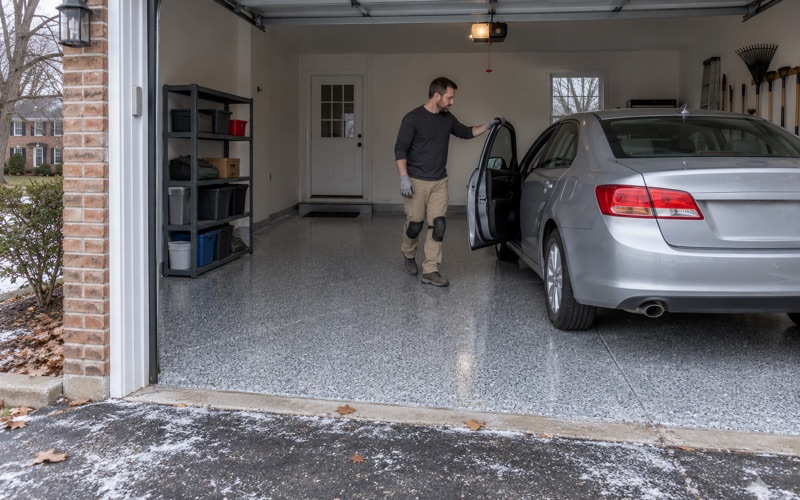
A Summit garage has to handle more than workshop drips. The systems we choose are meant to stand up to the brine and rock salt that come in on tires all winter. Cure schedules follow slab temperature and dew point, not the calendar, so an unheated garage in deep winter is told to wait for better conditions.
Before any job is sold, we explain what the coating warranty leaves out, with moisture as the first exclusion we name. Home jobs over the state threshold get a written contract and the Illinois Home Repair: Know Your Consumer Rights pamphlet before grinding starts.
- 20+ Years of Floor Work
- Moisture Tested in Writing
- Free Written Quotes