Downers Grove Epoxy Flooring has spent more than 20 years on epoxy flooring in Schiller Park and across the western suburbs, and the floors we think hardest about here are the ones where something heavy rolls instead of drives. A pallet jack spreads its weight across wheels built for the job. A loaded cable reel puts everything it carries onto two thin steel or wood rims, and a coating that looks fine under foot traffic can fail along those two lines first.
That is why our walkthrough starts with how the room is actually used. We want to know what gets rolled, where it stops, where it gets stored and which way the traffic turns, because a commercial floor in a working stockroom fails along its traffic pattern long before it fails anywhere else. The answer shapes the grind, the system and the finished thickness we write into the proposal.
Every proposal we hand over names the product line, the number of coats and the finished thickness, so a facility manager can hold the installed floor up against the paper. If the slab needs repair before it should be coated, we say so in writing before anyone signs.
Wire Cutting and Paralleled Reels on Des Plaines River Road
A distributor that cuts and parallels wire in the village
Schiller Park is a village in Leyden Township, Cook County, and one of the employers on its own principal-employer list shows exactly the floor problem this page is about. Willow Electrical Supply, listed at 3828 Des Plaines River Road, appears in the village’s FY2024 financial report with 76 employees. Its home page lists Switchgear Engineering, Lighting Solutions, Local Delivery, Wire Cutting, Paralleling Reels and Pipe Threading & Cutting among its services.
We have not worked for Willow and have not seen its reel room, its equipment or its floors. We use it here because it is a real, public example of a kind of work that happens in this village, and the floor demands of that work are well documented by the people who make the cable.
Why paralleled reels matter to a floor
Wire cutting means pulling conductor off a large supply reel and winding a measured length onto a smaller one. Paralleling reels means winding several conductors together onto one reel so a contractor can pull them as a set. Either way, the shop ends up with loaded reels that have to move between racks, payoff stands, staging and the will-call counter.
Most of that movement is done by rolling the reel on its flanges. Even when a forklift does the lifting, the last few feet into a rack or onto a stand are often a push by hand. That repeated rolling is a load pattern most coated floors were never specified for.
Looking for epoxy-flooring closer to Chicago Ridge? See Epoxy-Flooring Services in Chicago Ridge.
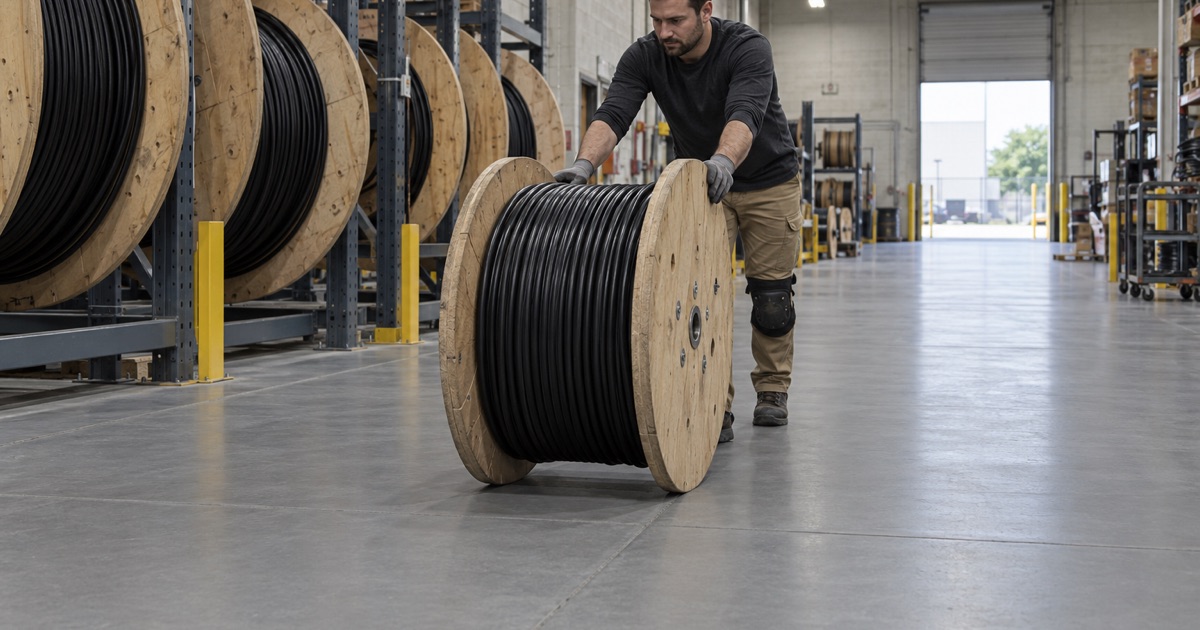
A Loaded Reel Rolls on Two Narrow Flanges
What a rolling line load does to a coating
A forklift tire or a caster spreads its load over a patch of contact. A reel flange does something different: it carries the whole weight of the reel and the cable on a narrow rim, and when the reel rolls, that rim traces a line across the floor. Two flanges mean two parallel lines, and in a busy stockroom those lines land in the same lanes day after day.
A thin, soft or poorly bonded coating shows the damage along those lanes first. Edges lift where the coating meets a joint, small chips open where a flange crosses a high spot, and once the edge of a chip is exposed, every pass after that pries at it. We plan reel lanes as their own zone rather than treating them like the aisle next to them.
How heavy the reels actually are
The reel itself is only part of the weight. One cable maker’s guidance lists common reusable reels running from 39 to 187 pounds empty, with flanges from 30 to 58 inches, before a single foot of conductor goes on. Wood reels with flanges of 40 inches and over carry a stenciled arrow that shows the rolling direction.
We do not quote a load or dent rating for any coating under a reel flange, because no such rating was sourced for this kind of use. What we can do is choose a hard, high-build system, profile the slab so it bonds properly, and keep the lane free of the edges and steps that start chips.
Dragging is the other half of the problem
A second cable maker’s guideline says reels should not be dragged or pushed even for short distances, because the flange may break or be damaged. It also says forks go under the reel perpendicular to the flange, and that reels are stored upright rather than on their sides.
Each of those habits changes the floor. A dragged flange gouges where a rolled one only presses. A reel set down flat concentrates a different load on a different spot. When we walk a reel room, we ask the staff how reels really move, not how the procedure says they should.
What the Cable Maker Asks of a Rolling Surface
Okonite’s words on rolling and storage
Cable maker Okonite published its reel handling guidance in Technical News 012 in April 2002. It says reels should only be rolled in a direction to tighten the cable wind, and that surfaces on which reels are to be rolled should be flat, clear of debris and protrusions. It also says reels should be stored with both flanges on solid, hard surfaces.
That guidance is written to protect the reel and the cable, not to endorse any floor product or installer. Still, it reads like a floor spec. A protrusion that a flange straddles can damage the cable, and a soft or uneven storage surface lets a reel settle unevenly on its rims.
Translating flat and protrusion-free into a coated floor
On bare concrete, the usual protrusions are joint edges, patched spalls that sit proud of the slab, and old anchors or bolt stubs. On a coated floor, the list adds lifted coating edges, chipped edges along a joint, and any raised strip or threshold someone installed to mark a lane or seal a doorway.
We map those before we price the job. Cracks, spalls and old coatings get marked on a floor plan, and the plan shows which ones get ground flush, which get filled, and which tell us the slab needs repair or replacement before a coating belongs on it. That map becomes part of the written scope.
Keeping the lane clear in daily use
Clear of debris is a housekeeping job, but the floor can help. A smooth or lightly textured topcoat is easier to sweep than a heavy broadcast, so cut wire ends, tape and banding do not hide in it. We specify slip resistance by the broadcast and topcoat we use, and in a reel lane we lean toward a finer texture that a flange can roll across without catching.
The guidance also says reels should not be stored near or in contact with chemical spills or oils. That is a storage-layout decision rather than a coating claim, and we keep the reel storage zone separate from any area the shop uses for other work.
Flush Joints, Captured Edges and a Hard Floor Where Reels Are Staged
Joints filled flush and edges captured
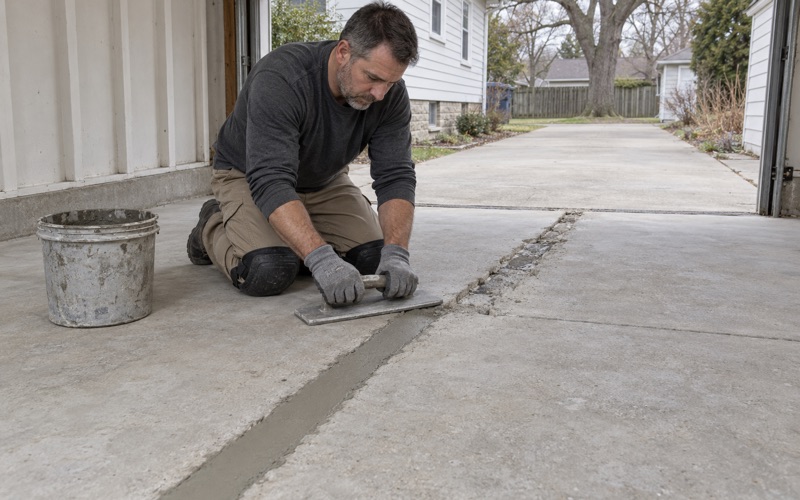
Control joints are the most common protrusion in a reel lane. An open joint is a groove a flange drops into; a joint filled proud is a ridge it climbs. We fill joints in the lanes with a semi-rigid filler and grind it flush with the surrounding surface before the coating goes down, so the flange sees one plane.
Coating edges get the same attention. Where a reel lane meets a rack base, a doorway or an uncoated area, we cut a keyway into the slab so the coating terminates in a groove instead of a feathered edge. A captured edge has nothing for a flange to catch and peel back.
No raised strips or thresholds in the lanes
Raised marker strips, transition thresholds and surface-mounted guides all count as protrusions under the cable maker’s wording. If a lane needs marking, we do it in the coating itself with a contrasting color line laid flush in the system, not glued on top of it.
The same logic applies at doorways between the stockroom and staging. Where an existing threshold sits in the path, we talk with the owner about grinding the transition into a gentle, continuous slope rather than leaving a step that every loaded reel has to climb.
A hard, high-build system for storage and staging
For the reel storage and staging area, we usually recommend a 100% solids epoxy base built up in layers, with a quartz aggregate broadcast where texture is wanted and a hard topcoat such as polyaspartic over it. The point is a dense, thick surface that resists chipping under a concentrated rim, with no soft layer for a flange to press into.
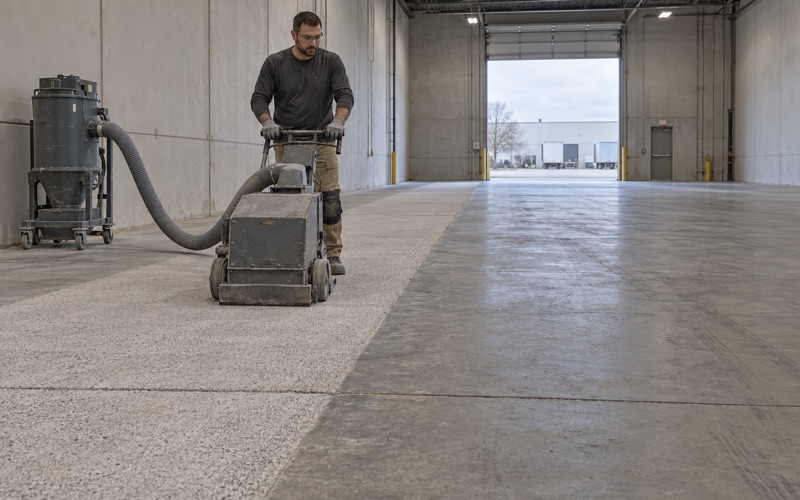
Before any of that, the slab is opened with a diamond grinder or a shot blaster to an ICRI concrete surface profile that suits the system, never an acid etch. Grinding dust is collected at the machine by a vacuum rather than swept or rinsed toward a drain. A moisture test, such as ASTM F2170 in-situ relative humidity probes, is part of the written scope before the price is final.
A distributor that runs a will-call counter cannot close the whole floor for a week. We phase reel lanes, storage and staging in sections, with overnight and weekend windows where needed, and we set cure times by slab temperature and dew point rather than by the calendar, so a section is not loaded before it is ready.
Before construction starts, we register with the Village of Schiller Park through its Community Core app with the insurance, bond and other documents the village asks for, and the license year runs May 1 to April 30. We also explain what a coating warranty leaves out before the job is sold, starting with moisture, so the shop knows exactly what it is buying.
- 20+ Years of Floor Work
- Moisture Tested in Writing
- Free Written Quotes