Downers Grove Epoxy Flooring brings more than 20 years of slab work to epoxy-flooring in River Grove, and the first thing we ask about a room is how it gets used after dark. A garage that sees daylight and headlights wants a different finish from a media room where the only light comes off a screen. Choosing the wrong sheen there is not a durability problem. It is a picture problem, and it shows up every time someone presses play.
That is why our proposals name the exact product line, the number of coats and the finished thickness, along with the sheen of the final topcoat. You can hold the finished floor up against the written quote and check it line by line. If the room is meant for viewing, the topcoat on that quote should read low-sheen, and the color should be one that fades away once the lights go off.
Before any of that, the slab gets opened with a diamond grinder or a shot blaster, never an acid etch, and a moisture test goes into the written scope before the price is final. A dark, flat finish still has to bond, and a coating that lifts off a damp slab looks just as bad in a theater as it does in a garage.
A 44-Foot Dome, a New Projector and the Floor Below It
What changed at Triton College in 2025
The Cernan Earth and Space Center on the Triton College campus is River Grove’s public planetarium. Its dome theater measures 44 feet across and seats 93, with weekend public programs, school and group presentations, and a monthly Saturday-night skywatch. In July 2025 the center replaced a decade-old, lamp-based projector with a laser phosphor projector, installed over three days, that focuses red, green and blue light through a lens onto the dome.
Triton’s own release describes the new system as brighter, with sharper images and more vibrant colors. The September lineup that followed included shows such as Laser Led Zeppelin, the kind of program where saturated color against a black sky is the whole point. A brighter projector raises the ceiling on what an audience can see, but only if the room around the image does not hand that light back.
Why we use the dome as an example, not a job
To be plain about it, we have never worked at the Cernan Center, and we have not seen what is under its seats. The dome is simply the most visible dark viewing room in the village, and it is a useful way to think about any floor in a room where people watch projected light. The same physics sits underneath a tilted planetarium dome, a commercial screening room and a family room with a ceiling-mounted projector.
What a laser source asks of the room
A projector that throws more light also throws more light onto everything near the screen. Some of it lands on walls, ceiling and floor, then bounces back toward the image and lifts the blacks toward gray. When the source gets brighter, a reflective floor gets more obvious, not less. That is the point where floor finish stops being decoration and starts being part of the picture.
Looking for epoxy-flooring closer to Schiller Park? See Epoxy-Flooring in Schiller Park.
Why a Dark Room’s Floor Shows Up in the Picture
What cinema engineers found about reflected light
A Dolby patent on improving theater contrast, granted in 2017, states that the maximum contrast ratio of a projected image is severely impacted by reflections. It attributes about 70 percent of the reflected light that causes a loss in contrast to the walls, floor and ceiling. It also notes that the floor may represent a third of the reflective surfaces close to the display screen.
That patent was written about flat-screen cinemas, not domes, so we treat it as a trade-level guide rather than a rule for any planetarium. Carrying it to a tilted dome is an inference. The principle still travels to every room where a screen is the main light source: the floor is a large, flat surface right in front of the image, and whatever it reflects ends up in the viewer’s eyes.
Gloss is a mirror in the wrong place
A high-gloss epoxy or polyaspartic topcoat is a fine choice for a garage, where it reads as clean and bounces overhead light around a work area. In a viewing room that same gloss behaves like a dim mirror under the screen. Every bright scene paints a reflection on the floor, and every dark scene loses a little depth.
The effect is easy to test before you commit. Turn the room lights off, run a bright scene and look at the floor in front of the screen. If you can see the image echoed on a tile, a painted slab or a glossy sample board, a coating with that same sheen will do the same thing for years.
Where planetariums and screening rooms have landed
Search summaries of one Montreal planetarium’s technical sheet list carpet in one theater and a semi-reflective black floor finish in another. Carpet guides for screening rooms point toward dark, light-absorbing colors. A coated concrete floor can follow that same logic with the right color and a flat or satin topcoat, while staying far easier to clean than carpet.
Sheen, Color and Texture for a Floor Used in the Dark
Gloss, satin and matte topcoats
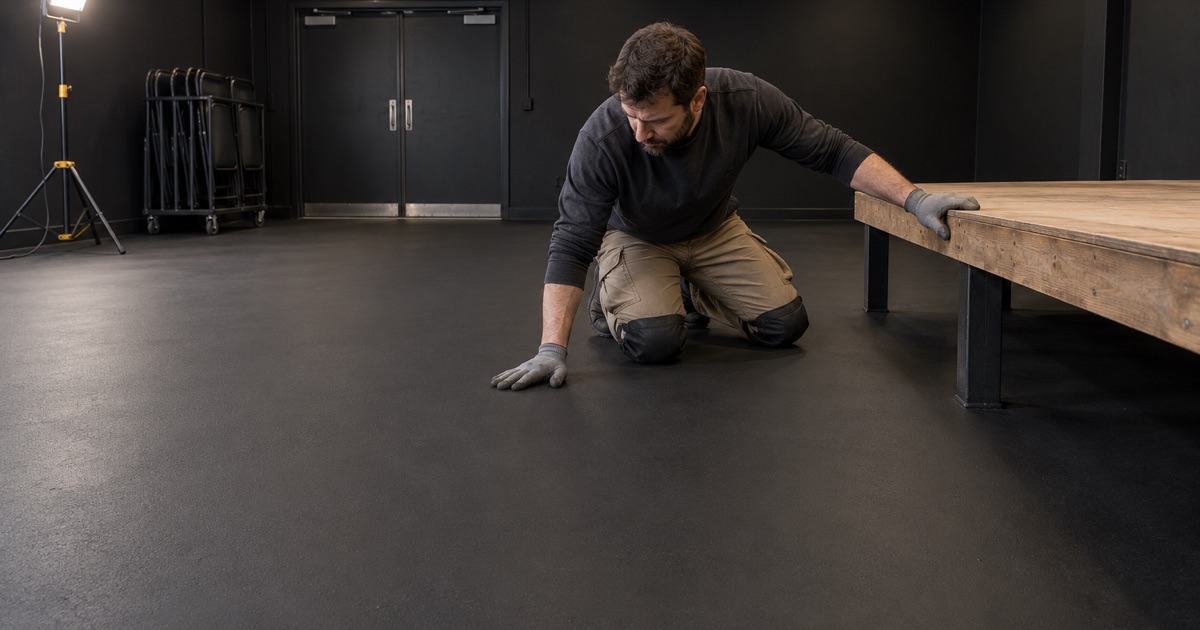
The body coat on a viewing-room floor can be the same 100% solids epoxy we use elsewhere. The difference is the top layer. Polyaspartic and polyurea topcoats are offered in more than one sheen, and for a dark room we steer toward satin or matte. Our proposal names the topcoat by product line and sheen, so the finish you get is the finish you approved.
A lower sheen also hides fine scratches and foot-traffic swirl better than high gloss does. That matters in a room where people walk in carrying chairs, snacks and blankets, and where a scuffed glossy floor catches screen light at every angle.
Choosing a color that fades into the dark
Charcoal, deep gray and other dark solid colors keep light from bouncing back toward a screen, and so do dark flake blends. A light gray or white floor is the opposite choice, because it acts like a reflector sitting directly under the image. If a homeowner wants some visual interest, a fine vinyl flake broadcast in dark tones adds texture without bright chips that sparkle under projector spill.
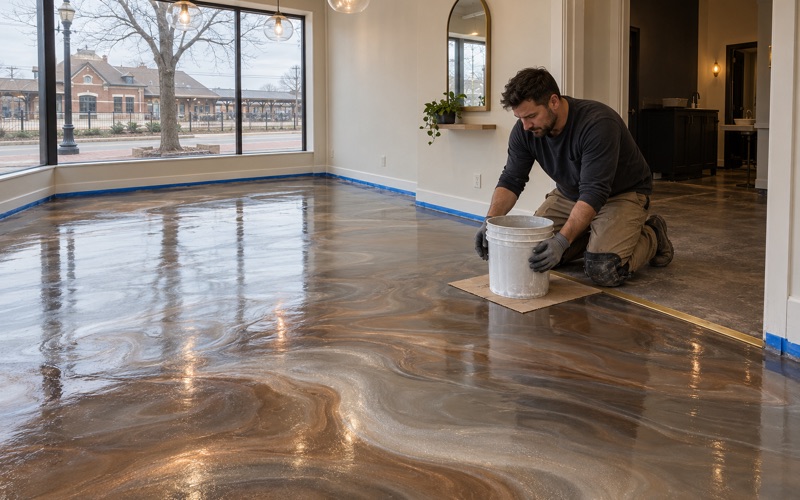
Metallic epoxy is the one decorative system we usually talk people out of for a theater. Its whole appeal is a reflective, pearly surface, which is exactly what a projection room does not need.
Texture, footing and cleanup in low light
People move around a dark room by feel. A slip-resistant finish here is specified by the broadcast and topcoat we use, such as a fine quartz aggregate broadcast locked under a matte topcoat, rather than promised as a slogan. Texture also scatters light instead of mirroring it, which helps the room in two ways at once.
A sealed floor wipes clean after a movie night in a way carpet never will. Soda, butter and crumbs stay on top of the coating rather than soaking into fibers, and a damp mop handles most of it before the next showing.
Home Theaters and Media Rooms in River Grove Houses
The houses a media room ends up in
River Grove counts 1,579 owner-occupied single-family detached homes, and much of its housing is mid-century: 1,086 units were built in the 1960s and 767 in the 1950s. When a homeowner turns a den, a family room or a converted garage bay into a theater, the slab underneath is often decades old. That age matters more than the projector budget when it comes to whether a coating will last.
Testing the slab before the dark finish goes down
An older slab can be dry on the surface and still push moisture vapor up through the concrete. We test before the price is final, using ASTM F1869 calcium chloride testing, ASTM F2170 in-situ relative humidity probes or an ASTM D4263 plastic sheet test, depending on the room. If the readings call for it, a moisture-mitigation primer goes into the scope, and we explain that moisture is the first exclusion on any coating warranty before you sign.
Cracks, spalls and old paint or adhesive get mapped before grinding. A dark low-sheen finish forgives light scuffs, but it will not hide a crack that keeps moving, so we say plainly when a slab needs repair first.
A closed media room also has less airflow than a garage, which makes product choice matter while the coating cures. We pick products inside the Illinois VOC limits for floor coatings, limits that bind the person applying them, and we plan ventilation for the cure rather than leaving it to chance.
Permits, scheduling and dust in an occupied house
River Grove requires a building permit for any remodeling valued over $100, and contractor licenses there run on the calendar year, January 1 to December 31, regardless of when they are issued. A theater conversion usually involves other trades, and the floor is often one of the last pieces scheduled, so we plan our window around theirs.
Grinding dust is captured at the machine with a vacuum, not swept or rinsed toward a drain, which matters inside a finished house with electronics waiting to go in. Cure schedules follow slab temperature and dew point rather than the calendar, so the room is ready when the coating is actually ready. For a home job above the Illinois threshold, you get a written contract and the Home Repair: Know Your Consumer Rights pamphlet before any grinding starts.
Commercial viewing rooms and screening spaces
The same approach carries to commercial rooms that run in the dark, from training rooms with projectors to small screening spaces and showrooms that demonstrate audio and video equipment. For spaces that cannot close during the day, we phase the work around opening hours with overnight and weekend windows. The finish stays dark and low-sheen, and the proposal still spells out product, coats and thickness.
- 20+ Years of Floor Work
- Moisture Tested in Writing
- Free Written Quotes