
Downers Grove Epoxy Flooring installs polyaspartic floor coating systems in Downers Grove, IL, serving surrounding cities including Hinsdale, Burr Ridge, Western Springs, La Grange and Westchester. In more than 20 years on concrete, we have watched polyaspartic go from a specialty product to the topcoat many of our floors depend on, because it cures fast, holds its color in sunlight and stands up to abrasion and chemicals that wear out ordinary coatings.
Fast cure is also polyaspartic’s biggest risk. A material that sets in minutes gives an installer very little room for a mistake, and it will not forgive a slab that was never properly prepared. Every polyaspartic floor we install goes down over a diamond-ground or shot-blasted surface, after a moisture test, with the product line, coat count and finished thickness written into the proposal.
Below we explain where polyaspartic fits, how it compares with epoxy and polyurea, and how we install it on garages and on commercial floors that cannot stay closed for long.
What Polyaspartic Coatings Are and How They Compare
Polyaspartic Chemistry in Plain Terms
Polyaspartic is an aliphatic polyurea, a two-part coating that cures by reaction rather than by drying. Because it is aliphatic, it resists the ultraviolet breakdown that causes standard epoxy to yellow, and because it cures quickly and fully, it reaches a hard, abrasion-resistant film in a fraction of the time an epoxy needs.
The working time is short, so batches are mixed in smaller amounts and applied by a crew that has done it many times. That speed is what lets a floor return to service quickly, and it is also why polyaspartic is no place for a first-time installer.
Polyaspartic Versus 100% Solids Epoxy
A 100% solids epoxy builds thick, bonds well into a ground profile, and has a longer working time, which makes it an excellent base coat and the body of a flake or quartz floor. Polyaspartic is thinner per coat but harder wearing at the surface and much more stable in sunlight.
That is why many of our systems combine them. An epoxy base carries the broadcast and fills the profile, and a polyaspartic topcoat takes the tire traffic, salt and daylight, so neither material is asked to do a job it is poorly suited for.
Polyaspartic Versus Polyurea Basecoats
Pure polyurea basecoats cure even faster than polyaspartic and stay flexible, which some installers use for one-day garage systems. The trade-off is a very short window to wet into the concrete, so surface preparation and slab temperature matter even more. We choose between polyurea, polyaspartic and epoxy basecoats based on your slab and schedule, not on a single product we push on every job.
Polyaspartic Floor Systems We Build
Flake Floors With a Polyaspartic Clear Coat
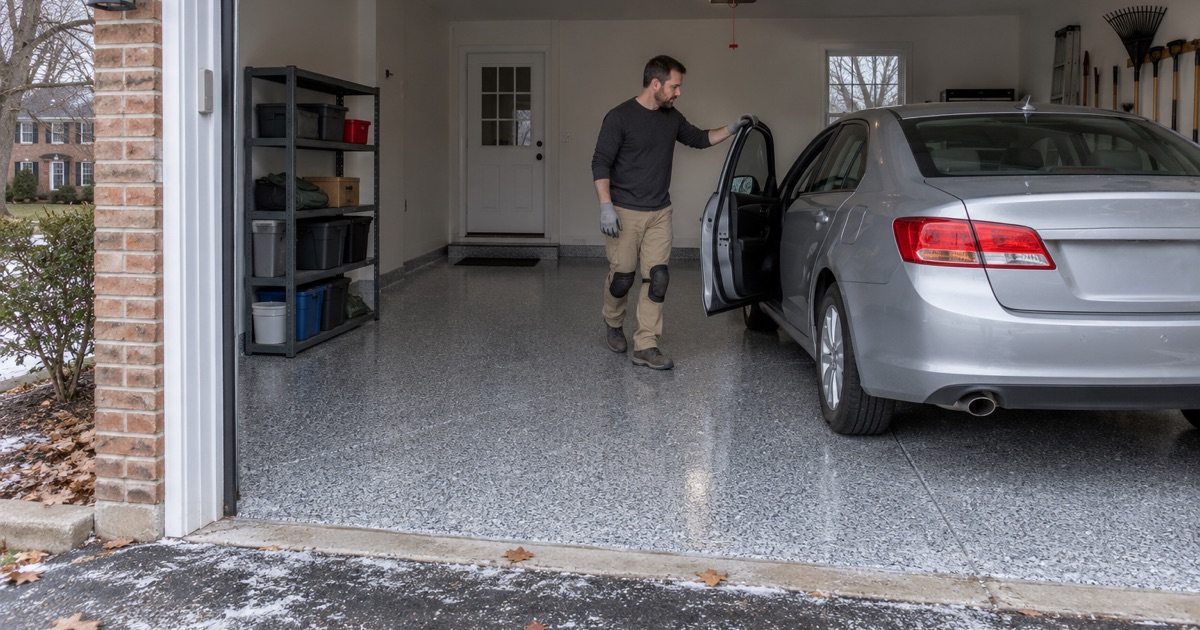
The most common system we install pairs a pigmented base coat with a full vinyl flake broadcast and a clear polyaspartic topcoat. The broadcast builds body and texture, and the clear coat locks the chips in place, resists scuffing and keeps the blend from yellowing where daylight reaches it.
Flake size and blend change how much dust, salt residue and tire marking the floor shows between cleanings. A finer chip in a mixed gray reads calm and hides the most, while a bold, larger chip makes more of a statement in a showroom garage.
Quartz Floors for Wet Footing
Where slip resistance matters most, such as entries, ramps, mudrooms on slab and commercial back rooms, we broadcast colored quartz aggregate instead of flake. Sealed under polyaspartic, quartz gives a fine sandpaper texture that grips when the floor is wet, and the amount of texture is set by the broadcast and the topcoat, not promised as a slogan.
Clear Polyaspartic Over Polished or Stained Concrete
Some owners like the look of their concrete and want only protection. A clear polyaspartic coat over a ground, densified or dyed slab keeps the character of the concrete while adding stain and abrasion resistance, and it can be recoated later without grinding the floor back to bare concrete.
Residential Polyaspartic Floor Coatings
Garages That Need to Be Back in Use Fast
For many homeowners the biggest draw of polyaspartic is getting the garage back quickly. With a dry slab and minimal repairs, a polyaspartic system can shorten the time between grinding and parking compared with an all-epoxy floor, so the car spends fewer nights in the driveway.
We still give you written walk-on and drive-on times, set by the slab temperature and the product data rather than a sales promise. A floor that is driven on too soon can print tire marks into a topcoat that never quite finished curing.
Garages That Face the Sun
A garage that sits with the door open on summer afternoons, or one with windows facing south or west, sends daylight straight across the floor. Standard epoxy ambers in that light, while an aliphatic polyaspartic topcoat holds its color, keeping a gray flake floor gray instead of turning it a dingy yellow over a few years.
Road Salt, Brine and Hot Tires
Polyaspartic topcoats resist the calcium chloride and rock salt brine that cars carry in all winter, and their hardness helps them hold up to hot tire pickup in summer. We pair them with a full flake or quartz broadcast so grit and salt residue are less visible between washes, and so the floor has texture underfoot when it is wet.
Basements, Sunrooms and Workshops
Polyaspartic also works in sunrooms, three-season porches on slab, workshops and basements, as long as the slab is tested first. A basement with moisture vapor coming through it may need a moisture-mitigation primer under the system, and we tell you that before you sign, along with what the coating warranty excludes for moisture.
Commercial Polyaspartic Floor Coatings
Fast Return to Service for Businesses
For clinics, offices, showrooms and restaurants, every closed day costs money. A polyaspartic system lets us grind, coat and topcoat a floor in an overnight or weekend window and hand the space back with a cured surface, phased around opening hours when a space cannot close completely.
Storefronts, Showrooms and Daylight
Retail spaces with large windows and car showrooms with glass walls expose floors to steady sunlight. A polyaspartic topcoat keeps colors and metallic effects from yellowing near the glass, so the floor near the entrance still matches the floor at the back of the room.
Clinics, Kitchens and Cleaning Chemicals
Medical offices and veterinary clinics clean with disinfectants daily, and commercial kitchens add hot water and degreasers. Polyaspartic topcoats resist many of those chemicals, and where a kitchen sees heavy thermal shock we pair or replace them with urethane cement and a coved base that meets DuPage County plan review.
How We Install a Polyaspartic Floor
Preparation That Matches the Cure Speed
The surface is ground or shot blasted to an ICRI concrete surface profile suited to the system, with vacuum dust capture at the machine. Cracks, spalls and old coatings are mapped and repaired first, and if the slab needs replacement rather than coating, we say so before quoting.
Moisture, Temperature and Dew Point
Before coating, we confirm the moisture test results in the written scope, then measure slab temperature and the dew point spread at the surface. A fast-curing coating still fails if moisture condenses on the slab during application, so the readings decide the timing, not the calendar.
Small Batches and Experienced Crews
Polyaspartic is mixed in small batches and placed quickly, with the broadcast thrown while the base is still open. Our crew works in a planned sequence so each section is coated, broadcast and backrolled before the material sets, which avoids lap marks and thin spots.
Final Topcoat and Care
The final polyaspartic topcoat seals the broadcast and sets the sheen, with aggregate added where slip resistance is needed. We hand over written return-to-service times and simple care guidance so the floor keeps its finish through salt season and summer heat alike.
- 20+ Years of Floor Work
- Moisture Tested in Writing
- Free Written Quotes