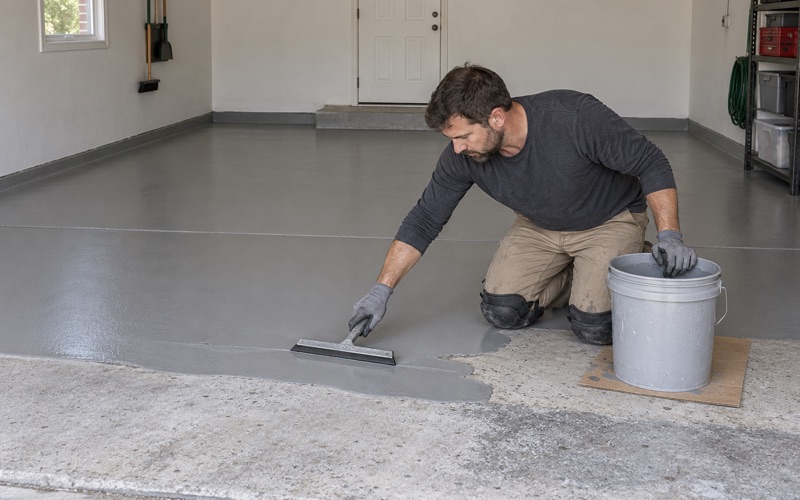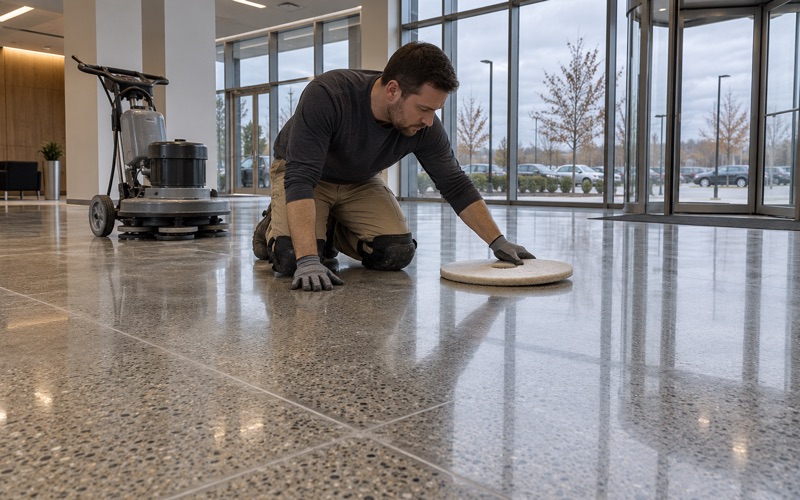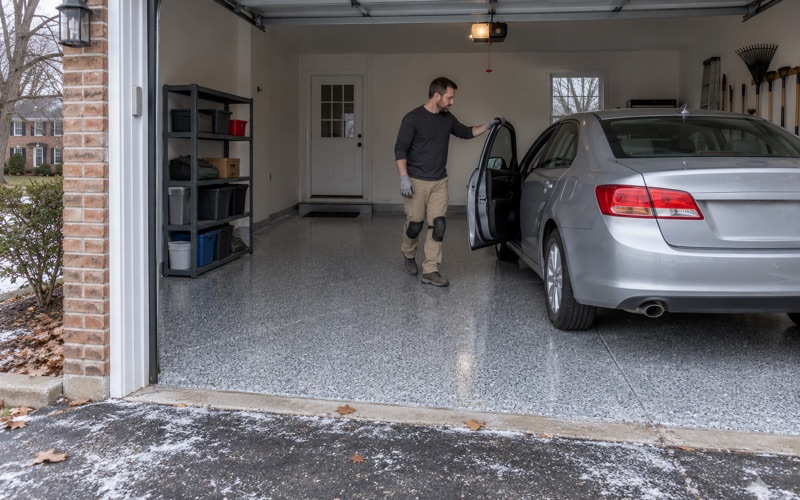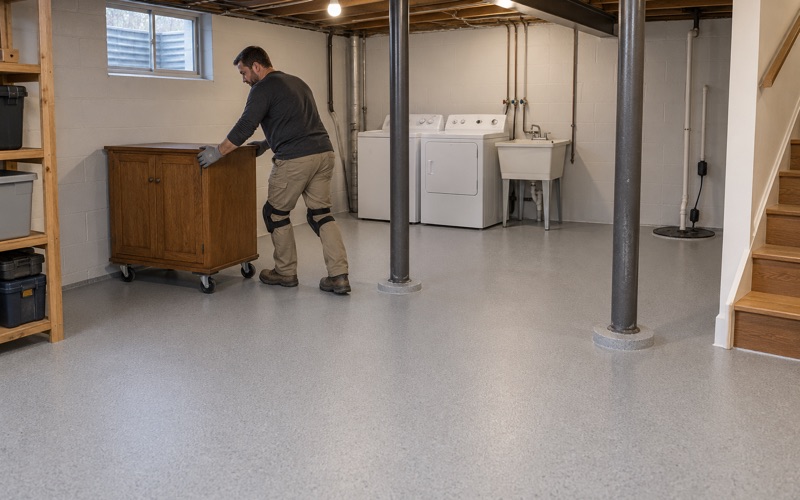
Downers Grove Epoxy Flooring has spent more than 20 years on epoxy-flooring in Palos Heights and across the southwest suburbs, and the lesson we keep relearning is that the coating is rarely where a job goes wrong. The finished floor is a cured, inert surface. The hours before it, when a bare slab is being opened up so the resin has something to bite into, are the hours that need a plan.
That preparation is mechanical and it is loud and dusty by nature. We open every slab with a diamond grinder rather than an acid etch, because an etched surface gives a coating almost nothing to hold, and a ground surface gives it a measurable profile. Grinding concrete makes fine dust, so the real question on any job is where that dust goes and who is breathing near it.
For most garages and shops the answer is simple: capture it at the machine and keep it out of the drains. In a building where people with weakened immune systems live, sleep and do their therapy, the same step becomes the part of the project everyone else plans around. This page is about that kind of job, and about the household version of it.
Post-Transplant and Cardiac Rehab on College Drive
Palos Heights is a city in Cook County, a southwest suburb of Chicago with a 2020 census population of 12,068. Along College Drive sits Avantara Palos Heights, a 184-bed facility at 7850 W College Dr that falls inside the city limits and in Palos Township. It offers short-term rehab and long-term care and is open around the clock.
Who the building serves
Avantara’s own location page lists Post-Transplant Care for liver and kidney recovery, limited to patients 10 days to 6 months post-operative. It also lists Cardiac Programming for people recovering from heart disease or cardiac surgery, which the facility says includes LVAD support. Short-term physical, occupational and speech therapy rounds out the published services.
We have no relationship with Avantara, and we know of no renovation or floor project there. We use it here because it shows plainly what kind of occupant changes the way a floor job has to be run. A patient a few weeks out from a liver or kidney transplant is on medication that deliberately holds the immune system down, and that is exactly the person construction dust can hurt.
Why that changes the floor conversation
In an empty warehouse, the schedule question is how fast we can grind, prime and coat. In a building that houses transplant recipients and patients living with a heart pump, the first question is how the dust from surface prep will be kept away from them. Speed comes second, and the facility, not the coating crew, decides what is acceptable.
That is a different kind of job from a busy retail floor or a restaurant kitchen, even though the coating chemistry may be the same. The difference is entirely in the preparation phase and in who has to sign off on it before the first grinder starts.
Looking for epoxy-flooring closer to Norridge? See Epoxy-Flooring Services in Norridge.
Why Surface Prep Is the Risky Step Near Immunosuppressed Patients
Coatings get the attention in a quote, but the grinding that comes before them is the step that disturbs a building. Opening a slab breaks up the top layer of concrete, along with whatever dirt, old sealer and debris has settled into it over the years. All of that wants to become airborne the moment a machine touches it.
What the CDC guideline says about construction dust
The CDC Guidelines for Environmental Infection Control in Health-Care Facilities (2003) put the concern directly. Construction and renovation “markedly increase the airborne Aspergillus spp. spore counts in the indoor air of such facilities.” Aspergillus is a common environmental mold, and the same guideline cites an aspergillosis outbreak among liver transplant patients.
The guideline goes on to say that containing dust and moisture from construction inside a facility “requires barrier structures,” and that dust can be managed by misting debris during heavy dust-generating work. It also notes that relocating patients might be especially prudent when construction happens within units that house immunocompromised people. None of this is about the finished floor. All of it is about the work that produces dust.
Grinding is the dust-generating step
On a coating job, diamond grinding is the step that matches that description. The resin itself goes down wet and cures in place; the grinder is what turns a solid slab into fine particles. So when we talk about protecting vulnerable occupants, we are really talking about how the grinding is contained, captured and cleaned up.
To be clear about limits: a floor coating does not prevent infection, and we never describe one as antimicrobial or as protection against mold. What we can control is how much dust our own work puts into the air while the floor is being prepared, and how thoroughly we clean up after it.
Moisture and repair findings still come first
The dust plan sits on top of the normal scope, not instead of it. We still map cracks, spalls and old coatings before pricing, and we still run a moisture test as part of the written scope, because a coating over a wet slab fails no matter how carefully it was installed. If a slab needs repair first, we say so, since patching later means a second round of grinding and a second round of dust.
Barriers, Shrouded Grinders, Misting and No Dry Sweeping
The practical tools for keeping prep dust contained are not exotic. What matters is that they are planned before mobilization and used every hour the machines run, not pulled out after someone complains about haze in a hallway.
Sealed barriers around the work area
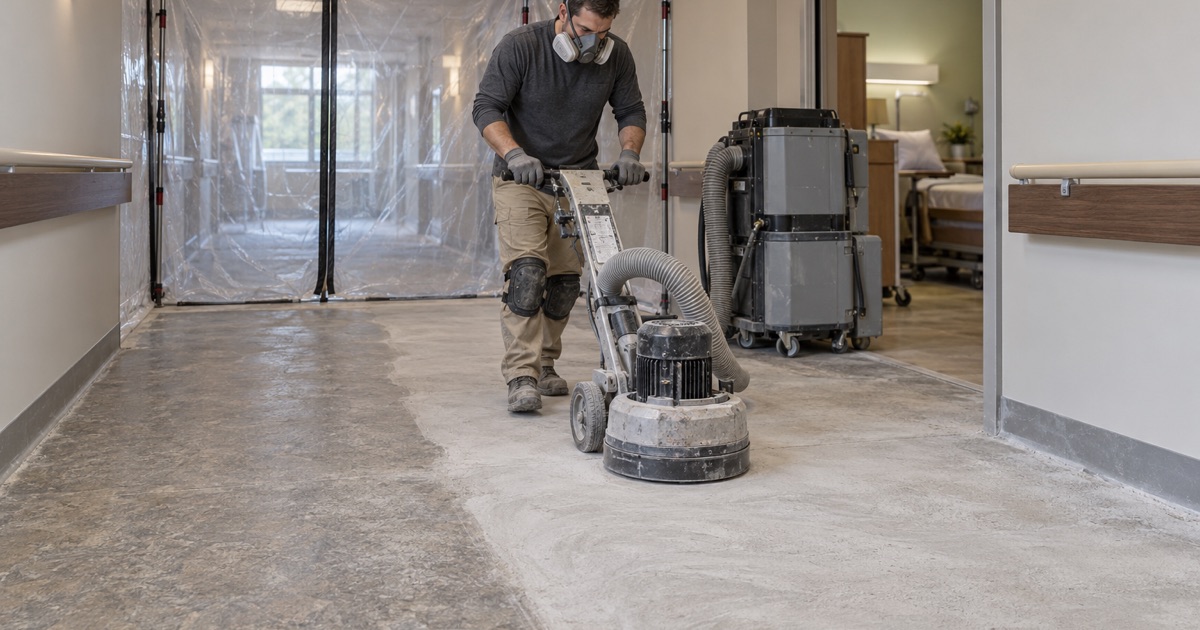
The CDC language on barrier structures is the starting point. In practice that means the area being ground is closed off from occupied space, with the barrier sealed at the floor, walls and ceiling so dust cannot drift into corridors or adjoining rooms. Doors in the barrier stay shut, and the route our crew and equipment take in and out is set ahead of time.
Where a facility uses negative-pressure containment or other engineering controls, those belong to the facility’s plan and its mechanical staff. We work inside whatever envelope they define rather than improvising our own.
Vacuum-shrouded diamond grinding
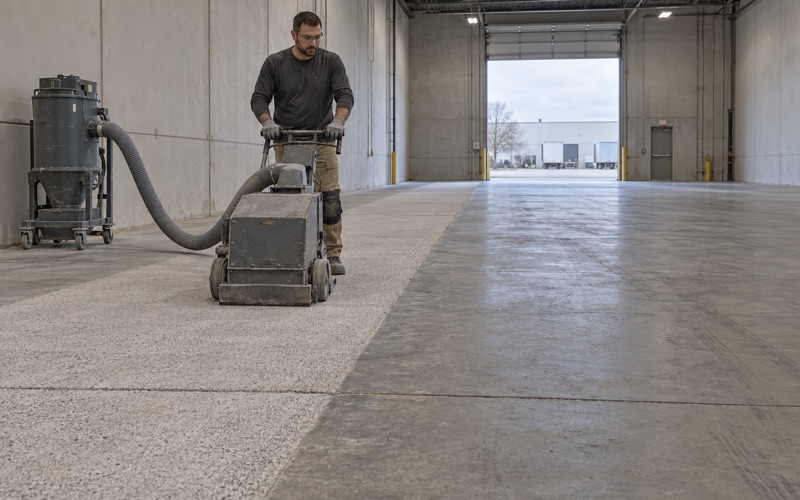
Our grinders run with a shroud around the cutting head, connected to an industrial vacuum, so dust is pulled off the slab at the point it is made. HEPA filters, as the CDC guideline notes, are at least 99.97% efficient for particles of 0.3 micrometers and larger. Capture at the machine also keeps grinding dust from being rinsed toward a floor drain or a storm inlet, which we avoid on every job, not just sensitive ones.
Edge work along walls and around fixtures is where dust most often escapes on a careless job. Shrouded hand tools on vacuum handle those margins, so the perimeter is held to the same standard as the open floor.
Misting, wet cleanup and no dry sweeping
Misting dirt and debris during heavy dust-generating activity is one of the controls the CDC guideline names. Cleanup follows the same logic. We vacuum and wet-wipe rather than push dust around with a broom.
That is also a worker-safety rule. OSHA’s respirable crystalline silica standard, 1910.1053(h), restricts dry sweeping and dry brushing where they could contribute to silica exposure. On a slab-prep job, a broom is simply the wrong tool, and it stays off our trailer.
Working Inside a Facility’s Infection-Control Plan, and at Home
In a care building, the people who decide how construction is run are the facility’s infection-prevention and facilities staff. Our role is to fit the floor work into their requirements and to show, in writing, exactly what we will do and when.
What an infection-control risk assessment decides
The CDC guideline describes an infection-control risk assessment, or ICRA, as a tool that “can identify potential exposures of susceptible patients to dust and moisture.” The facility runs that assessment and sets the conditions: where barriers go, which hours work may happen, whether patients are moved, and what inspection happens before an area is released.
We hold no healthcare-construction or ICRA certification, and we do not present ourselves as having one. What we bring is a scope that answers the questions such an assessment raises. Our proposal names the product line, the number of coats and the finished thickness, along with the grinding method, the dust controls and the cleanup sequence, so facility staff can check every step against what they approved.
Scheduling around a building that never empties
A rehab building that is open 24 hours cannot close for a floor. Work gets phased room by room or zone by zone, often in overnight or weekend windows, so only a small, sealed area is ever out of service. Cure times are set by slab temperature and dew point rather than by a calendar, which matters when an area has to return to use on a fixed date.
Permits and paperwork in Palos Heights run through the City of Palos Heights Building Department at 7607 W College Drive. Contractor registration there is completed in person or by mail, and emailed registrations are not accepted, so we handle that step well before a start date.
Palos Heights homes with a family member recovering
The same reasoning applies at a smaller scale in a house. Palos Heights is largely owner-occupied, and plenty of homeowners plan basement or garage projects without thinking about who inside the house might be on immunosuppressing medication after a transplant.
If someone in the household is recovering, tell us before we quote. We can seal the work area from the living space, run every grinder on vacuum, mist and wet-clean rather than sweep, and keep the door between an attached garage and the house closed while we work. It is also reasonable to ask the patient’s care team whether that family member should stay elsewhere during the grinding days, and to schedule the job around that answer.
For a home project over the state threshold, you get a written contract and the Illinois consumer-rights pamphlet before any grinding begins. Between that paperwork and a dust plan agreed in advance, the slow, careful part of the job happens on terms your household has already chosen.
- 20+ Years of Floor Work
- Moisture Tested in Writing
- Free Written Quotes