Downers Grove Epoxy Flooring has more than 20 years behind it, and when we plan epoxy flooring in Northlake truck terminals and warehouses, the first place we look is not the middle of the floor. It is the doorway. In a building that moves freight through dozens of dock doors, the open floor rarely fails first. The edge where the slab meets the steel of a dock leveler pit is where a coating gets tested over and over every shift, and it is usually where a tired floor starts to come apart.
So our scope for a dock-heavy building starts with a walk along the dock wall. We map the cracks, spalls and any old coating already on the slab, door by door, and we tell an owner plainly when a stretch of concrete needs repair before anything should go over it. The proposal then names the product line, how many coats go down and the finished thickness, so a facility manager can hold the installed floor up against the paper.
That approach matters most in a building where one detail repeats once per door. Get the edge wrong and the same failure shows up at every position along the wall; get it right and the floor’s weakest line becomes one of its strongest.
137 Dock Positions and the Edge at Every Pit
Northlake has plenty of buildings where the dock wall is the busiest surface on site. A good example of the scale is the facility The Custom Companies built at 135 Railroad Avenue, an address in the Leyden Township part of the city. The company’s own groundbreaking post from 2019 describes a 225,000-square-foot logistics building developed by CenterPoint Properties, designed for 53-foot trailers now that trucks have grown from an average of 40 feet, with 137 dock positions so trucks can be brought in quickly.
The company describes its less-than-truckload division as servicing thousands of shipments daily with 33 distribution points. We have never worked in that building, and we have not seen its levelers or its floor finishes. We use it here because it shows, at full size, the kind of floor this page is about: an LTL carrier’s terminal where nearly every load crosses a dock door.
Where concrete meets steel
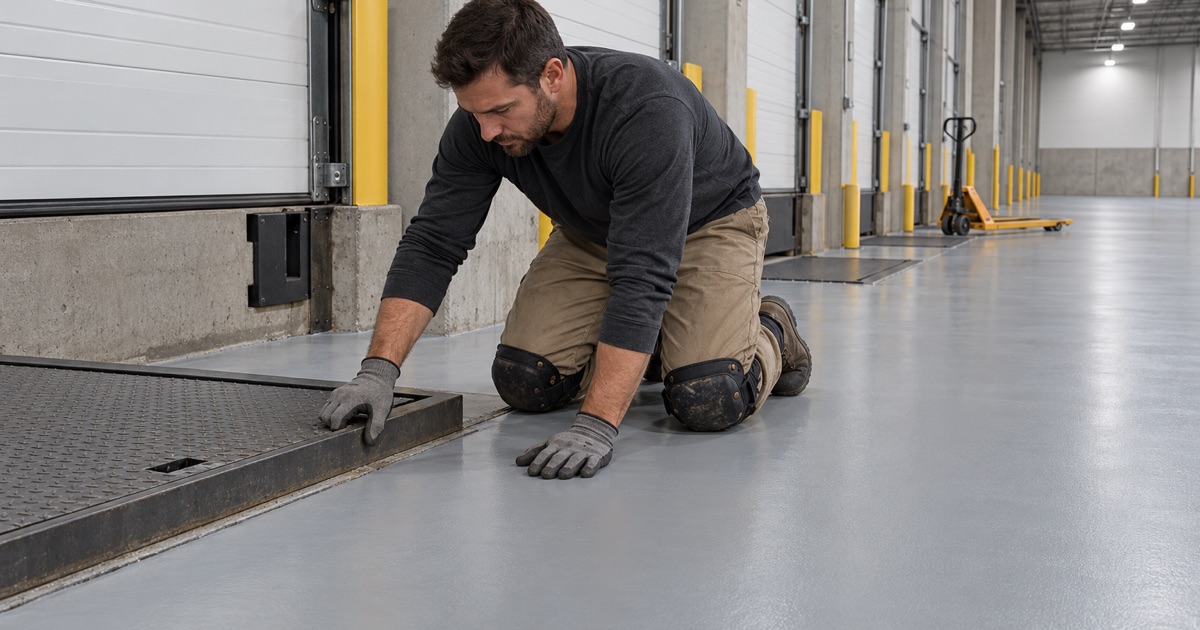
Each dock leveler sits in a pit, and the pit is edged with embedded steel curb angles that protect the pit and the dock edge and anchor the leveler. A leveler maker’s pit drawing calls for welded curb angle joints and side curb angles set at 90 degrees to the dock face. To a forklift, that steel is simply part of the path out to the trailer.
To a coating, it is a hard change of material in the busiest lane of the building. Concrete is porous and takes a ground profile; smooth steel does not. Resin bonded to a ground concrete surface behaves very differently from resin smeared onto the face of a steel angle, and the line between the two is exactly where every wheel lands.
Why the doorway decides the floor
In a terminal with a dock position every few feet of wall, every pallet jack and forklift leaves across a leveler lip and that curb angle. The doorway strip collects the load of the whole floor, compressed into a few feet. When we look at a high-dock-count floor, we count the doors first, because each one is another copy of the most-loaded edge in the building.
Looking for epoxy-flooring closer to Justice? See Epoxy-Flooring in Justice.
Why a Feathered Coating Edge Peels at the Dock
The quickest way to finish a floor at a pit is to feather the coating out toward the steel: roll it thinner and thinner until it disappears against the curb angle. It looks tidy on the day the crew leaves. It is also the detail we see fail most often at dock doors.
What wheel impact does to a thin edge
A feathered edge has almost no thickness at the very point where wheels hit hardest. A loaded pallet jack dropping off a leveler lip, or a forklift’s hard tire rolling back in from a trailer, strikes that edge from the side rather than rolling across its face. With nothing behind it to hold it down, the thin margin chips, lifts and starts to curl back.
Once a corner lifts, the problem grows. Every pass after that catches the raised lip and pries it a little farther, and dirt packs into the gap beneath. A small chip at the steel turns into a peeled band reaching back into the doorway, and in a building with a long dock wall that can happen at several doors in the same season.
Repairing a peeled coating edge at a leveler
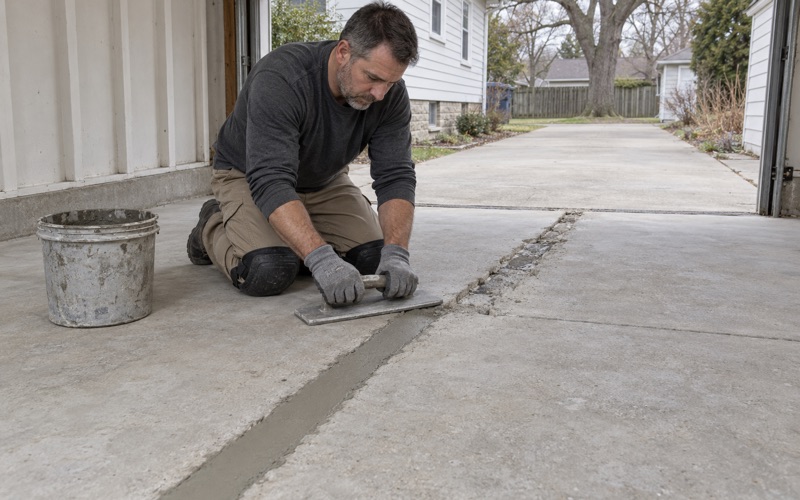
When we are called to a floor like that, we do not patch over the curl. We cut back to coating that is still firmly bonded, grind the exposed concrete open, and rebuild the edge with a proper termination rather than another feathered one. Recoating over a failed edge only hides where the next failure will start.
We also check the slab before we price the repair. A moisture test is part of the written scope, because a coating that lets go near a door is sometimes reacting to vapor coming up through the concrete, not just to wheel traffic. If that is the cause, a new edge alone will not hold, and we say so before the job is sold.
The Saw-Cut Key-In Termination
The detail that holds up at a dock door stops the coating in a captured edge instead of letting it taper to nothing. Resin-flooring manufacturers publish standard details for exactly this. One manufacturer’s detail, KEY-DTL-7, titled Epoxy Flooring Key-In Termination, ends the flooring in a saw-cut edge in the structural slab, with the resin filling the cut.
How a key-in termination works
A key-in termination gives the coating a shoulder. We saw a shallow, clean cut into the slab a short distance back from the steel, open it up, and carry the resin down into the cut so the edge of the floor is locked into the concrete itself. Instead of a paper-thin margin, the wheel meets a full-thickness edge that the slab holds in place.
Where the layout calls for it, the coating can instead be terminated against the curb angle with a keyed edge. Either way the principle is the same: wheels hit a captured edge, never a feathered one. The same manufacturer’s guide carries separate details for control joints, expansion and isolation joints, construction joints, trench drains and thresholds, and a dock wall usually touches more than one of them.
Preparing the slab for the edge to grip
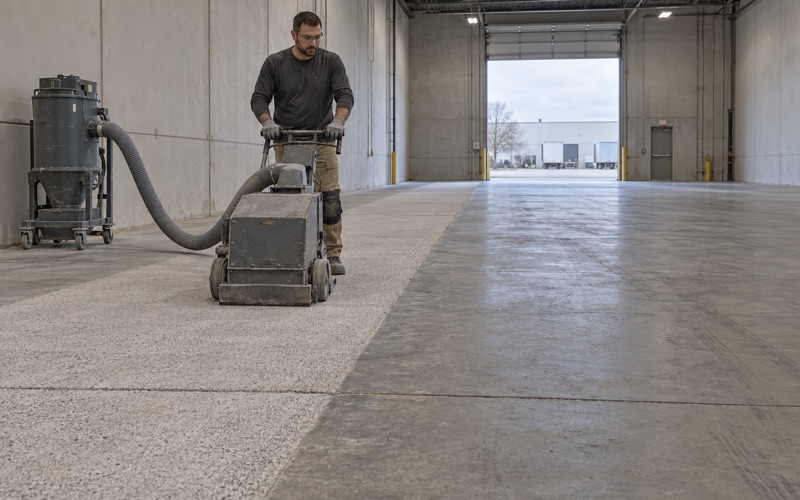
A termination is only as good as the bond behind it. Every slab we coat is opened with a diamond grinder or a shot blaster, never an acid etch, so the resin has a real profile to grip right up to the saw cut. Grinding dust is captured at the machine with a vacuum rather than washed toward a floor drain or a storm inlet, which matters in a working building where the dock area may stay partly in use.
Product choice follows the same logic. For a dock strip we lean toward 100% solids epoxy built to a meaningful thickness, often with a quartz aggregate broadcast and a tough topcoat, and the slip-resistant texture is specified by the broadcast and the topcoat used rather than promised as a slogan. Cure is planned around slab temperature and dew point, not the calendar, so the edge is fully hard before the first pallet jack rolls over it.
Treating the Strip Inside Each Door as the Wear Zone
Even a well-built edge sits inside a strip of floor that works harder than anything else in the building. We treat the band just inside each dock door as its own zone, with its own build and its own maintenance plan, rather than pretending it will wear at the same rate as an aisle in the back of the warehouse.
Building up the wear strip
The doorway strip stays coated and gets the heaviest section of the floor, keyed in at the pit and carried back far enough to cover the turning and braking area just inside the door. Where wheels brake, turn and accelerate in the same few feet all day, the extra build and the harder broadcast surface buy years. Away from the docks, the open floor can often take a lighter system without giving anything up.
We are clear about our limits on this work. We do not install, repair or service dock levelers or pits; our job ends at the coating and its edge. If a curb angle is loose, a pit is damaged or a leveler needs attention, that belongs to a dock equipment company before we cut a single key-in line.
Phasing the docks around a running terminal
A building that moves freight every day cannot shut its whole dock wall down for a coating. We phase the work in groups of doors, with overnight and weekend windows where the schedule allows, so trucks can keep moving through the positions that are not being coated. Each group is ground, keyed in, coated and cured before the next one closes.
Before work starts, every contractor and subcontractor on a Northlake job has to register with the City of Northlake Building Department: a $100 annual license good for one year from issuance, a $10,000 bond and a certificate of insurance naming the city. Fire protection here is handled by the Northlake Fire Protection District rather than a city department, so any fire-code question on a commercial floor goes to the district. We also explain up front what a coating warranty excludes, and moisture is the first exclusion we name, so a terminal manager knows exactly what the edge at each door is covered for.
- 20+ Years of Floor Work
- Moisture Tested in Writing
- Free Written Quotes