Downers Grove Epoxy Flooring has more than 20 years behind it, and when we plan epoxy-flooring in North Aurora we start with a question most quotes skip: what will people be wearing on their feet when they walk across it? A coating that grips a work boot well can behave very differently under a sock, a slipper or a bare heel. The answer changes the texture, the topcoat and the cleaning plan we write down.
Slip resistance is something we specify, not something we promise. The proposal names the broadcast, the topcoat, the product line, the number of coats and the finished thickness, so an owner can hold the installed floor up against the paper and see exactly what was bought. A word like “non-slip” printed on a bucket tells you very little about how a floor feels under a sock.
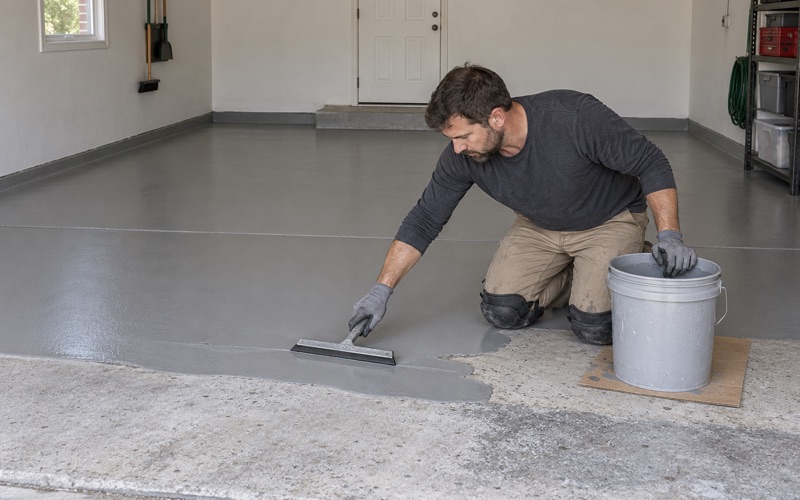
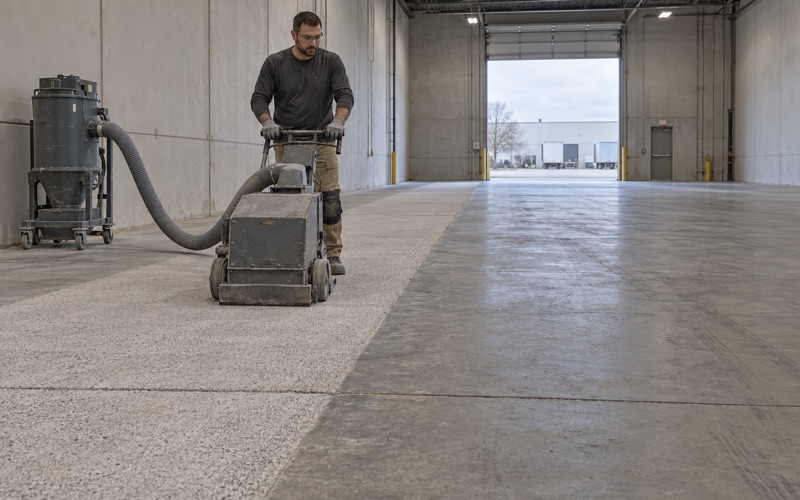
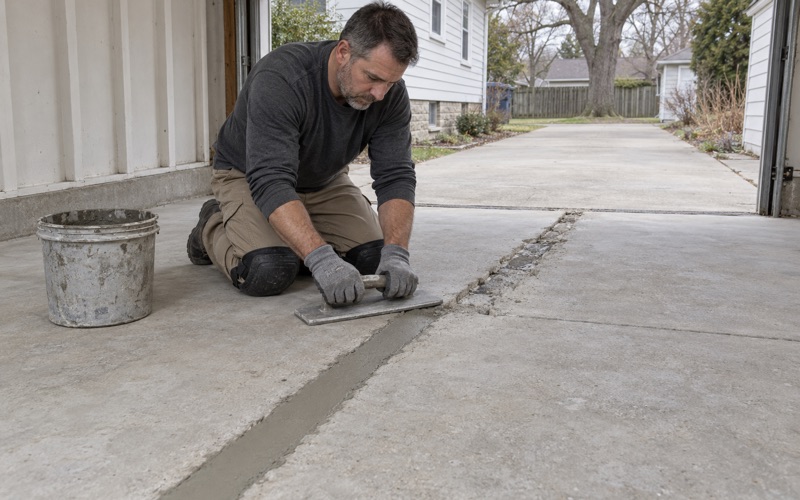
Before any of that, the slab gets opened with a diamond grinder or a shot blaster, never an acid etch. Cracks, spalls and old coatings are mapped first, and if a slab needs repair before it should be coated, we say so in writing before anyone signs.
Shoes Off and Grip Socks at North Aurora’s Indoor Slide Park
A park that runs on socks
North Aurora is a village in Kane County, and in October 2024 it picked up a floor problem most suburbs never see. Slick City Action Park opened early that month in North Aurora Towne Center, with a grand opening on October 29, 2024. It is an indoor slide and air-court park, the chain’s first Illinois location, with giant dry slides, air courts for basketball and dodgeball, a junior bounce court, an indoor zip line and an arcade.
The guest rules are what caught our attention. The brand’s safety page tells guests to always take off shoes and wear grip CitySocks, to use the provided mats and return them to marked areas after each slide, and not to ride in wet clothes. US pages for the chain say park grip socks are required and that socks from other entertainment centers are not accepted.
Why that matters for a floor
Put those rules together and you have a commercial building where the whole crowd walks in socks, from the check-in desk to the slide stairs and back. Nobody there is wearing a shoe sole, and the floor between the attractions is carrying mats, kids and parents all day. We did no work at this park and have not seen its floor finish; we use it here because it describes a kind of traffic that a coating plan rarely names.
Grip socks on a hard, sealed surface
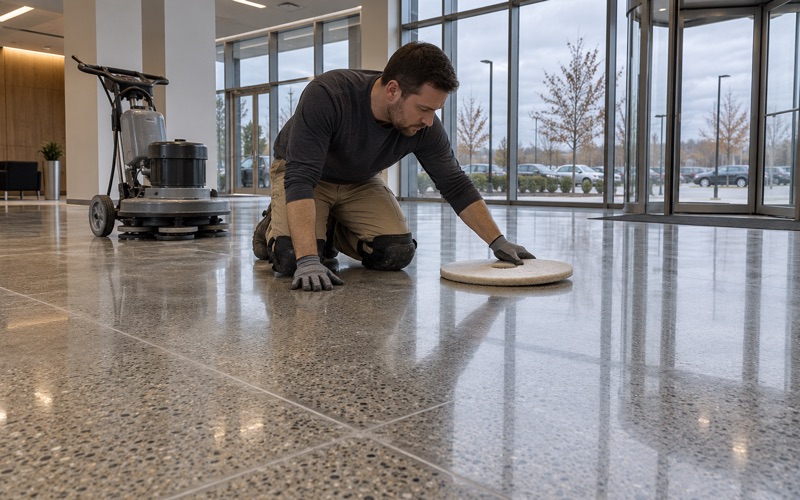
A grip sock has rubber dots or patterns on the sole, and those dots behave nothing like a tread lug. They touch the floor at small points, they flatten under weight, and they pick up dust and fibers as the day goes on. A smooth, high-gloss coating can feel fine under a shoe and still let a sock skate, while a very coarse broadcast can be harsh on bare skin and hard to keep clean.
Looking for epoxy-flooring closer to Alsip? See Epoxy-Flooring in Alsip.
Slip Tests Use Shoe-Sole or Bare-Foot Rubber, Not a Sock
What the pendulum actually measures
The common field test for floor friction is the ASTM E303 pendulum. A floor-friction testing firm describes running it with two rubber types: one that mimics shoe soles and one that mimics bare feet. Those two rubbers cover a lot of real floors, from store aisles to locker rooms, and they give a useful number when a surface is being judged.
What we could not find is a common slip test that uses a sock. That is not a finding that socks are safe or unsafe on any coating. It simply means no standard number exists for that pairing, and anyone quoting one for a sock is quoting something we have never seen published.
Comparing surfaces is not the same as predicting slips
The same testing firm says it does not recommend ANSI A326.3 for judging the real-world slip resistance of floors, describing it as a test for comparing surfaces. It also gives 0.42 DCOF as the minimum for level indoor floors that are expected to get wet in use. That figure is about shoes on wet tile and similar surfaces, and we do not stretch it into a rating for anything else.
How we handle that gap on a quote
So we do not hand anyone a sock rating, because there is not one to give. What we can do is put a sample board of the planned texture and topcoat on the floor, let the people who will use the room walk it in the footwear they will actually wear, and adjust the broadcast before the job starts. The choice ends up in writing, tied to a named product, rather than a slogan.
Finish, Texture and Marked Mat-Return Areas for Sock Traffic
Choosing the broadcast for sock feet
The texture on a resin floor comes mostly from what is broadcast into it and how heavily the topcoat buries it. A vinyl flake broadcast under a clear topcoat gives a gentle surface that most people find comfortable in socks. A quartz aggregate broadcast gives more bite, and the topcoat thickness decides whether that bite stays sharp or rounds over into something softer underfoot.
For a shoes-off floor we usually aim between the two: enough texture that a grip-sock dot has an edge to catch, but not so much that dust packs into the low spots and turns the surface slick again. Polyaspartic and polyurea topcoats both take a fine anti-slip additive well, and the amount goes on the proposal as a measured choice.
Sheen and what people read in it
Sheen matters for more than looks. A full-gloss floor shows every scuff from sock rubber, and it can read as wet even when it is dry, which makes people walk awkwardly. A satin or matte topcoat hides sock marks better and keeps the surface reading as dry floor rather than ice.
Marking mat-return and staging areas in the floor
Slick City’s rule about returning mats to marked areas points at something a coating can do well. Instead of tape or paint that wears off under sock traffic, the marked zones can be built into the floor itself, with a contrasting color laid in a separate coat and sealed under the same topcoat. Mat staging lanes, queue lines and keep-clear zones then last as long as the floor does.
We lay those zones out with the operator before the coating goes down, because moving a line later means grinding through the topcoat. The edges of each zone are kept flush, so a sock foot never meets a ridge between colors.
A cleaning routine that keeps the texture working
A textured floor only keeps its grip if the texture stays clean. Dust, lint from socks and residue from cleaners all fill the profile over time. We leave the owner a written routine, including which cleaners leave a film and which do not, and the park’s own no-wet-clothes rule is a reminder that a dry surface is part of the plan too.
Socks, Slippers and Bare Feet on a North Aurora Basement or Garage Floor
The same question at home
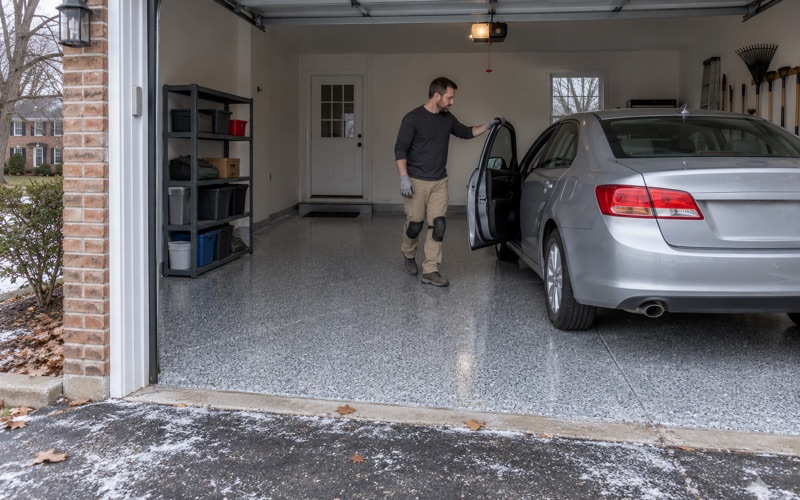
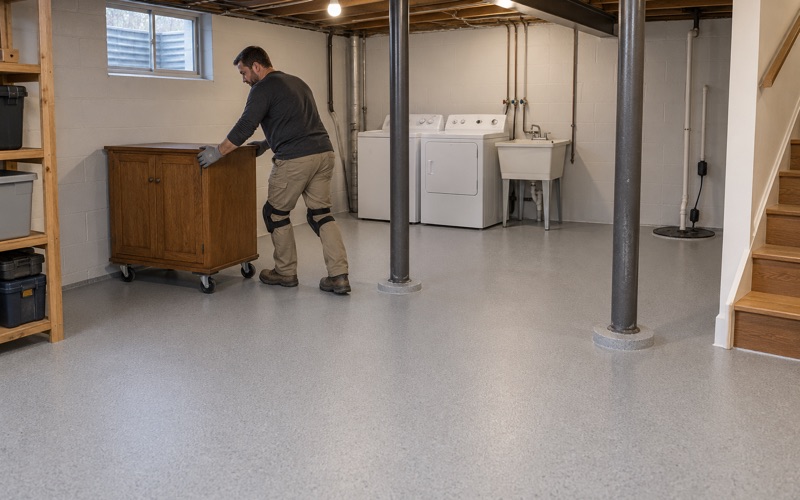
Plenty of North Aurora homes are shoes-off houses, and the basement or attached garage is often walked in socks or slippers on the way to the laundry, the freezer or the car. A garage floor coated for boots and tires can feel slick to a sock on the step into the house. We ask how a family actually uses the room, then pick the broadcast and topcoat for that, not for a showroom photo.
Slabs from the building boom
Half of North Aurora’s homes were built in 2000 or later, 2,642 of them in 2000 through 2009, so many garage and basement slabs here are roughly 15 to 25 years old. That is old enough for sealers, old coatings and hairline cracks to show up. Each one gets mapped, ground and repaired before any resin goes down.
A moisture test is part of the written scope before the price is final, whether we use an ASTM F2170 in-situ relative humidity probe or an ASTM F1869 calcium chloride test. When the reading calls for it, a moisture-mitigation primer goes into the system and onto the proposal. Moisture is also the first warranty exclusion we explain, before the job is sold.
Permits, contracts and paperwork in the village
The Village of North Aurora’s building and zoning page lists flooring among the projects that do not need a permit, and it states that contractor registration is not required. A coating on its own is therefore permit-free here. Slab replacement, driveways, patios and structural work are on the permit list, and we point to those rules before anyone quotes a coating on a new pour.
Home jobs over the state threshold still get a written contract and the Illinois Home Repair: Know Your Consumer Rights pamphlet before any grinding starts. Grinding dust is captured at the machine with a vacuum, not rinsed toward a drain. For a business space that cannot close, such as a play or fitness floor, we phase the work around opening hours with overnight and weekend windows.
- 20+ Years of Floor Work
- Moisture Tested in Writing
- Free Written Quotes