Downers Grove Epoxy Flooring brings more than 20 years of epoxy flooring work to Norridge, and this page is about one problem that kitchens and garages share: fat. Not motor oil or tire marks, but the grease that comes off cooking food, settles on the floor and stays there. A floor that handles it well looks unremarkable for years, while one that does not turns slick, stained and eventually soft at the surface.
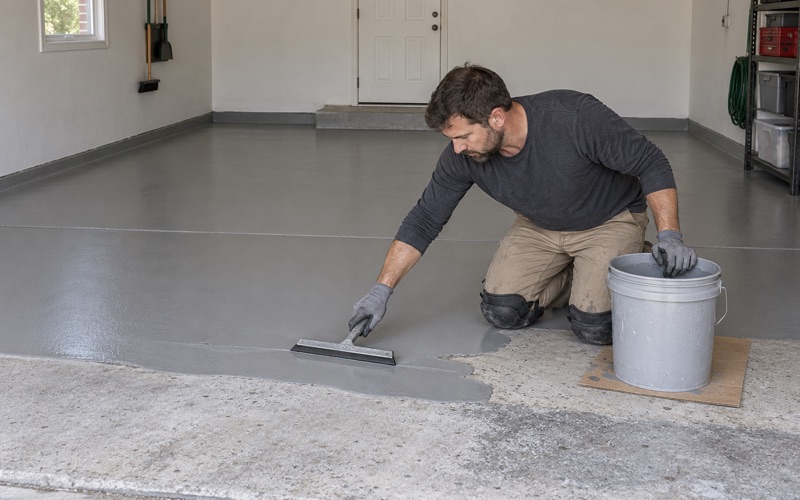
Our answer is a sealed, seamless floor with a texture chosen for wet conditions, and it starts with preparation. Every slab we coat is opened mechanically, with a diamond grinder or a shot blaster, so the resin bonds into sound concrete rather than sitting on a film of old grease. Acid etching is not part of our process, and it is a poor match for a slab that has already absorbed cooking fat.
Before a price is final, the written scope includes a moisture test and a map of the cracks, spalls and old coatings we find. The proposal names the product line, the number of coats and the finished thickness, so a restaurant owner or a homeowner can check the finished floor against the paper.
Fat From the Grill and the Pastry Bench on Lawrence Avenue
A Serbian bakery and grill at 7701 W. Lawrence Avenue
ABC Bakery & Deli sits at 7701 W. Lawrence Avenue, an address that geocodes inside the Village of Norridge in Norwood Park Township, Cook County. It is a Serbian bakery, deli and grill, open seven days a week for dine-in, carry-out and catering. We have no connection to the business and have never been in its kitchen; we use it because its own menu describes, plainly, the kind of cooking that puts fat on a floor.
The menu says bread, burek, pies, cakes and cookies are prepared daily in the bakery, and that the burek, in cheese, meat or spinach plus a pizza version, is prepared fresh daily in Norridge. Daily baking means daily oil, butter and fat on benches, sheet pans and the hands of the people working the dough. In any bakery, some of that ends up on the floor in small amounts that add up.
Cevapi and pljeskavica from a Leskovac-style grill
The other half of the menu comes off the grill. Cevapi are described as freshly grilled and served in a warm homemade bun, and the pljeskavica as freshly grilled for a rich, juicy and smoky flavor, with the restaurant citing Leskovac grill traditions. Ground-meat dishes like these carry a good deal of fat, and grilling is the step that releases it.
A loss-control bulletin from the insurer AmTrust, published in June 2019, describes that release. It says fats start to render from the meats around 180 degrees, and that the rendering will also produce atomized particles of fat. In other words, a grill does not just drip; it puts a fine mist of fat into the air around it.
Why that matters below knee height
Fat in the air eventually comes down, and much of it lands on the floor near the cooking line and wherever the air carries it. Add drips from a grill, oil from pastry pans and the crumbs that soak it up, and a bakery-grill floor takes fat from two directions at once. That is a different load than a kitchen that only bakes or only fries.
We are not describing any particular kitchen’s floor here, ABC’s included. What we are describing is the exposure a menu like that implies, and the kind of floor that stands up to it.
Looking for epoxy-flooring closer to North Aurora? See North Aurora Epoxy-Flooring.
Saponification: What Fat Does to Bare Concrete and Grout
The lime in cement paste
Concrete and cement grout are alkaline. As cement hydrates, it leaves calcium hydroxide, Ca(OH)2, in the tiny capillary pores of the paste. A 2017 paper by Han and colleagues in the Proceedings of the Japan Concrete Institute describes what happens when fatty acids reach it: the alkali reacts with them in a process called saponification, the same chemistry that turns fat and lye into soap.
The product of that reaction is a fatty-acid salt that expands as it forms. The paper describes that expanded salt damaging the microstructure of the paste from the inside. On a bare slab, the result is a surface that loosens and breaks down where fat sits on it again and again.
Why grout lines and bare slabs suffer first
On a tiled kitchen floor the tile is rarely the weak point. Cement grout between tiles is softer, more porous and lower than the tile face, so it collects fat and water and holds them. That makes grout joints a natural place for saponification to start, and once grout erodes, the edges of the tile lose support.
A bare or poorly sealed concrete floor behaves the same way across its whole surface. Fat that soaks in cannot be mopped back out, and the alkaline paste it reaches is exactly what the reaction needs. Sealing the surface is the point: keep fat on top, where a cleaner can reach it, instead of letting it into the pores.
What the laboratory work does and does not show
The evidence on saponification comes from laboratory work, including concrete samples immersed in oil, not from measurements of working kitchen floors. We use it to explain the mechanism, not to predict how fast any real floor will wear. A floor that is cleaned every day is not the same exposure as a sample left soaking.
What the chemistry does tell us is which surfaces to stop exposing. Bare cement paste, open grout and cracked concrete are all places where fat meets lime, so the floor we specify for a bakery-grill closes every one of them off.
Sealed, Seamless and Degreased Daily, With Texture Where It Gets Wet
Seamless means nowhere for fat to collect
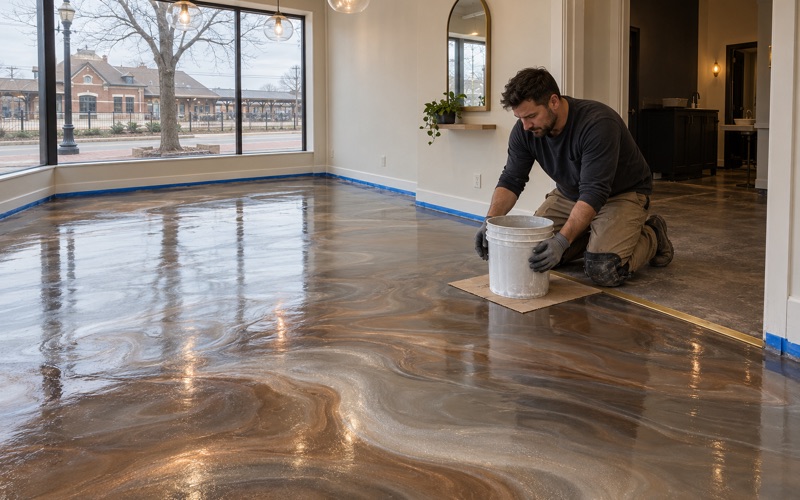
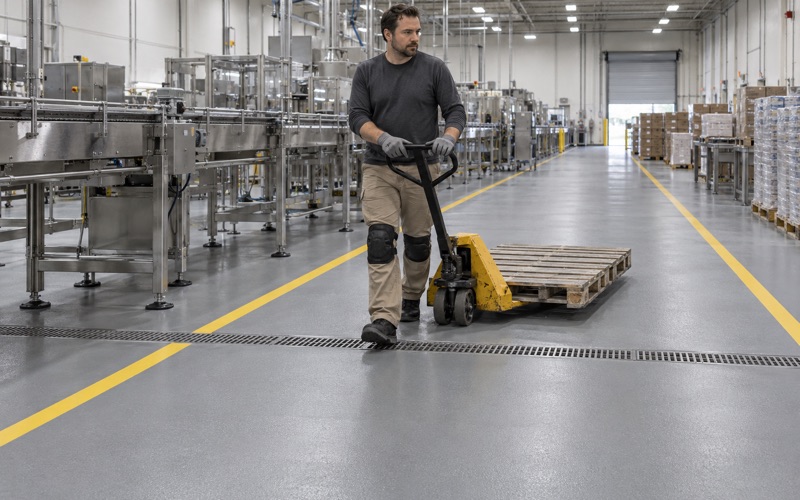
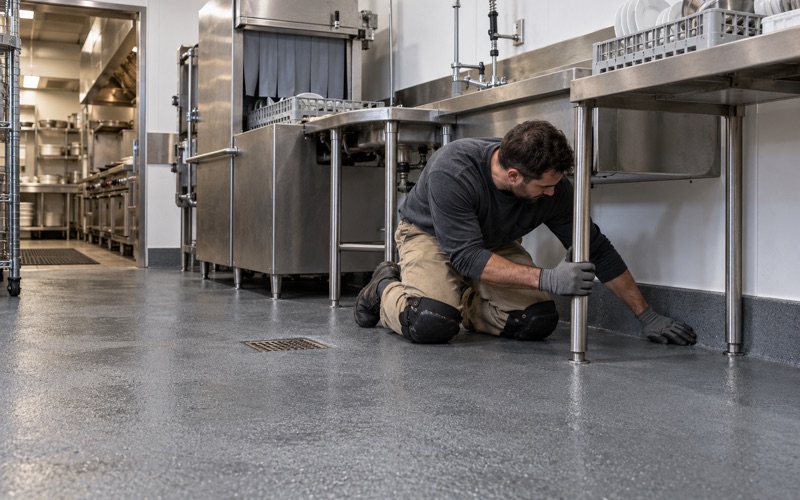
A resinous floor puts a continuous, nonporous layer over the concrete, with no grout joints to soak up fat. For kitchens we usually look at urethane cement, which handles heat, hot-water washdown and the temperature swings of a busy cooking line better than most epoxies, or a 100% solids epoxy system where the room stays cooler. Either way, the floor turns up the wall as an integral cove, so the corner where floor meets wall can be cleaned instead of collecting grease.
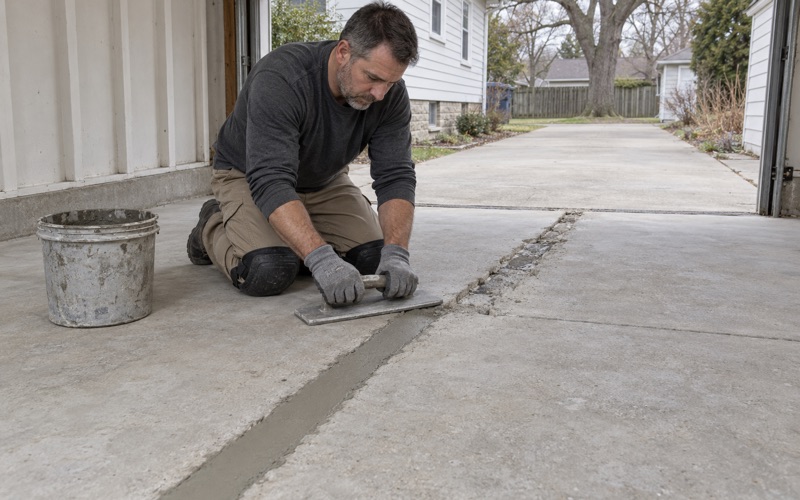
Joints in the slab still need respect. A Sika white paper on joint treatments warns that a joint designed to accommodate significant movement should not be rigidly bridged simply to create a seamless appearance, and that a treatment that is too rigid can transfer movement into the flooring and cause cracking or delamination. We honor moving joints with a flexible sealant and make everything else continuous.
Built for a daily degrease
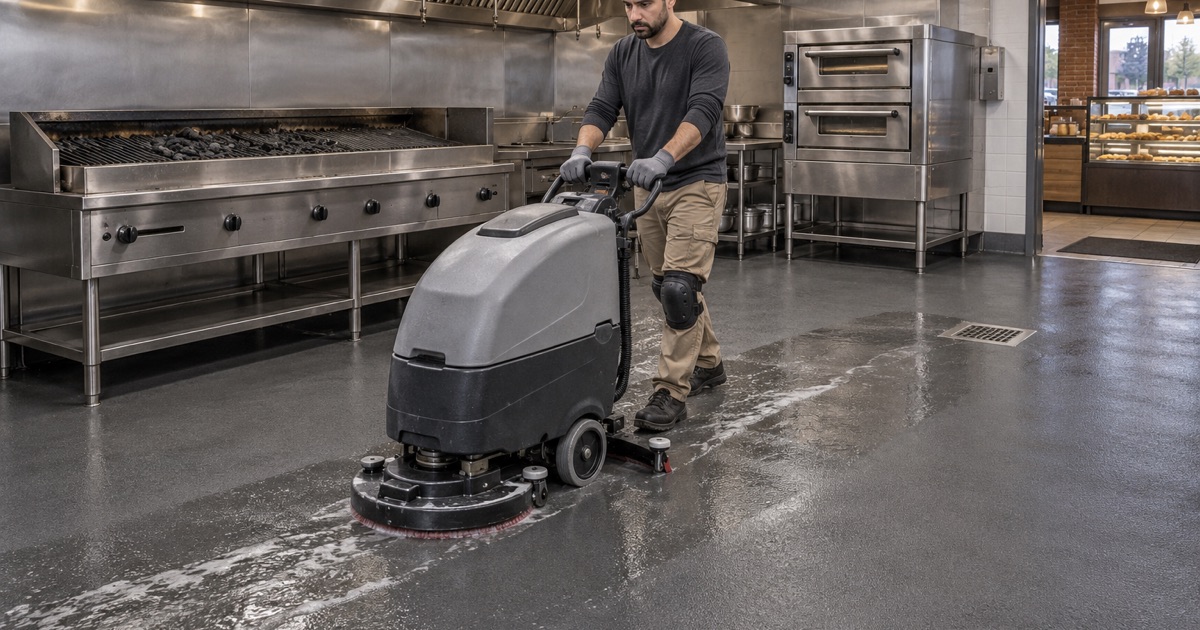
A seamless floor only stays sound if fat comes off it, so we pick topcoats that hold up to the degreasers and scrubbing a commercial kitchen uses every day. A sealed surface makes that routine faster, because the fat stays on top and the cleaner does not have to chase it into pores or grout lines.
We also talk through where wash water goes. Sloping the finish toward floor drains and keeping the cove detail tight at drain bodies means the degreasing routine rinses fat away instead of pooling it at the edges of the room.
Texture specified by broadcast and topcoat
A smooth, glossy floor and a film of fat are a bad combination. We set slip resistance by the aggregate we broadcast and the topcoat we lock it in with, typically a quartz aggregate broadcast in cooking and dish areas, and we can step the texture down in dry storage where easy sweeping matters more. The aim is a floor that stays walkable when it is wet and greasy, yet is not so rough that a mop shreds on it.
Prep and scheduling around service
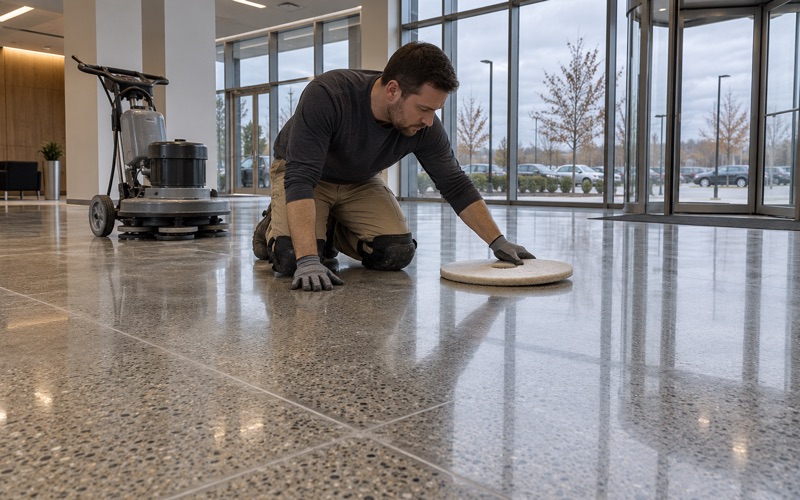
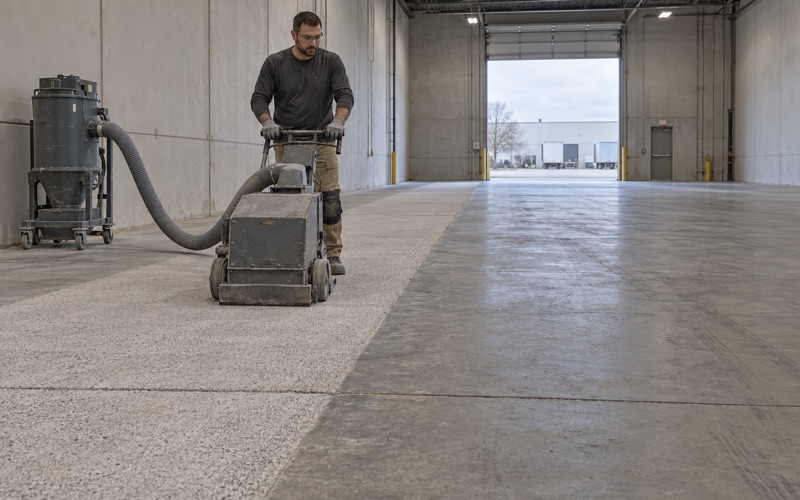
Getting a coating to bond to a slab that has absorbed cooking fat starts with mechanical prep. We grind or shot blast to a concrete surface profile on the ICRI CSP scale that suits the system, capture the dust at the machine with a vacuum rather than washing it toward a drain, and test for moisture before the price is final. Where fat has soaked deep, we tell the owner plainly whether the concrete can be prepped or needs repair first.
A restaurant open seven days cannot simply close for a week. We phase restaurant floors around opening hours, with overnight and weekend windows, and cure times follow slab temperature and dew point rather than the clock on the wall.
Grills, Smokers and Fryers on Norridge Garage Floors
The same chemistry in a home garage
Norridge was incorporated as a village in 1948, stymieing an effort by Chicago to annex the area, and with Harwood Heights it still forms an enclave inside the city that is sometimes called the Island Within a City. It is a village of houses with garages, and a garage is where a grill, a smoker or a turkey fryer often gets stored, and sometimes used, near the open door.
Wherever that happens, the same rendered fat and oil spatter that reaches a commercial kitchen floor reaches a bare garage slab, in smaller doses. The concrete underneath is the same alkaline material, so the same reaction applies, and the dark stain where a fryer sat is the first sign that fat has gone into the pores.
Choosing a garage system around cooking fat
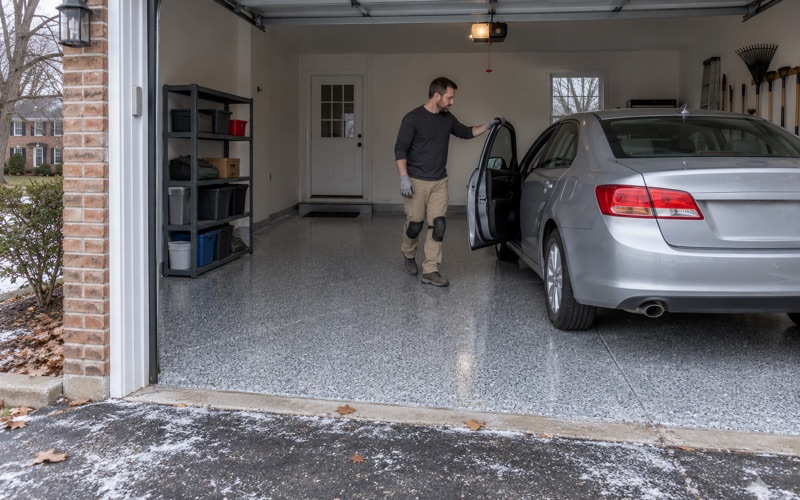
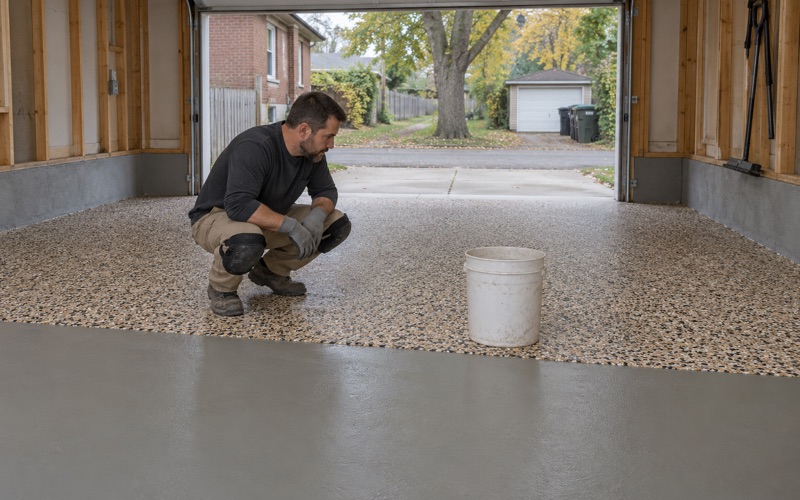
A coated garage floor keeps fat on the surface where it can be wiped up. We typically build a garage system on a 100% solids epoxy base with a vinyl flake broadcast and a polyaspartic topcoat, which cleans up with a degreaser and also stands up to the brine and rock salt that ride in on tires all winter.
Heat is the other consideration. Hot tire pickup is the better-known heat problem on garage floors, but a grill or fryer set directly on a coating, or hot oil spilled on it, is a reason to keep cooking equipment on a stand or mat rather than on any finish. We say that before the job, not after a mark appears.
Moisture, cure and what the warranty excludes
Every garage job includes a moisture test in the written scope, using methods such as ASTM F1869 calcium chloride testing or ASTM F2170 in-situ relative humidity probes, before we commit to a price. Moisture coming up through a slab is the first exclusion we name when we explain what a coating warranty does not cover.
Cure schedules follow the slab, not the calendar. An unheated Norridge garage in deep winter is too cold for most systems to cure properly, and we will tell a homeowner to wait rather than coat a floor that cannot cure. Home jobs over the state threshold get a written contract and the Home Repair: Know Your Consumer Rights pamphlet before any grinding starts.
- 20+ Years of Floor Work
- Moisture Tested in Writing
- Free Written Quotes