Downers Grove Epoxy Flooring brings more than 20 years of epoxy flooring work to Lyons, and some of the floors that teach the most are the ones under exercise equipment. A bike, a rower or a row of cycles stays in one place, the rider stays on it, and everything that drips lands on the same few square feet of slab, session after session. That pattern is easy to overlook until the concrete starts to darken and smell.
We work on garages, basements and commercial rooms alike, and every proposal we write names the product line, the number of coats and the finished thickness. That way the floor that goes down can be checked against the quote, whether it ends up under a car, a washing machine or a line of stationary bikes.
This page is about one particular kind of wear: sweat, and the daily cleaning that follows it. It covers how a cycling room loads a floor, what wiping and mopping do to a coated surface compared with bare concrete, and how the same reasoning applies to a single exercise bike in a basement or garage.
Cycle Classes on Harlem Avenue and Where the Sweat Lands
A Cycling Room Inside a Big-Box Club
LA Fitness at 3940 S. Harlem Avenue in Lyons lists group fitness classes “including Cycle” among its amenities at no additional charge, alongside free weights, cardio and strength equipment. The club opens at 5:00 a.m. Monday through Thursday and stays open until 11:00 p.m., with shorter hours on Friday and weekends. A schedule like that means a group cycling room can host classes from before sunrise into the late evening.
We have no connection to the club and have not seen its cycle room, its bike count or what its floor is made of. The club’s own page notes that its photos depict a typical location. What makes it worth discussing is the type of room it represents, because the same floor problem shows up in any studio, school fitness room or home where bikes stay put.
Fixed Rows, Fixed Drip Lines
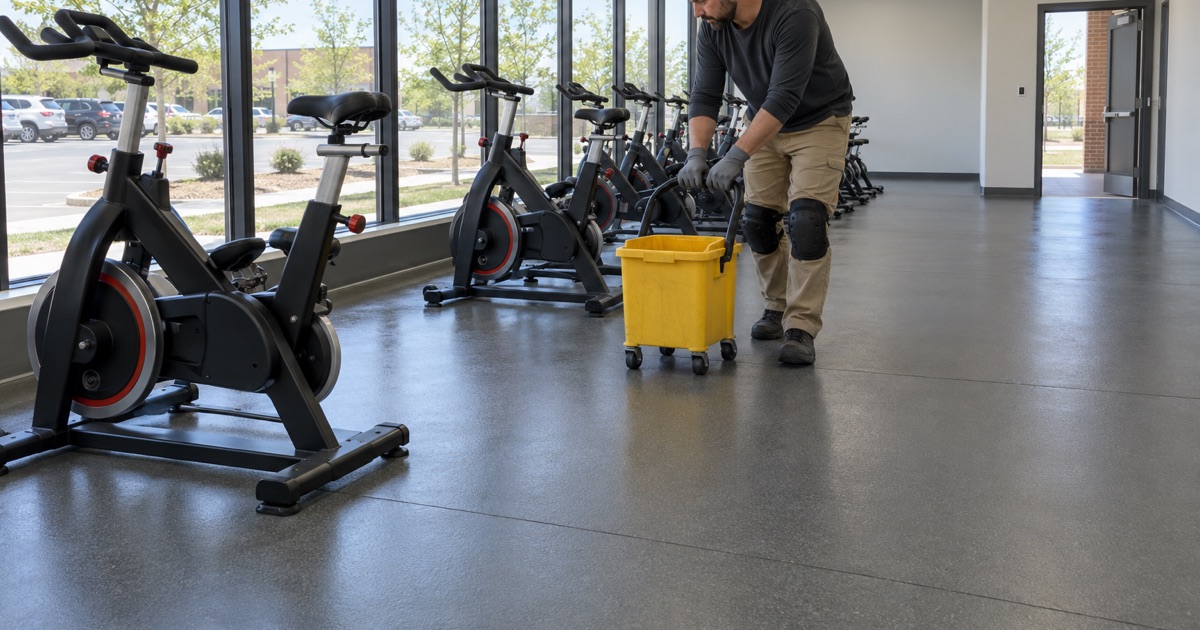
Indoor cycles in a class room are usually lined up in rows and rarely moved. A rider leaning over the handlebars for a full class sheds sweat in a predictable band: off the face and forearms onto the floor in front of the crank, and down the frame toward the feet. The bike doesn’t shift between sessions, so the next rider drips into the same spot.
On concrete, that repetition matters more than the volume of any one class. A single puddle dries and is forgotten. The same patch wetted with salty water several times a day, then dried, then wetted again, is a different exposure, and bare concrete is porous enough to take some of it in each time.
What the Bike Makers Say About Sweat
Sunny Health & Fitness, in its maintenance guide for indoor cycle bikes, tells owners that the end of a workout “is an optimal time to wipe all the equipment down,” and warns that “sweat is very corrosive and may cause long-term trouble.” A BODY BIKE manual is blunter: “Wipe off the cycle after EVERY use.”
Those statements are about bike parts such as seat posts, handlebar posts and chain guards. They are not floor tests, and we don’t treat them as proof of anything about epoxy. What they do tell a floor owner is that the people who build these machines consider sweat something to remove every time, not something to let sit.
Looking for epoxy-flooring closer to Summit? See Summit Epoxy-Flooring.
Wipe-Down After Every Ride, Mopping Every Day
The Cleaning Is Part of the Load
A room following the bike makers’ advice gets a wipe-down after every ride. Sweat, plus whatever spray or cleaner the wipe uses, runs off seats and frames and lands on the floor below. The floor is then mopped at the end of the day, which spreads water and cleaner across the whole area, including the ground under each bike.
That is a lot of wetting for one floor to take. Any surface in a cycling room has to handle both the drip and the cleaning that follows it, and the cleaning is the part that happens every single day whether the room was busy or not.
Mats Treat the Symptom
Retail trainer mats are sold to keep “sweat and grease” off the floor and to stop scuffing of hard surfaces. That is a reasonable idea for one bike in a spare room. Under a row of cycles, though, mats bring their own problems: edges that curl, moisture held between rubber and concrete, and seams that collect what drips off the sides.
A mat moves the question rather than answering it. Whatever lands beside or under the mat still reaches the slab, and nobody lifts a dozen mats every evening to mop beneath them.
Slip Resistance on a Wet Floor
A freshly mopped floor and riders stepping off pedals in damp shoes is a slip risk. On every coated floor we specify slip resistance through the broadcast and topcoat used, such as a fine quartz aggregate broadcast locked under a polyaspartic or urethane topcoat, rather than promising it as a word on a brochure. The texture also has to stay cleanable, because a surface too coarse to mop defeats the point of sealing it.
Sealed and Seamless Under a Bike Row Versus Bare Concrete
Why Bare Concrete Holds On to Sweat
Bare concrete is porous, and open joints are worse. Sweat carries salts, and when it soaks into an unsealed slab and dries, our reading is that those salts and the odor that goes with them stay in the pores, where a mop can’t reach them. No floor test of sweat on concrete sits behind that; it is reasoning from how porous surfaces behave, and we present it that way.
Sawn control joints and cracks in a bare slab catch the runoff from mopping too. Over time they turn into lines of darker concrete running right under the bikes.
What a Sealed, Seamless Floor Changes
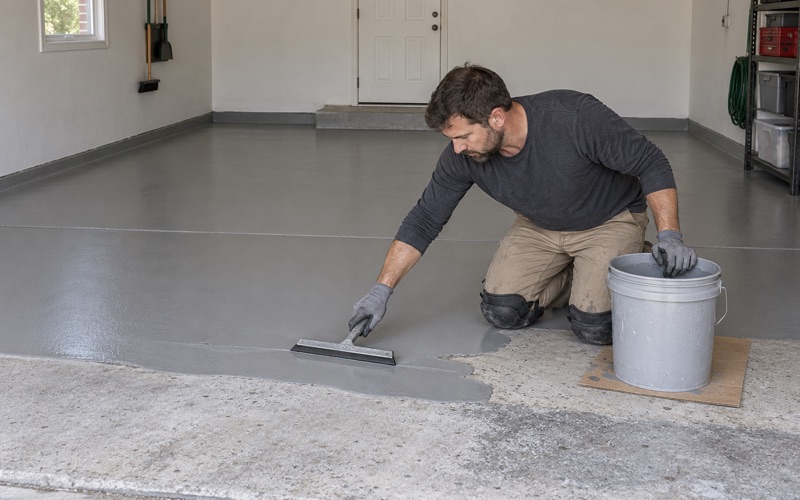
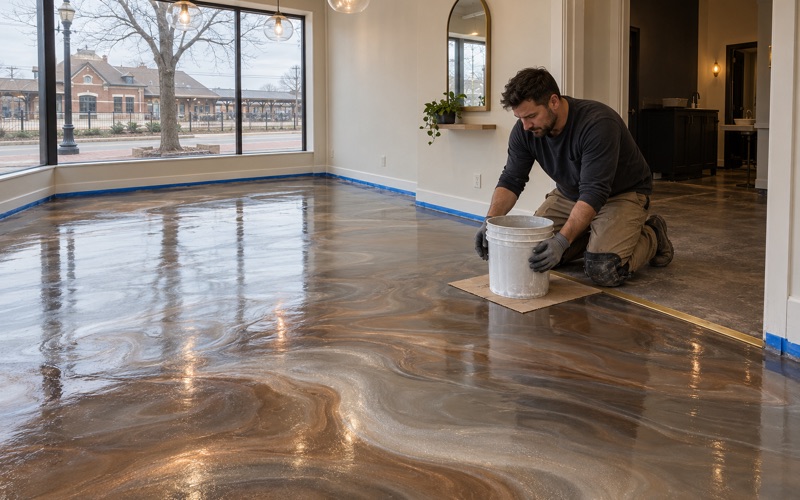
A coating closes the surface. A seamless floor under a bike row, ground, primed, built up in 100% solids epoxy and finished with a polyaspartic or polyurea topcoat, keeps the drip and the daily mop water on top, where they can be wiped away. It does not sanitize anything and is not a disinfecting surface; it simply gives the cleaning crew a floor where what they remove actually leaves.
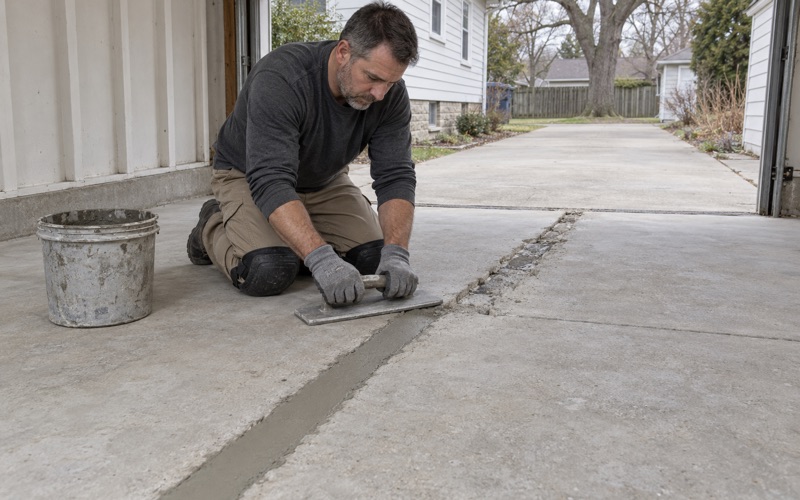
Joints are a decision rather than an afterthought. Where a joint has to keep working, we fill it with a flexible caulk-type material, typically polyurea, rather than packing it solid with rigid epoxy, which risks the joint cracking through the floor. That keeps the surface continuous to the eye and the mop while letting the slab move.
Preparing a Slab That Has Already Taken Years of Drip
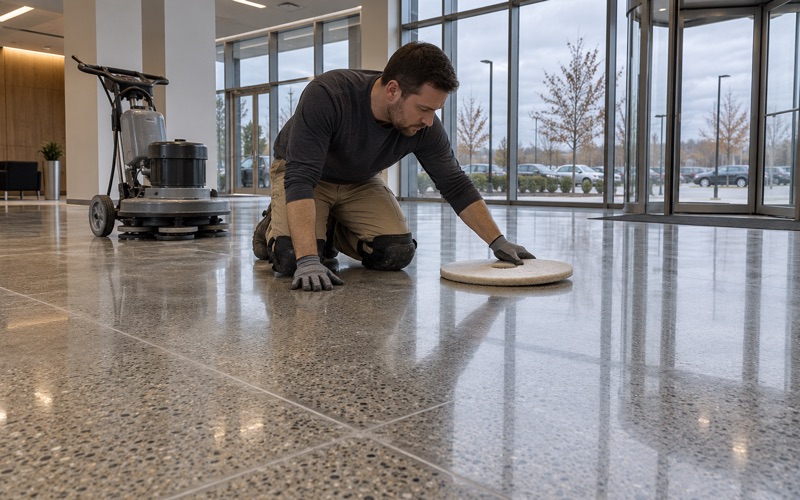
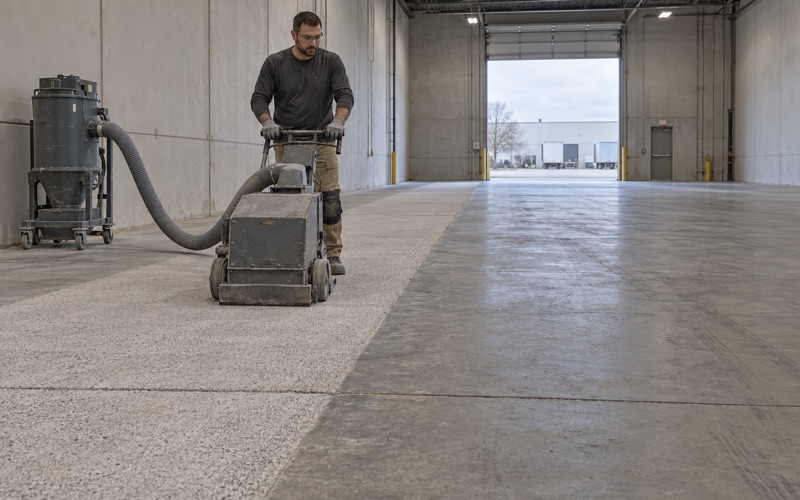
An existing gym slab often arrives stained, sealed with something unknown, or carrying an old coating. We map cracks, spalls and failing coatings first and say plainly when a slab needs repair before it should be coated. A diamond grinder or shot blaster, never an acid etch, opens the surface to the ICRI concrete surface profile the system calls for, and the dust is captured at the machine with a vacuum instead of being washed toward a drain.
Moisture comes next. We run ASTM F1869 calcium chloride tests or ASTM F2170 in-situ relative humidity probes before the price is final, and if the readings call for it, a moisture-mitigation primer goes into the scope. Moisture is also the first exclusion we name when we explain what a coating warranty leaves out.
Working Around Opening Hours
A club open from 5:00 a.m. on weekdays cannot hand over a room for a week. Commercial floors like that are phased around opening hours, with overnight and weekend windows when a space cannot close. Cure times follow slab temperature and the dew point spread at the slab surface, not a calendar promise, so the room goes back into service when the floor is ready rather than when a schedule says it should be.
An Exercise Bike or Rower on a Lyons Basement or Garage Floor
The Same Drip, One Machine at a Time
Lyons is a village in Cook County, home to the Chicago Portage National Historic Site, and most of its housing is single-family: 2,765 single-family detached units out of 4,390. Plenty of those homes have the kind of space people turn into a workout corner, an exercise bike in the basement or a rower parked against the garage wall.
The physics are the same as a class room, just smaller. The machine sits in one spot, the rider drips in one spot, and the floor gets wiped or mopped in one spot. A trainer mat helps; a sealed floor under the whole corner helps more, because the drip that misses the mat still has nowhere to soak in.
Older Slabs and Basement Moisture
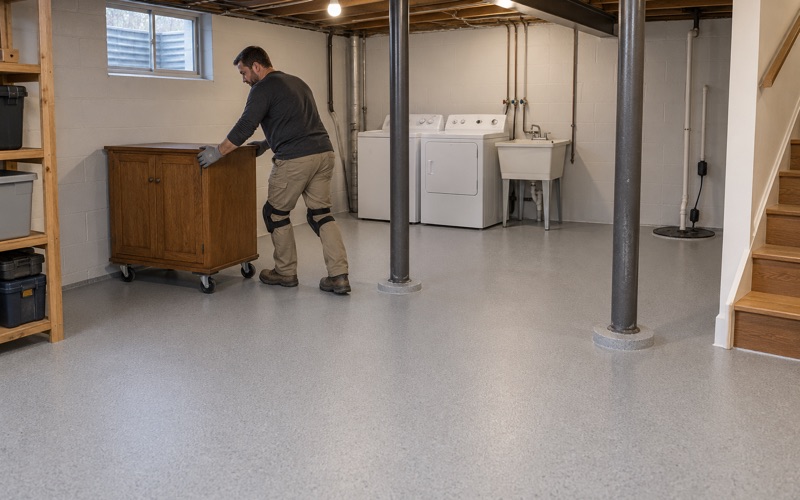
Lyons has 1,131 housing units built in 1939 or earlier and another 798 from the 1950s, so many of the slabs under these home setups are old concrete with no record of an under-slab vapor retarder. A basement is where moisture decides whether a coating lasts. We start with a moisture test, often an ASTM D4263 plastic sheet test as a first read followed by quantitative testing, and we tell a homeowner when a slab is pushing too much vapor for a standard system.
If a basement slab shows efflorescence or signs of hydrostatic pressure, the plan changes before any color chip is picked. A coating sealed over trapped moisture is the first kind of floor to fail, and we would rather say so at the estimate than at a warranty call.
Garages That Double as Gyms
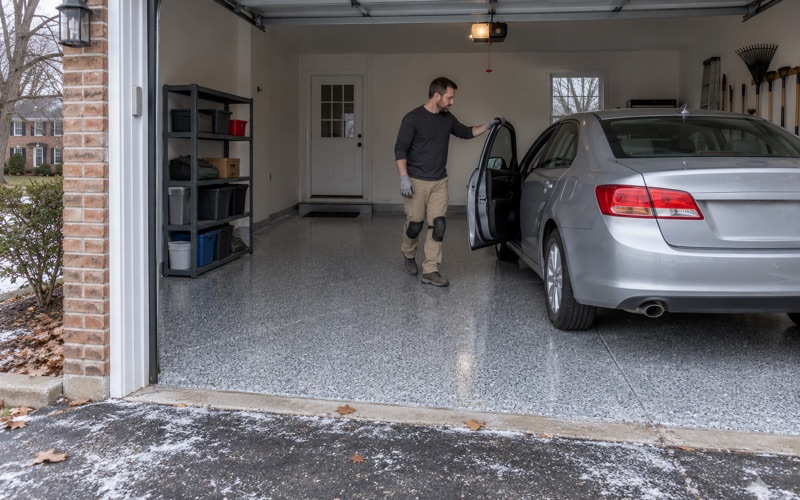
A garage gym has two jobs. In summer it holds a bike and a rower; in winter it also holds cars that bring in brine and rock salt on their tires. We pick garage systems for that salt load first, so the same floor handles sweat in July and deicer slush in January. Cure in an unheated garage follows the slab’s temperature, and in deep winter that sometimes means telling the owner to wait.
For home jobs over the state threshold, a written contract and the Illinois Home Repair: Know Your Consumer Rights pamphlet come before any grinding starts, and the estimate spells out what the moisture readings showed. A homeowner should know what the floor is being built to handle before the first machine goes back on it.
- 20+ Years of Floor Work
- Moisture Tested in Writing
- Free Written Quotes