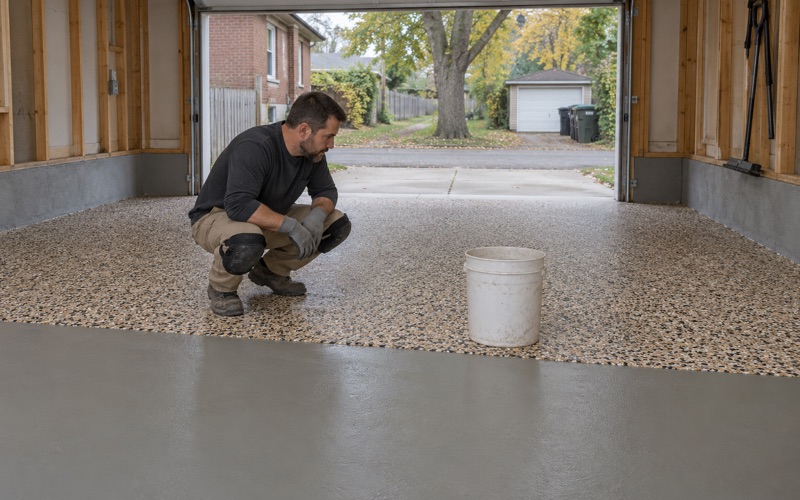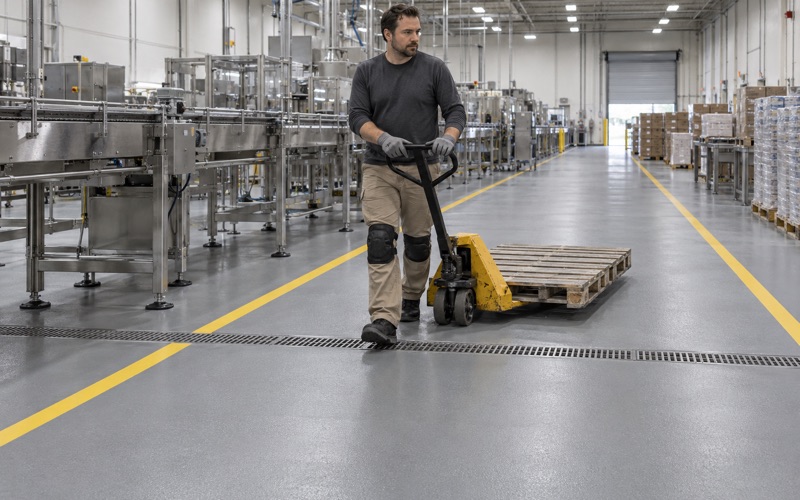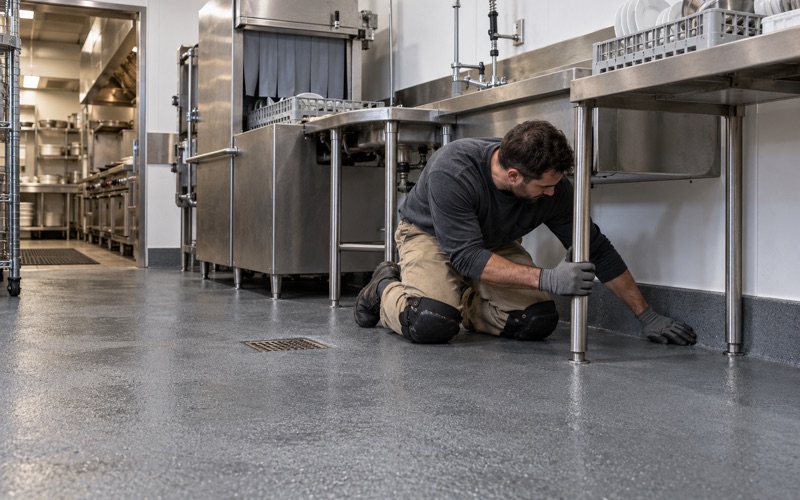
Downers Grove Epoxy Flooring brings more than 20 years of experience to epoxy flooring in Lemont, and the garages we coat here tend to share one overlooked weak spot: the lawn and garden corner. A garage slab carries cars, bikes and boxes, but it also carries the bag of fertilizer that was opened in spring and never quite closed. That bag matters more than most homeowners expect, because some fertilizer chemistry works on the concrete itself rather than just staining the surface.
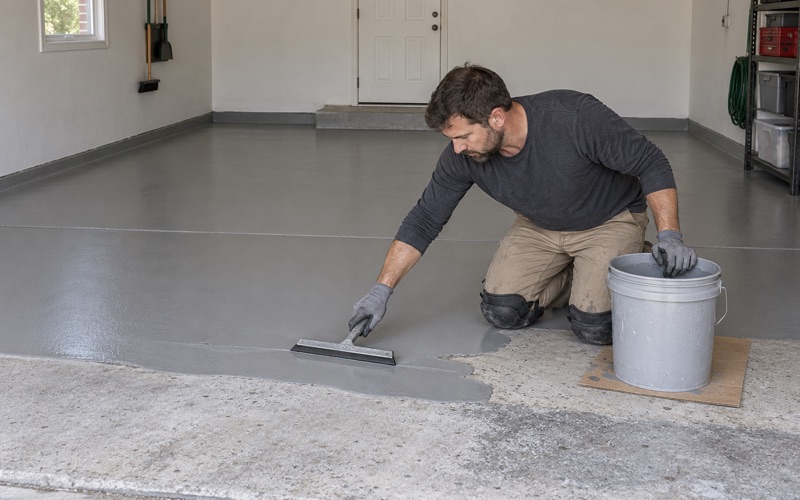
Our work starts with the slab, not the color chart. Every floor is opened with a diamond grinder or a shot blaster instead of an acid etch, and we map cracks, spalls and old coatings before we price anything. When a slab needs repair before it should be coated, we say so in writing, and the proposal names the product line, the number of coats and the finished thickness so you can check the finished floor against the quote.
This page explains what lawn fertilizer does to bare concrete, why the damage is slow and easy to miss, and how a sealed floor plus a few storage habits keeps a garden corner from becoming the weakest patch of slab in the garage.
A State Street Lawn and Garden Aisle, and the Bag That Comes Home
Lemont Ace Hardware at 1096 State Street
Lemont Ace Hardware stands at 1096 State Street, next to Chipain’s Fresh Market, in the part of the village that lies in Lemont Township, Cook County. Local reporting in November 2012 described electricians finishing the lighting and shelving going in ahead of a targeted December 17, 2012 opening. The store is a franchise of Dan and Pattie Harris, who also own Palos Ace Hardware in Palos Heights.
The building has changed hands before. The site once held a True Value hardware store and then a short-lived sports complex called The Swing, before the current store moved in. Ace describes the location as serving grill, hardware, home improvement, lawn and garden, and tool needs.
We have no connection to the store, and we have not seen how it stocks or shelves anything. We mention it because it is exactly the kind of place where a Lemont homeowner picks up spring lawn food, loads it into the trunk and carries it straight to the garage.
Why the garage is where fertilizer ends up
Fertilizer is bought in bulk and spread a few times a season, so it needs a home that is dry, close to the spreader and out of the house. In most Lemont homes that means a corner of the garage, usually beside the mower, the grass seed and the potting mix. The bag sits directly on bare concrete for months, and nobody looks underneath it until the corner is cleared.
Lemont’s housing is overwhelmingly owner-occupied single-family homes, detached houses and townhomes alike, and their garages often double as the garden shed. That makes the garden corner one of the most common storage spots in the village, and one of the easiest to treat as shelving space rather than part of the floor.
Looking for epoxy-flooring closer to Brookfield? See Epoxy-Flooring in Brookfield.
What Ammonium Fertilizer Does to the Paste in Concrete
The chemistry in plain terms
Concrete holds together because cement paste binds the sand and stone, and that paste is alkaline and rich in lime. Ammonium-based fertilizers, ammonium nitrate and ammonium sulfate among them, react with the paste once they get wet. The ammonium draws lime out of the paste, and what remains is weaker and more open to whatever comes next.
Ammonium sulfate brings a second problem along with the first. A University of Manitoba thesis describes ammonium sulfate, commonly used as a fertilizer, as extremely deleterious to concrete because it combines acid attack with sulfate attack. Both reactions need moisture, and a damp bag or meltwater pooling around spilled granules is enough to supply it.
What the laboratory tests found
Researchers Wong, Asrah, Rahman and Mannan, writing in 2013, opened their paper with a blunt observation: the storage of chemical fertilizers in concrete buildings often leads to durability problems due to chemical attack. They exposed concrete to a 20 percent ammonium nitrate solution and tracked what happened as leaching went on.
The results moved in one direction. The pH fell, porosity rose, compressive strength dropped, and the depth of degraded concrete grew with leaching time. They also found that the stronger of the two concrete mixes they tested held up better than the weaker one, which fits a general rule of concrete work: a dense, sound surface resists chemical attack longer than a soft one, though no bare slab is immune.
Why a lab bath is not a garage floor
A laboratory solution is far harsher than a scatter of granules on a garage floor, and we never put a rate, a depth or a timeframe on fertilizer damage at home. The value of the study is direction, not speed. It shows which way a damp patch of fertilizer pushes the concrete beneath it, and that alone is reason enough to keep the two apart.
It also explains why the damage is so easy to miss. Nothing about a bag of lawn food looks corrosive, and the floor under it does not change overnight. By the time anyone notices, the paste in that one spot has usually been working against moisture and ammonium for a long while.
Damp Bags, Spilled Granules and a Floor Built to Shrug Them Off
Slow, local damage
Fertilizer damage on a garage floor rarely looks dramatic. It shows up as a rough, pale patch where a bag stood, or as light pitting where granules rolled under a shelf and sat in meltwater dripping off a car. Because the damage stays in one place and develops slowly, homeowners usually find it only when they move the bag or clear the corner for a new floor.
When we map a slab before quoting, the garden corner gets the same attention as a crack or a spall. Softened paste has to come off before anything goes on, because a coating bonded to weakened concrete is only as strong as the layer underneath it.
Preparing the corner before coating
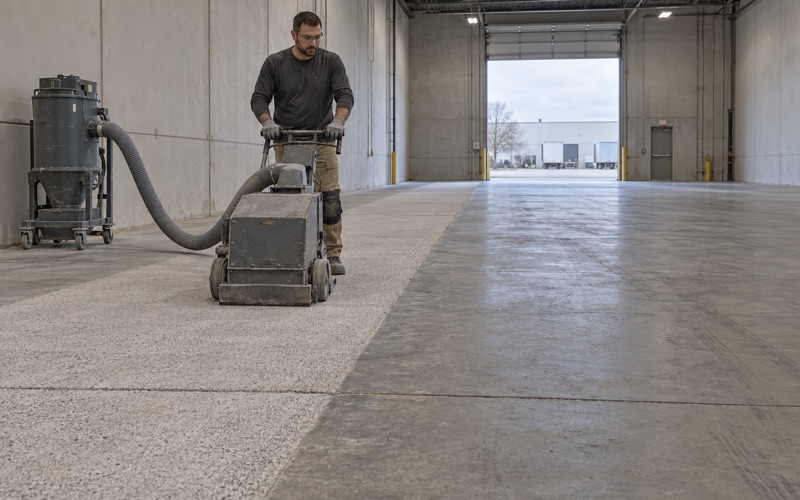
Our diamond grinders and shot blasters cut through to sound concrete and leave a profile on the ICRI CSP scale that the primer can grip. Over a fertilizer-damaged patch, that can mean grinding deeper in one area or patching it before the full floor is coated. Grinding dust is captured at the machine with a vacuum rather than rinsed toward a floor drain or out the garage door.
A moisture test is written into the scope before the price is final. Depending on the slab, that may be an ASTM F1869 calcium chloride test, ASTM F2170 in-situ relative humidity probes, or an ASTM D4263 plastic sheet test as a first read. Moisture is also the first warranty exclusion we name, and we walk through what else a coating warranty leaves out before the job is sold.
What a sealed floor changes
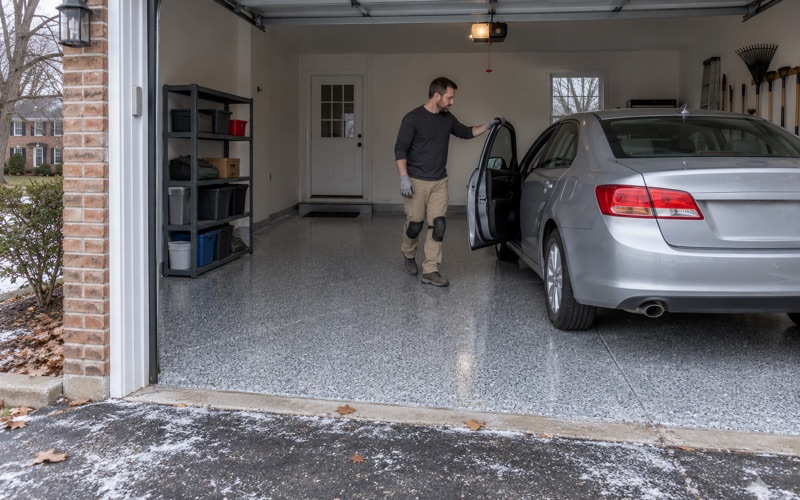
A 100% solids epoxy base under a polyaspartic topcoat puts a continuous, non-porous layer between the slab and anything that lands on it. Spilled granules sit on top of the coating instead of dissolving into the paste, and they sweep up without leaving a mark behind. A vinyl flake or quartz aggregate broadcast adds texture, and we specify slip resistance by the broadcast and topcoat we use rather than by a slogan.
A coating does not make a floor indifferent to everything stored on it, and we do not sell it that way. What it does is turn a slow, invisible chemical problem into a simple housekeeping one, which is far easier to stay ahead of.
Lawn Bags, Spreaders and Seed in Lemont Garages
Keeping bags off bare concrete
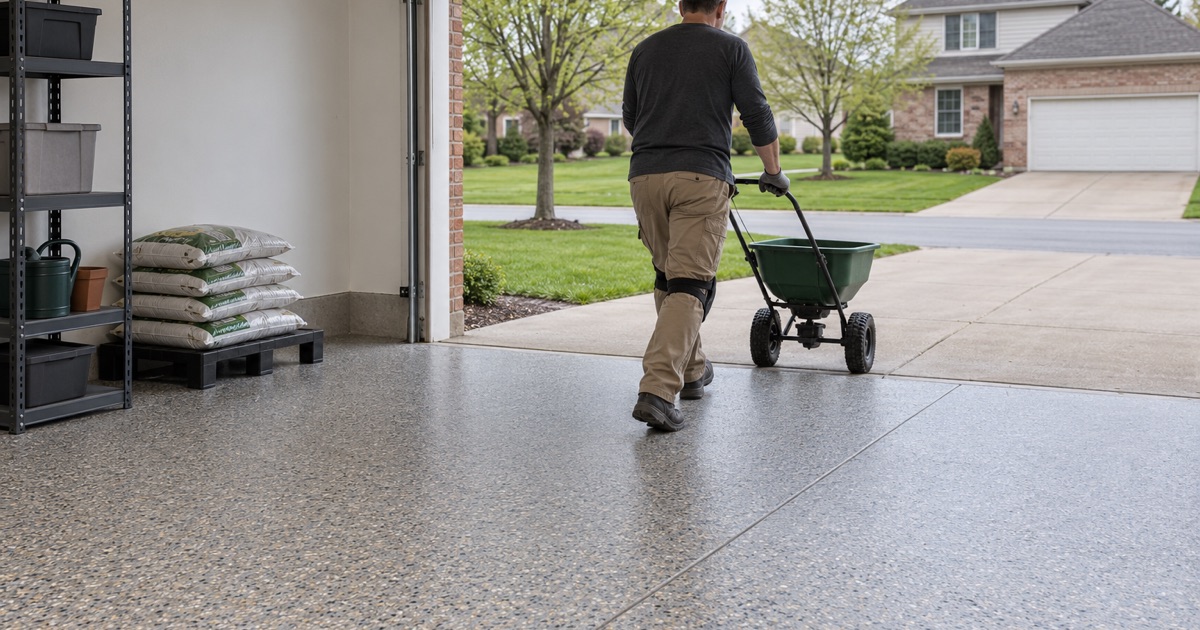
Whether a floor is coated or not, fertilizer bags belong off bare concrete. A lidded plastic tote, a sturdy shelf or a low pallet keeps the bag dry and keeps any leakage away from the slab. The same reasoning holds in a store aisle and in a garage alike: fertilizer and bare concrete are poor neighbors anywhere moisture can bring them together.
When a bag tears or the spreader tips over, sweep the granules up dry before they meet water. Hosing them across the floor only dissolves them and spreads the solution into joints and cracks, which is the exact condition the laboratory work describes.
Planning the garden corner with you
When we coat a Lemont garage, we plan the garden corner with the owner before any grinding starts. We talk through where shelving will stand, whether the spreader comes back in with wet wheels, and where seed, soil and lawn food will actually live once the floor is done. Those answers shape how we detail that corner and how the broadcast is laid around it.
The mower and spreader usually share the same corner as the bags, and both track in grass clippings, soil and moisture. A coated floor makes all of that a matter of sweeping, but only if the storage plan keeps fresh fertilizer off the surface between cleanings.
Timing the work around the season
Lawn season and coating season overlap, so we schedule around both. Cure schedules follow slab temperature and the dew point spread at the slab surface rather than the calendar, and an unheated garage in deep winter is told to wait for better conditions. That way the garden corner is ready for the spring bags instead of fighting a coating that never fully cured.
Home jobs over the state threshold get a written contract and the Home Repair: Know Your Consumer Rights pamphlet before any grinding starts. Products are chosen inside the Illinois VOC limits for floor coatings, which bind the person applying them.
Who signs off locally
The Village of Lemont spans Cook, DuPage and Will counties, and its Building Department enforces a village building code that adopts the 2021 International Codes. We could not confirm the village’s contractor registration terms, so we check with the Building Department before starting a job. Illinois itself licenses no general, flooring or coatings contractor, which makes the written scope and contract the record you can rely on.
- 20+ Years of Floor Work
- Moisture Tested in Writing
- Free Written Quotes