Downers Grove Epoxy Flooring has spent more than 20 years on epoxy-flooring in La Grange and the rest of the western suburbs, and the jobs that teach the most are the rooms where the floor is part of a written rule. A pharmacy compounding area is one of them. Its floor gets cleaned and sanitized on a schedule, inspected against a checklist, and judged on whether it sheds, stains or soaks anything up.
That changes how we price and build a resin floor. The proposal names the product line, the number of coats and the finished thickness, so an owner can hold the finished room against the paper. The topcoat is chosen after we read the label on the sanitizer the staff actually uses, not before. And the slab is ground open with a diamond grinder or shot blaster first, never acid etched, because a coating that lets go at the edges turns into the particle-shedding surface the rules warn about.
Below is how that plays out for a small clinical or pharmacy space in La Grange, from the state rule down to the cure schedule.
A Compounding Pharmacy on Catherine Avenue and the Rule Behind Its Floor
A block off La Grange Road, at 12 N. Catherine Avenue, sits a pharmacy whose home page states plainly: “Ashland Health is a non-sterile compounding pharmacy.” It is open Monday through Friday from 8:30 a.m. to 4:30 p.m. The federal NPI registry lists the same address as a pharmacy with compounding marked yes. The address sits inside the village, in Lyons Township, Cook County. We have not worked there and have not seen that room or its floor; it is simply the clearest local example of a space Illinois writes floor language for.
What 68 Ill. Adm. Code 1330.640 brings in
Illinois pharmacy rules handle non-sterile compounding by reference. Section 1330.640 of 68 Ill. Adm. Code says that all nonsterile pharmaceutical compounding “shall be governed by the USP Chapter 795,” and subsection (e)(3) calls for “an area of the pharmacy used exclusively for compounding.” So the floor question is not about the whole store. It is about one dedicated area, which may be a back room, a partitioned bay or a corner of a former retail space.
The checklist every licensed pharmacy fills out
The Illinois Department of Financial and Professional Regulation publishes a Non-Sterile Compounding Self-Inspection Form, and every licensed pharmacy completes a self-inspection annually under Section 1330.800. The form reads USP 795 out item by item. Several of those items describe the floor, and a few more describe how the floor gets treated every working day. That is useful to an owner planning a fit-out, because the room will be read against the same list once the work is done.
Looking for epoxy-flooring closer to Westchester? See Epoxy-Flooring Services in Westchester.
Reading USP 795 Line by Line: Cleanable, Non-Porous, No Carpet
The floor lines in USP 795 use “should,” not “must,” and none of them names a material. Epoxy is not required, and no coating makes a pharmacy compliant on its own. What the lines do is describe a performance target, and a sealed resin floor is one practical way to hit it if the system is picked carefully.
The no-carpet line and the state of repair
Section 4.1, as quoted on the state form, says the compounding area is kept “in a clean, orderly, sanitary condition and in a good state of repair,” and “there should not be carpet in the compounding area.” Carpet is the easy part to remove. The harder part is what sits under it in an older building: patched concrete, adhesive residue, an old tile mastic or a thin skim of leveler. We map cracks, spalls and old coatings before quoting, and if the slab needs repair or replacement before it should be coated, we say so in writing rather than burying the problem under a fresh color.
Easily cleanable, not porous, not particle generating
Section 5 asks that “floors in the compounding area should be easily cleanable and should not be porous or particle generating.” Bare or merely densified concrete fails the porous test over time, and a worn paint or a chalking single-coat product fails the particle test. A 100% solids epoxy body coat closes the pores; the question is what goes on top of it. We look for a finish that will not chalk under daily wet cleaning and that stays tight at walls, thresholds and around fixed casework, where a floor usually starts to break down first.
Components off the floor
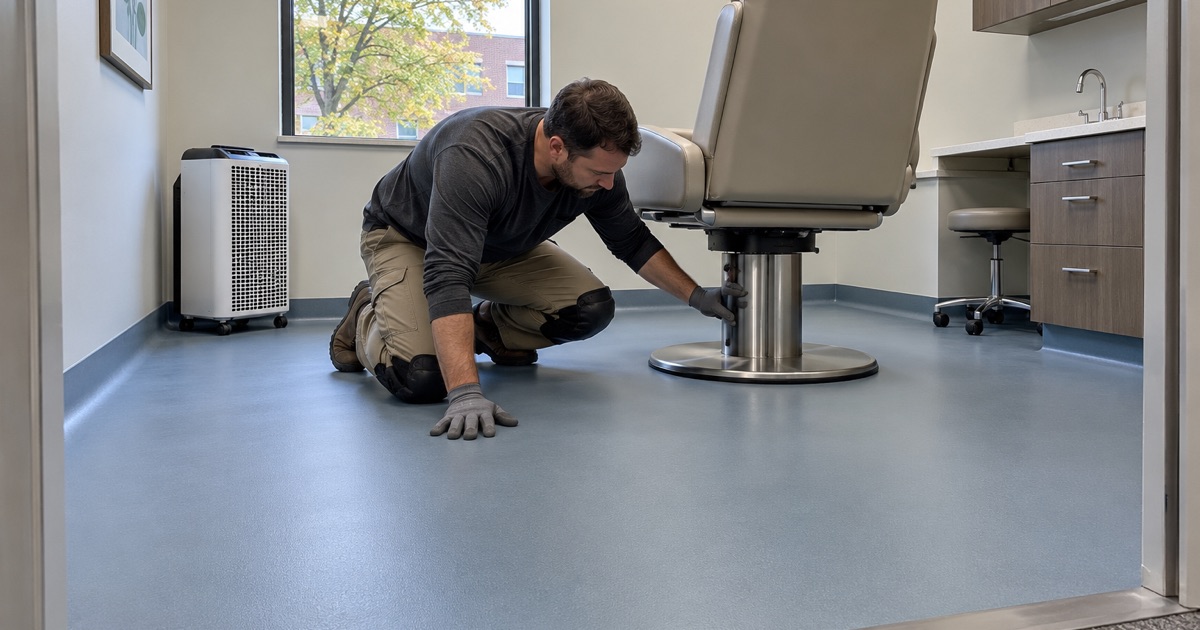
The form also expects components, containers and equipment to be stored off the floor, per section 4.2. That matters to us mostly as layout: shelving legs, mobile carts and a stool or two are what the floor carries, so a smooth, low-texture finish usually makes more sense here than an aggressive broadcast. Where a slip-resistant texture is wanted, we specify it by the aggregate and topcoat used, so the room is still easy to wipe.
Daily Sanitizing and the Topcoat That Has to Survive It
The same section 5 language says surfaces “should be resistant to damage by cleaning and sanitizing agents,” and it sets the schedule: floors cleaned and sanitized “daily on days when compounding occurs, after spills and when surface is contaminated.” When cleaning and sanitizing are separate steps, cleaning comes first. A floor in that room may see two chemical passes a day for years, which is a very different life from a garage floor that gets hosed off in spring.
Matching the finish to the label
There is no single best sanitizer-resistant topcoat in the abstract. Before a system is chosen, we ask for the product names of the detergent and the sanitizer the pharmacy uses, then check them against the coating maker’s chemical-resistance data. Epoxy topcoats, aliphatic urethanes and polyaspartic finishes each handle a given chemical differently, and a finish that dulls or softens under one product can shrug off another. If the staff later switches cleaners, that comparison should be repeated.
What wear looks like in a sanitized room
Chemical damage on a resin floor rarely announces itself as a hole. It shows up as a dull path where the mop runs, a tacky patch near the sink, or a fine powder on a dark cloth wiped across the surface, which is the chalking that turns a floor into a particle source. When an owner sees any of those, the fix is usually a fresh topcoat over a lightly abraded surface, not a new system, as long as the body coat underneath is still bonded. We walk the owner through those signs at handover so the annual self-inspection is not the first time anyone looks closely at the floor.
Why cleaning first matters to the coating
Cleaning before sanitizing is a pharmacy procedure, but it also protects the floor. Sanitizer applied over residue can leave a film that builds up, and staff then scrub harder or reach for a stronger product. A smooth, fully cured surface makes the first step faster, which keeps the second step working as intended.
Cure time is part of the schedule
A coating that is walked on, carted over or wiped with sanitizer before it has cured can stay soft or blush. Amine blush, the waxy film some epoxies form in cool, damp air, is wiped and checked before the next coat goes down, because a topcoat laid over it can fail to bond. We set cure schedules by slab temperature and dew point rather than the calendar, and we tell the owner the date the room can take its first full cleaning, not just the date it can be walked on. On a weekday-only operation, that often means starting the work at the end of a Friday and planning the first sanitizing pass for Monday only if the readings support it.
Fitting Out a Downtown La Grange Storefront for Health Care
Downtown La Grange centers on La Grange Road and the BNSF line, and much of the village around it is older stock: more than a third of the housing units were built in 1939 or earlier. A small pharmacy, therapy office or clinic moving into a storefront here is often inheriting a slab with an unknown past. That past drives the scope more than the finished color does.
Moisture first, then the price
An old slab on grade may have no vapor retarder under it at all. A moisture test is part of our written scope before the price is final, using ASTM F1869 calcium chloride readings or ASTM F2170 relative humidity probes depending on the slab. Older storefronts also hide a history of tenants, and a slab that once sat under a different use may carry oils or sealers that a grinder has to remove before any primer will bond. High readings point to a moisture-mitigation primer, and moisture vapor transmission is the first exclusion we explain in any coating warranty, before the job is sold.
Grinding without contaminating the room
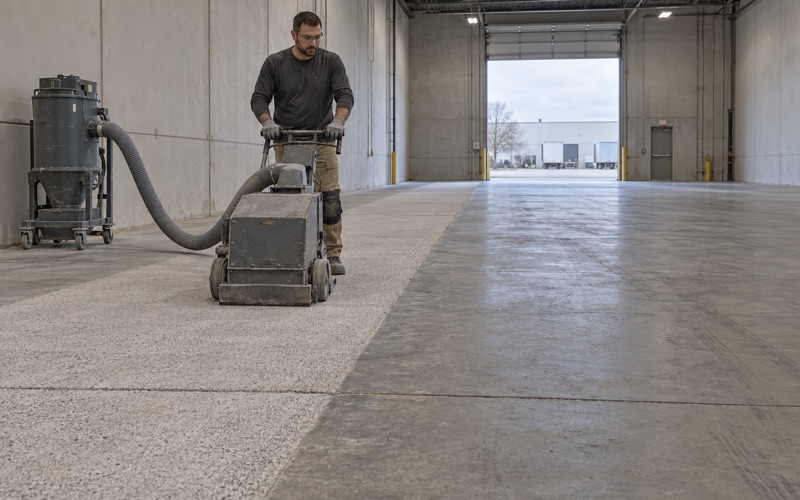
A room meant to be non-particle-generating should not start life full of concrete dust. We grind to a measured ICRI concrete surface profile with the vacuum attached at the machine, so the dust is captured rather than swept or rinsed toward a drain. Neighboring tenants in a shared building notice that, too.
Permits and phasing
The Village of La Grange issues its own building permits, and its permit page lists replacing existing flooring among the jobs that need no permit; the page does not mention floor coatings at all. Community Development, at (708) 579-2320, can confirm what a larger fit-out triggers. Because a health-care tenant often cannot close for a week, we phase the work around opening hours, using evenings and weekends. Every product we bring in sits inside the Illinois VOC limits for floor and industrial coatings, which bind the applicator as much as the manufacturer.
Edges, thresholds and the dedicated area
Because the rule asks for an area used exclusively for compounding, the coated floor often covers one room and stops at a doorway into ordinary retail space. That line deserves a planned edge: the coating is ground into a shallow keyway or terminated under a threshold strip, rather than feathered out where carts will catch it and start a peel. Walls get the same attention, since the joint between the floor and the base is where cleaning water sits and where a lifted edge first starts to shed. We note those terminations on the proposal so the owner knows where the system begins and ends.
- 20+ Years of Floor Work
- Moisture Tested in Writing
- Free Written Quotes