Downers Grove Epoxy Flooring has spent more than 20 years on epoxy-flooring in Justice and the surrounding suburbs, and the floors that teach the most are the ones that carry something heavy and precise. A machine shop or a garage headed for a car lift asks a different question of its concrete than a parking stall does. The coating is the last layer, but the decisions that matter are made in the slab underneath it.
That is why our process starts with a map rather than a color chart. Before anything is ground, we walk the floor and record every saw cut, expansion joint, crack, spall and patch, along with the old coatings that have to come off. When a slab needs repair or replacement before it should be coated, we say so in writing instead of covering the problem.
The proposal that follows names the product line, the number of coats and the finished thickness, so the floor you get can be measured against the floor you were quoted. A moisture test is part of that written scope, not an add-on after the price is set.
Machine Shops on South 86th Court and the Slab They Stand On
Justice is a village of small businesses rather than big plants, and its industrial streets show it. South 86th Court is a short run of working buildings, and one of them belongs to E.C. Machining, a CNC machine shop at 8267 S. 86th Court that has made precision components since 1981, with gear cutting, welding and sheet metal work done in house. We have never worked on that shop’s floor and have not seen its machines; it simply shows the kind of work this street does.
Why a machine tool cares about concrete
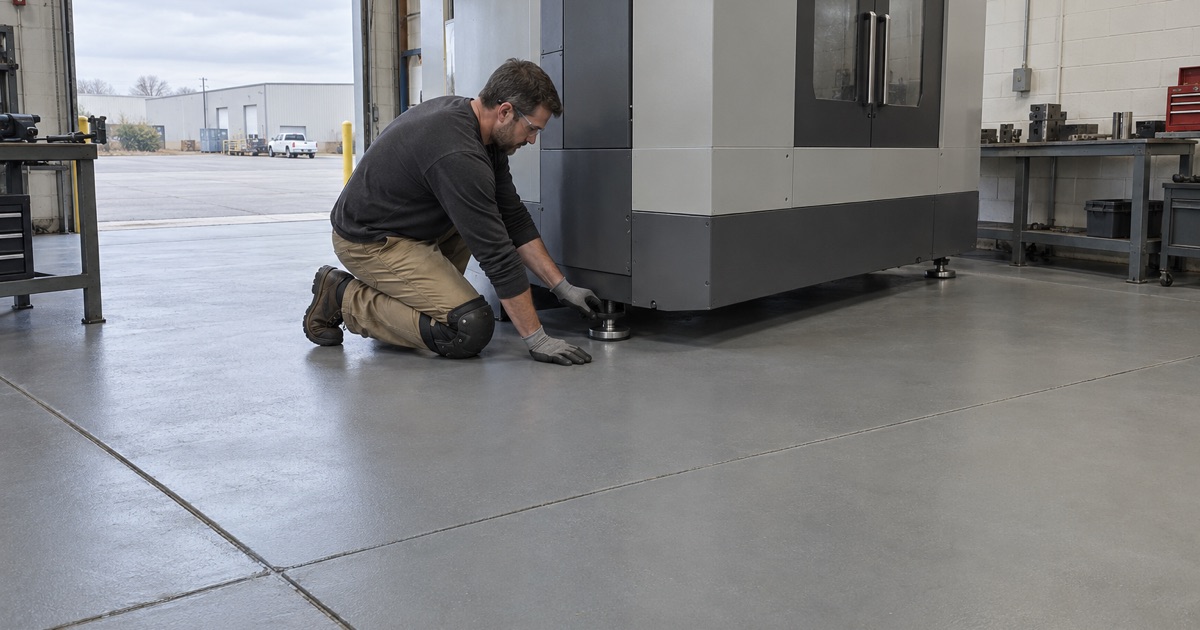
A CNC machine is a heavy precision instrument. Its accuracy depends on the frame staying true, and the frame is only as steady as the slab under its leveling feet. If two pieces of concrete move differently beneath one machine, the geometry the operator set up drifts with them.
That is the point most floor-coating conversations miss. To a machine maker, the concrete is structure. The coating on top is a cleanable, chemical-resistant skin, and it does nothing to change how the slab carries load.
What a machine maker asks for
Haas publishes pre-installation guidance for several of its machine series, and the requirements are plain. The machine goes on a continuous slab poured directly on grade, with concrete rated at 3,500 psi. Machines must not be placed across expansion joints or cracks, and the leveling feet sit at least 12 inches from the edge of the slab.
An older Haas installation manual adds the reason in practical terms: the 6-inch concrete floor of a typical industrial building is generally suitable, but a machine set across two slabs may see them shift and throw off its geometry. A shop floor coating has to be planned with that rule in view, not in spite of it.
Looking for epoxy-flooring closer to Lyons? See Epoxy-Flooring Services in Lyons.
Never Across a Joint or a Crack
The same rule turns up in a very different trade. Vehicle lift makers write their concrete requirements with the same caution machine builders do, and they are just as specific about where steel can and cannot go into a slab.
What BendPak puts in writing
BendPak’s concrete foundation requirements for its lifts, revised in February 2025, read almost like a warning label. A lift is never to be installed over concrete expansion or control joints of any kind, and every anchor must sit at least 6 inches away from expansion seams, control joints or other inconsistencies in the concrete. Damaged or defective concrete is off the table entirely.
For an existing floor, the document requires a core sample and test to confirm the concrete reaches 3,000 psi. It also says the floor must be test drilled to determine the actual thickness, and it lists 4.25 inches as the minimum for most two-post and four-post models, with heavier two-post models calling for 6 or 8 inches. It warns never to drill or cut a post-tensioned slab.
The problem a coating creates
Here is where our work and those requirements meet. A fresh coating, especially a full-broadcast vinyl flake or quartz aggregate system, hides exactly the things those rules tell you to avoid. Once the floor is one continuous color, a hairline crack or a filled control joint can disappear from view.
That makes the order of work important. If a lift installer or a machine rigger arrives after the coating is done, they may be drilling blind. A coating adds no thickness, strength or anchoring capacity a lift or a machine can count on, so nothing about the finished surface tells them where it is safe to set a post or a foot.
Map the Slab, Fix the Layout, Then Coat
In a shop or a garage that will hold equipment, we treat the layout as part of the floor scope. The goal is simple: by the time the topcoat cures, everyone should already know where the machines or the lift posts will stand and that those spots avoid joints and cracks.
Recording what is there
Our first visit produces a drawing of the slab. Expansion joints, saw-cut control joints, cracks, old patches and any slab edges are measured and marked, along with spalls and areas of failing coating. That record goes to the owner and, if the owner wants, to whoever is planning the equipment.
We also test for moisture before the price is final, using ASTM F2170 in-situ relative humidity probes or ASTM F1869 calcium chloride testing depending on the slab. Moisture is the first warranty exclusion we name, and we explain the others before the job is sold rather than after a problem appears.
Settling the layout before the first coat
With the map in hand, the owner and their equipment people can decide where a machine or a lift goes while the joints are still visible. We cannot tell anyone a slab is strong enough or thick enough, because that answer comes from the test drilling and core testing a lift maker requires, done by others. What we can do is make sure the coating does not erase the information they need.
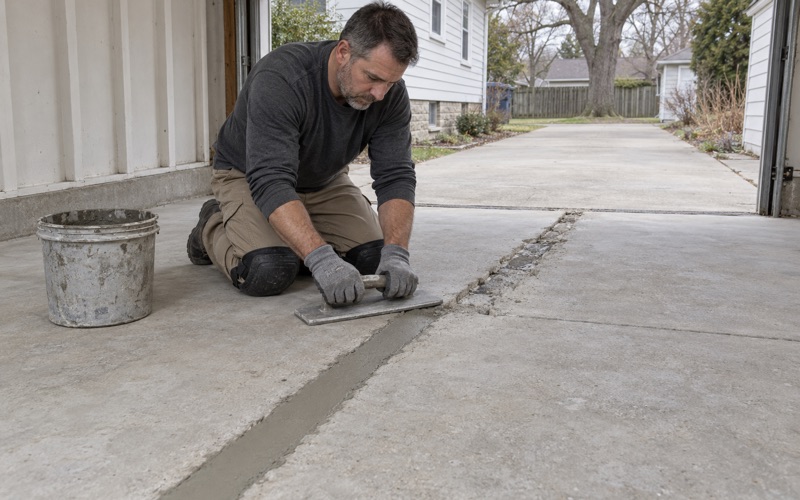
In practice, that means the joints are honored through the coating so they stay visible as lines in the finished floor, rather than being filled flush and painted over. Any anchor holes drilled later then go into spots that were already chosen on known, sound concrete.
Preparing and coating the floor
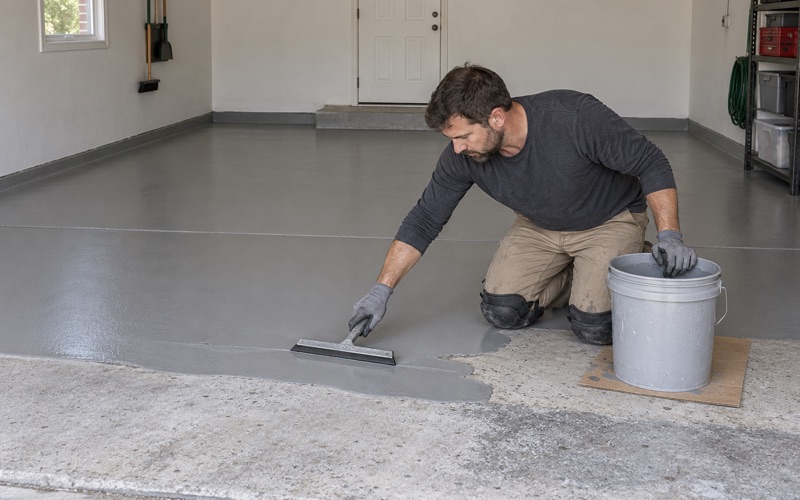
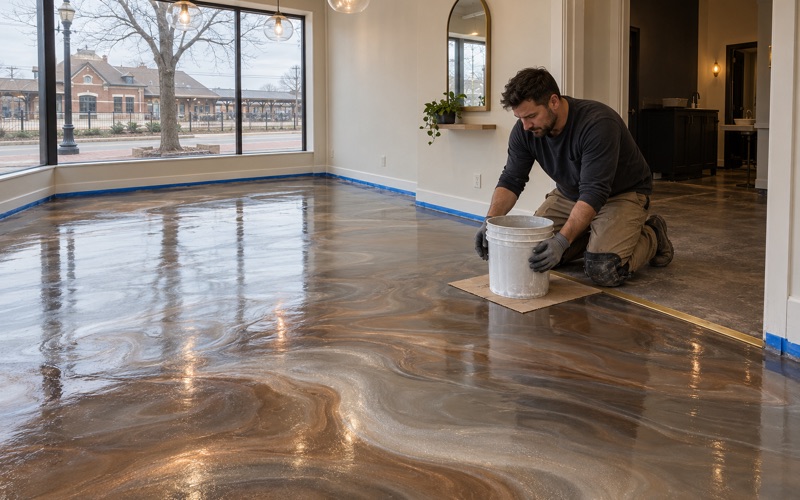
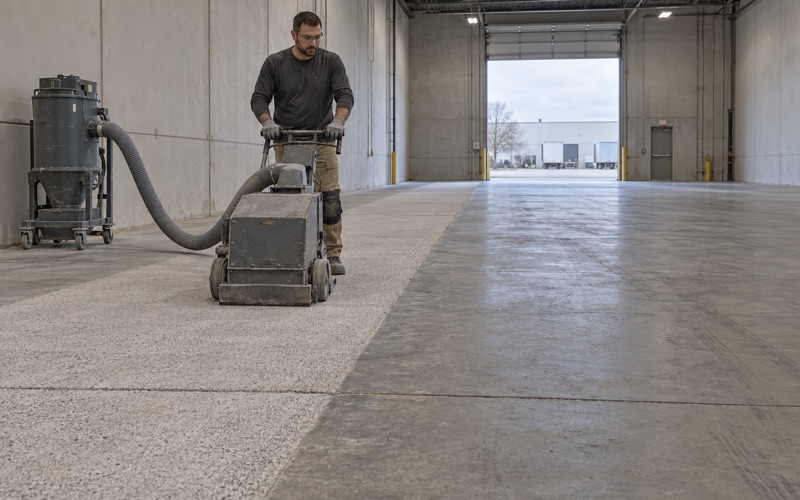
Every slab is opened with a diamond grinder or a shot blaster to a measured ICRI concrete surface profile, never an acid etch. The grinding dust is pulled into a vacuum at the machine instead of being rinsed toward a floor drain. On a shop floor we typically build with a 100% solids epoxy and finish with a polyaspartic or polyurea topcoat chosen for the fluids and traffic the room sees.
Cure time follows the slab temperature and the dew point spread at the surface, not a calendar date. A shop that cannot shut down for long gets a schedule built around its working hours, so the floor is ready before equipment rolls back across it.
A Car Lift in a Justice Garage
The same logic applies at home, and it may matter more there, because a residential garage was rarely poured with a lift in mind. Justice has a wide range of housing, much of it built from the 1960s through the 1990s, and the garage slabs that came with it vary in age, thickness and condition.
Test drilling comes first
If a lift is on your list, even for next year, the order of operations is the most useful thing we can give you. The lift maker’s own document says to test drill the floor to find the actual thickness and to confirm strength with a core test. Those steps belong to the lift installer and happen before any coating decision is made final.
Once the posts or the runways have a planned location clear of every joint and crack, we can coat the garage around that plan. If the test drilling shows the slab is too thin, the honest answer may be a new pour, and in that case we point you to the village rules for concrete work before anyone quotes a coating on it.
Permits and paperwork in the village
Justice runs a Contractor’s Work Permit Program through its Building Department on West 82nd Place, and contractors working under a permit must be registered and bonded with the village before a permit issues. Concrete work is a listed permit item and also calls for a plat of survey. Illinois does not license flooring or coatings contractors, so that village registration is the credential that applies here.
On a home job above the state threshold, you receive a written contract and the Illinois Home Repair: Know Your Consumer Rights pamphlet before any grinding begins. The contract states the system, the coats and the thickness, the same way it would for a shop.
What the finished garage floor does and does not do
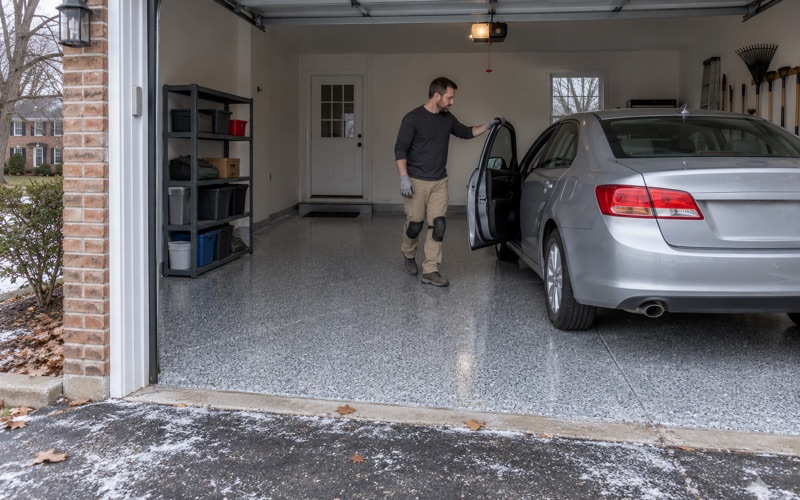
A coated garage in Justice has to survive winter brine and rock salt on the tires, so we choose systems that resist both and specify slip resistance by the broadcast and topcoat rather than promising it. Hot tire pickup and amine blush are prevented by the right products and the right cure conditions.
What the coating will not do is make a floor ready for a lift. It does not repair a crack, add thickness or hold an anchor. It gives you a clean, durable surface over concrete that has already been checked, and the joint lines you can still see tell you where not to drill.
- 20+ Years of Floor Work
- Moisture Tested in Writing
- Free Written Quotes