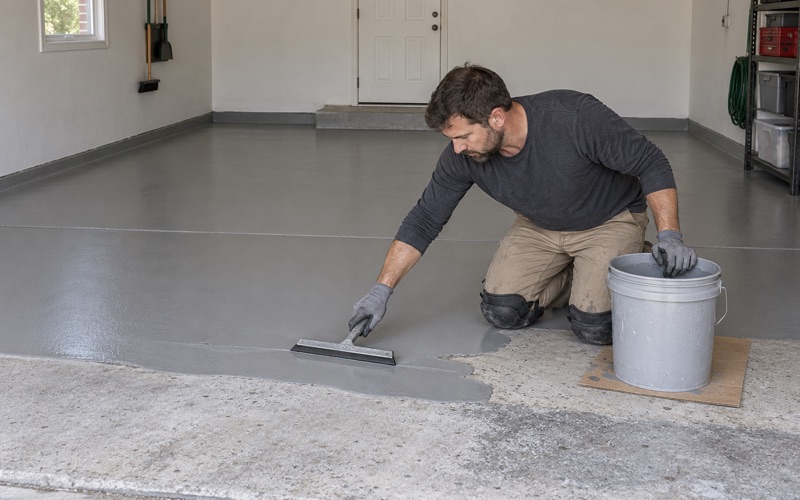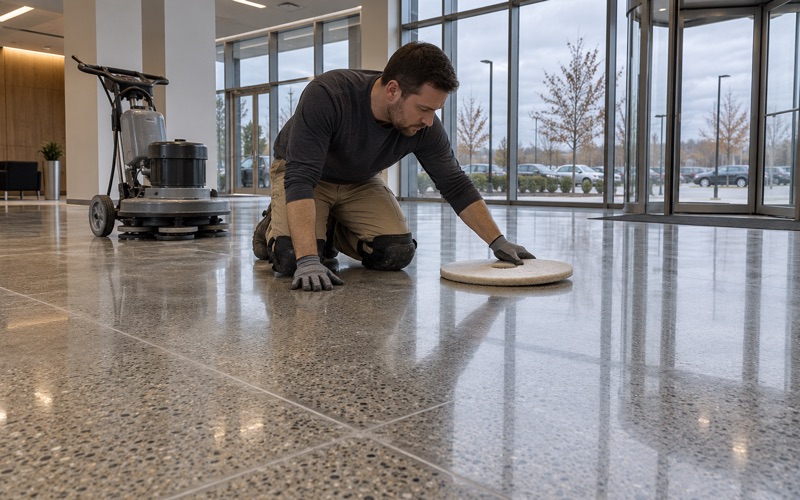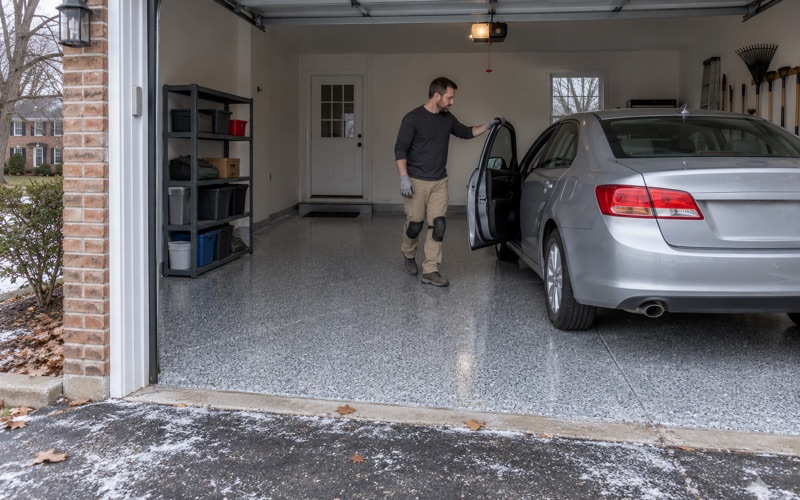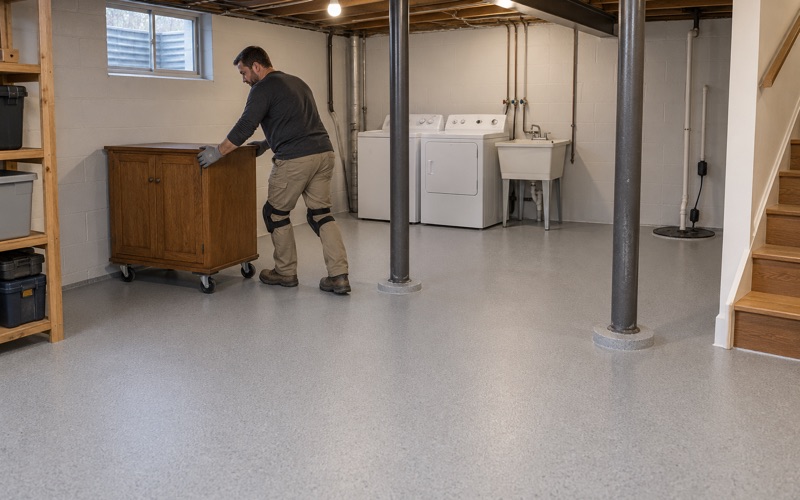
Downers Grove Epoxy Flooring has spent more than 20 years on epoxy flooring in Hinsdale, and most of that work is ordinary in the best sense: garages, basements, shops and commercial back rooms where a coating has to grip, wear well and clean up. A smaller share of jobs starts with a different question. When the room beside the slab holds people or work that reacts to the air, the coating is judged by what it releases while it hardens, not only by how tough it is once it has.
That changes the order of the conversation. Before we talk about color, flake or gloss, we ask who shares the air with the floor, how the space is ventilated and how long it can stay closed. The answers decide whether the job gets a solvent-free system, how the cure and airing-out time are written into the schedule, and occasionally whether the room should get a resin floor at all.
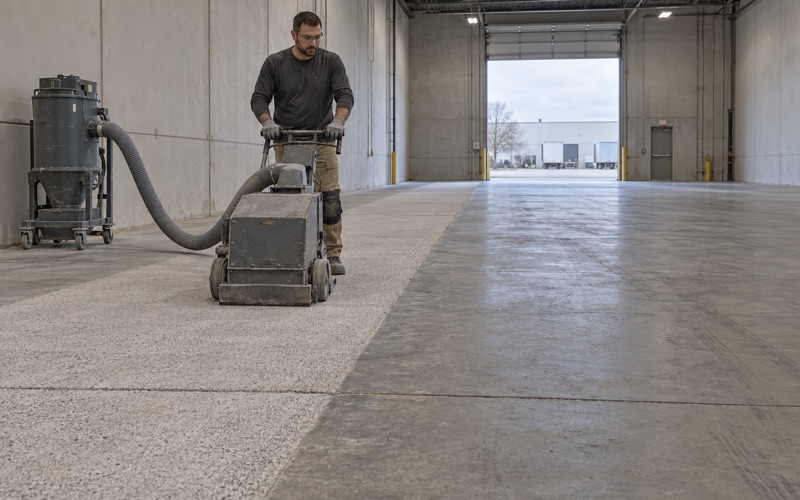
Our proposals name the product line, the number of coats and the finished thickness, so a facility manager or homeowner can check the finished floor against the paper. The slab is opened mechanically, and the dust is pulled into a vacuum at the machine instead of drifting through the building.
An Accredited Gamete Laboratory on North Elm Street
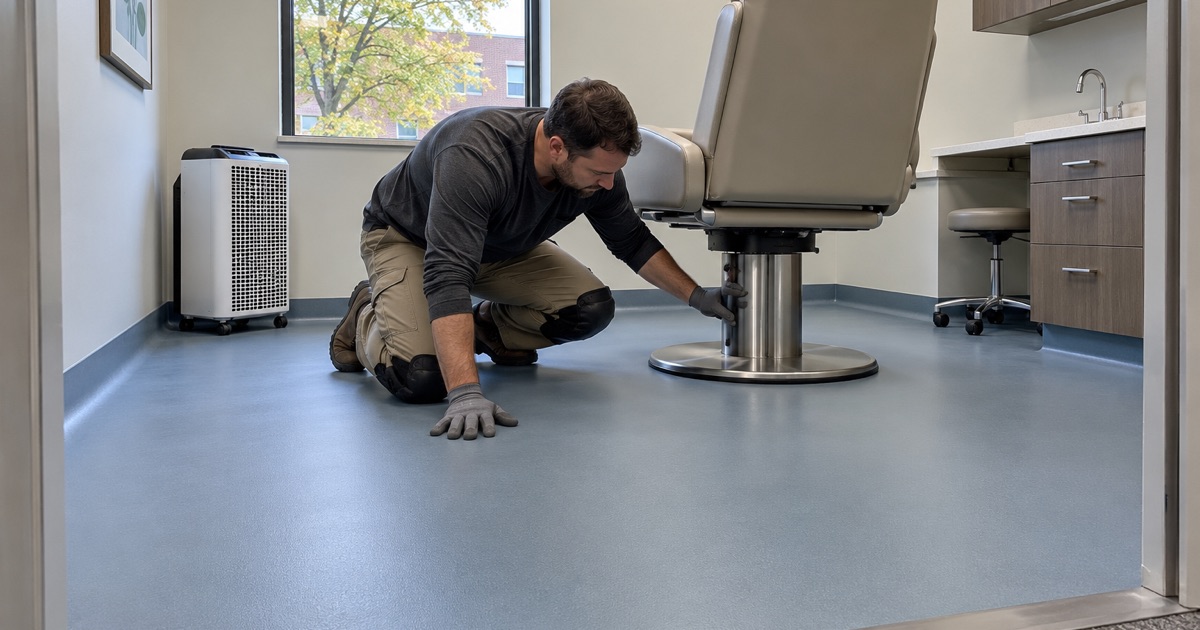
At 121 North Elm Street, the Hinsdale Center for Reproduction describes its facility as one that “includes an on-site, accredited gamete laboratory,” and says it is fully accredited by the Society for Assisted Reproductive Technologies (SART) and the College of American Pathologists (CAP). The address sits inside the village, in the Downers Grove Township part of DuPage County. Those accreditations belong to the clinic, and we have no relationship with it; we have not seen its laboratory, its finishes or its air handling.
We bring it up because a lab like that is the clearest example of a room where floor work becomes an air-quality decision. Anyone planning flooring in or near such a suite, whether the practice, the building owner or the tenant next door, is working inside the same constraint.
Why embryology labs watch what floors give off
IVF laboratory guidance treats building materials as a source of airborne chemicals. A 2015 article by Giles Palmer on the Vitrolife blog lists construction materials, MDF, PVC flooring, paints and adhesives as the major indoor source of volatile organic compounds, and says plainly that “Epoxy paints emit VOCs and take several weeks to cure and thus their use should be avoided.” The same piece notes that vinyl glue used in the final stages of floor surfacing showed emissions of hazardous VOCs, and that renovating an existing lab can introduce a variety of compounds into the workplace.
Two caveats keep that honest. Vitrolife sells IVF laboratory products, so this is a vendor source, and the article itself concedes there is little evidence in the IVF literature that these substances harm embryos in vitro. We never call a coating embryo-safe. What the guidance does support is caution about anything still curing near a culture room.
A habit of airing things out
That caution shows up elsewhere in the field. A 2021 paper in JBRA Assisted Reproduction concluded that off-gassing lab plasticware for at least 72 hours decreased its toxicity before use. The study is about dishes, not floors, but it shows the habit of mind: anything new in the room is aired out before it is trusted, and a floor is a very large new surface.
Looking for epoxy-flooring closer to Burr Ridge? See Epoxy-Flooring Services in Burr Ridge.
Solvent-Free Systems, Cure Clocks and Airing Out
When a floor has to go down near an air-sensitive room, three choices carry most of the weight: what the resin is carried in, how long it is given to cure, and how long the space is ventilated before people and work return.
Solvent-borne versus solvent-free
A solvent-borne coating thins the resin with a carrier that has to evaporate out of the film, and that evaporation is both the smell and the emission. A 100% solids epoxy has no carrier to flash off, so its release during cure is far lower, though not zero; the reaction and any additives still give off something while the film hardens. Polyaspartic and polyurea topcoats vary by product, with some formulated for low emissions and others carrying solvent, so we read the technical data sheet rather than the front of the pail.
Every product we apply already sits inside the Illinois VOC limits for floor and industrial coatings, which bind whoever does the applying. A compliant product is still emitting while it cures, though, so in a sensitive suite we choose from the solvent-free, low-emission end of what the rule allows. Where a moisture-mitigation primer is needed, it is held to the same standard.
A cure clock set by the slab, not the calendar
Resin cures on chemistry, and chemistry slows on cold concrete. We schedule by slab temperature and the dew point spread at the slab surface, because a coating laid too close to dew point can develop amine blush and cure slowly, which also stretches the window in which it is giving anything off. A building engineer who keeps the space warm and dry through the cure shortens that window more reliably than any product choice.
Walk-on time is not reopening time
A floor that can be walked on has not necessarily finished releasing what it will release. For a sensitive room we write a cure period and a separate ventilation period into the schedule before work starts, agree with the tenant how the space will be aired out, and leave the decision about when the lab resumes to the people who run it. If the schedule cannot hold that time, the plan changes rather than the cure.
Rooms that should not get a resin floor
Some rooms are better served by a finish that is installed rather than cured in place, or by work done in a planned shutdown with the lab’s own staff deciding when to reopen. We say so before pricing, the same way we tell an owner when a cracked or spalled slab needs repair or replacement before anyone should coat it.
Medical Suites Downtown: Planning Around the Most Air-Sensitive Tenant
A directory places the Elm Street clinic on Level One of its building, and that is the typical arrangement in a multi-tenant medical building: suites share corridors, stairwells and often air handling. Coating a hallway, a storage room or a neighboring suite can put cure emissions into air that reaches a tenant who never asked for floor work.
Ask who shares the air
Before we price a job in a medical building, we ask the property manager which suite is the most sensitive and how the ventilation connects the spaces. The plan is built around that tenant, not around the one paying for the floor. Sometimes that means closing off returns, running temporary exhaust to the outside, or sequencing the work for a long weekend when the sensitive suite is already shut.
Phasing, profile and dust
Clinic and office floors are phased around opening hours, with overnight and weekend windows when a space cannot close. Diamond grinding or shot blasting opens the slab to an ICRI concrete surface profile the coating can grip, and we never acid etch. The dust is captured at the machine with a vacuum rather than swept or rinsed, because in a medical building airborne dust is a second problem layered on top of the cure.
Moisture belongs in the written scope
A moisture test is part of the written scope before the price is final. Whether that means ASTM F1869 calcium chloride testing or a quick ASTM D4263 plastic sheet check depends on the slab, but the result goes on paper. Moisture is also the first exclusion we name when we explain what a coating warranty does not cover, before anyone signs.
Hinsdale Basements and Garages That Share Air With the Living Space
The same logic applies at home, on a smaller scale. Hinsdale is 89.9 percent owner-occupied, and most of its housing is single-family detached, which means a lot of attached garages and finished basements that share air with bedrooms, kitchens and home offices.
Basements on the house’s air
A basement slab usually sits inside the home’s heating and cooling loop, so whatever a coating releases while it cures moves upstairs. For basements we lean toward a solvent-free 100% solids epoxy, plan around the furnace returns and the family’s schedule, and talk through how long the rooms above should be aired out. If someone in the house is sensitive to odors or fumes, we would rather move the date than rush the cure.
Attached garages
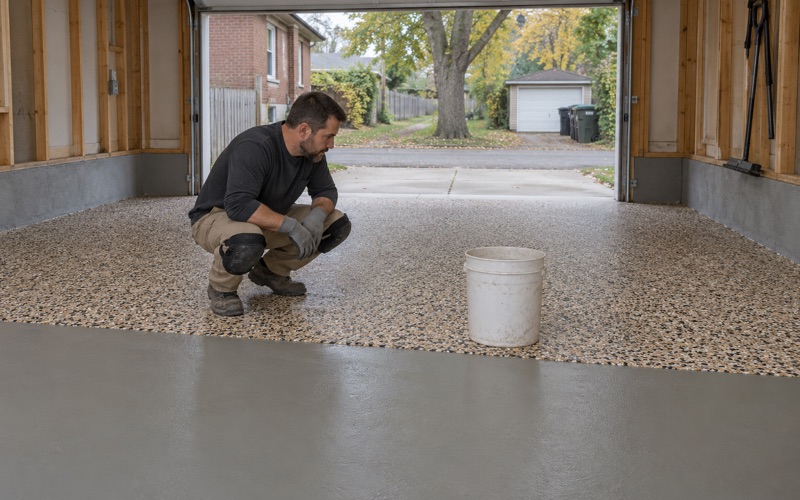
An attached garage shares a door and often a wall with the living space. The systems we put down in garages are chosen to hold up against the brine and rock salt that ride in on tires all winter, and the topcoat is picked for that before it is picked for color. A slip-resistant texture comes from the broadcast and topcoat we specify, not from a slogan, and an unheated garage in deep winter is told to wait for a warmer slab.
Paperwork and limits
Home jobs over the state threshold get a written contract and the Illinois “Home Repair: Know Your Consumer Rights” pamphlet before any grinding begins. Because basement coatings are sometimes pitched as a radon fix, we say it directly: we never sell a floor coating as radon reduction, since in Illinois that is licensed mitigation work.
- 20+ Years of Floor Work
- Moisture Tested in Writing
- Free Written Quotes