Downers Grove Epoxy Flooring brings more than 20 years of slab work to epoxy flooring in Forest Park, and the jobs we think hardest about here are the ones where a floor gets washed every shift. Production rooms, bakery back rooms and commissary kitchens do not fail because the color fades. They fail when the surface opens up and starts holding what the cleaning crew is trying to remove.
That changes the order of the work. Before we talk about flake colors or gloss levels, we walk the slab and mark every crack, chipped joint, hollow patch and peeling remnant of an older coating. Those openings get closed first, and the coating goes over a floor that is continuous enough to be cleaned completely.
Homeowners get the same discipline at a smaller scale. A basement corner where someone bakes for the holidays or puts up jars every August has the same enemy as a plant floor: a gap in the concrete that flour, sugar and spilled brine settle into and never quite leave.
A Brownie Bakery and the Federal Rule That Names the Floor
Baking on Des Plaines Avenue since 1983
Silverland Bakery has been making brownies and bakery bars in Forest Park since 1983, along with cookies, crispy rice treats and raw bars. Athena Uslander, a former structural and civil engineer, founded it, and she has described starting out in a hot, 400 square-foot storefront. That first shop is not the operation running today.
By the bakery’s 40th anniversary in 2023, a trade publication was describing a wholesale business selling nationwide to cafes, grocers and caterers, offering co-packing for other companies, and running her 20 employee plant. Local customers can still visit the Forest Park bakeshop. The address, 439 Des Plaines Avenue, geocodes inside Forest Park village in Proviso Township, Cook County.
We have no connection to Silverland and have never seen its floor. We use it as an example because a wholesale bakery that also co-packs is the plainest case in the village of a floor with a written job description.
What 21 CFR 117.20 asks of a plant floor
The FDA’s Current Good Manufacturing Practice rule for human food, 21 CFR 117.20(b)(4), says a plant must be built so that floors, walls and ceilings may be adequately cleaned, kept clean and kept in good repair. The same paragraph covers drip and condensate from fixtures, ducts and pipes, and it asks for aisles and working spaces between equipment and walls that are unobstructed and wide enough for people to work.
Those Subpart B practices apply to food manufacturing facilities generally. Whether any particular Forest Park bakery is registered with FDA, or exempt from other parts of the rule, is outside what we checked, so read this as the standard a food plant is generally held to rather than a finding about any one business.
Who else looks at the room
In Forest Park, permits for floor and building work run through the Village Building Department. Food establishments answer to the Cook County Department of Public Health, and the village’s own Health and Safety Department administers the local public health and safety code. Our part is narrower than any of theirs: we build the surface that the operator’s sanitation program has to clean.
Looking for epoxy-flooring closer to Bensenville? See Epoxy-Flooring in Bensenville.
Good Repair Is a Sanitation Question
Cracks, spalls and open joints
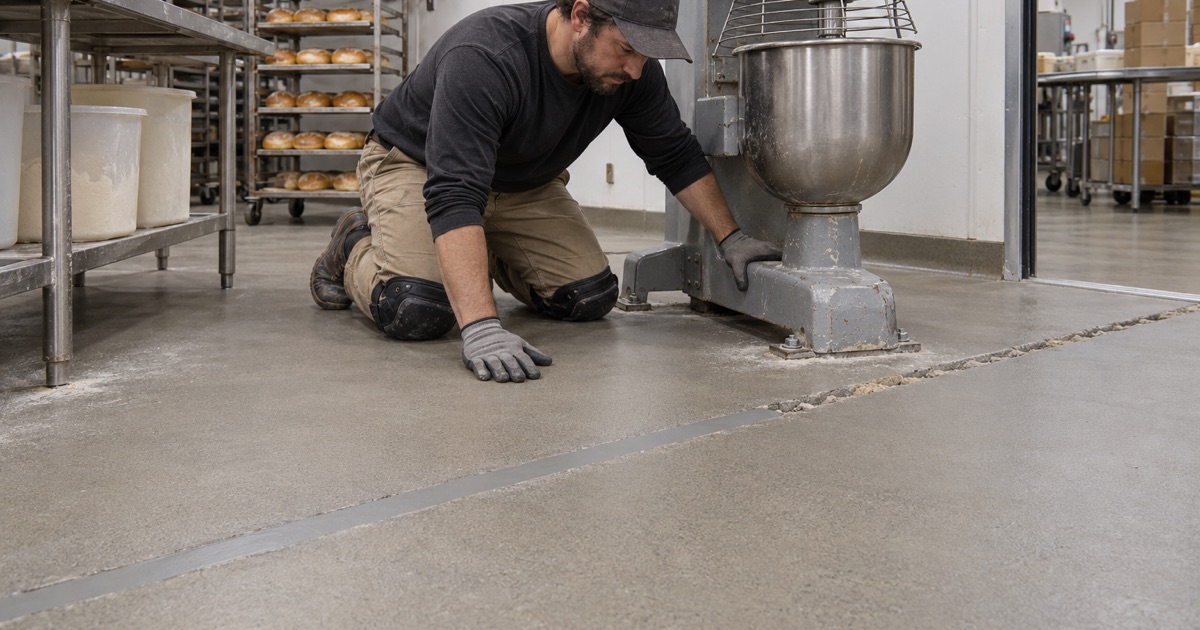
In a bakery, good repair is not about looks. A hairline crack, a spalled saw-cut joint or a patch that has lifted at its edge becomes a narrow channel, and batter, crumbs and flour work their way into it. A mop rides over the top. A squeegee skips across it. What sits in the bottom of that opening is exactly what the floor is supposed to let a crew remove.
Flour and water make a paste that dries hard in a joint, and the next wash softens only the surface of it. Sugar syrups and fats behave the same way, and each shift adds a layer the last one did not clear. That is why the rule ties the floor’s condition to cleaning rather than appearance.
Why an old coating can be worse than bare concrete
A coating that has started to peel is its own kind of opening. Water and cleaner get under the lifted edge, residue follows, and the film hides what is building up beneath it. Bare concrete at least shows its stains. A failing coating can look fine from standing height and still be holding a wet pocket underneath.
What a coating can and cannot claim
No coating makes a plant compliant with a federal rule, and we never describe a floor that way. Compliance belongs to the operator and the program they run. What a floor contractor adds is a surface with fewer places for residue to hide: continuous across the field, tight at the edges where floor meets wall and equipment bases, and repaired before it is coated rather than coated over its damage.
Closing the Openings Before a Production-Floor Coating
Mapping and repair come first
Every food-floor proposal we write starts with a map of the slab. Cracks, spalls, hollow patches and old coatings are marked and measured, and the written scope says so when a section needs repair, or full replacement, before it should be coated. Pricing a coating over damage we have not accounted for is how a new floor reopens along the old lines.
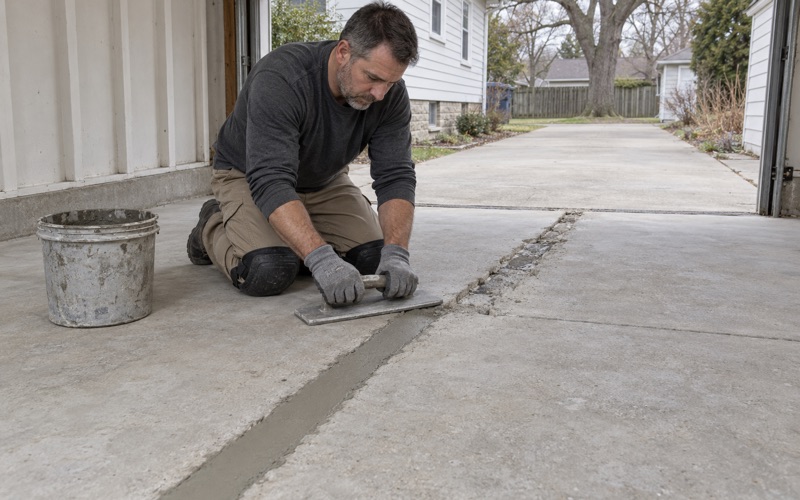
Repairs follow the defect. Live cracks are routed and filled with a material that can tolerate the movement, while dormant cracks take a rigid epoxy fill. Spalled joint edges are cut back to sound concrete and rebuilt with epoxy mortar, and any patch that sounds hollow under a hammer comes out entirely. Control joints are rebuilt and honored, not buried under the coating where they will telegraph through as a crack.
Opening the slab and testing it
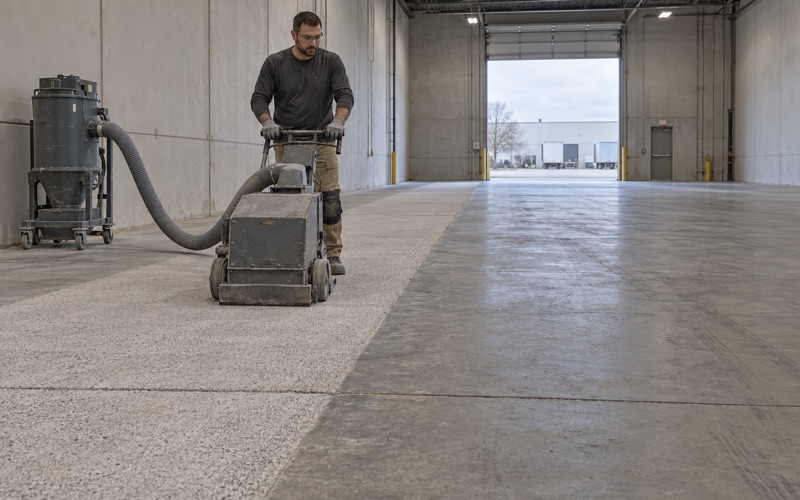
We open the surface with a diamond grinder or a shot blaster, never an acid etch, so the repair material and the coating both bond to a real profile. Grinding dust is pulled into a vacuum at the machine instead of being washed toward a floor drain. Before the price is final, moisture testing goes into the written scope. On a slab on grade, ASTM F2170 in-situ relative humidity probes are set at 40 percent of the slab’s thickness, because that slab can only dry from one side.
Choosing the system and the schedule
A production room with hot-water washdowns and ovens nearby is often a urethane cement floor, which tolerates heat and repeated wet cleaning better than a thin epoxy film. A dry packaging or storage room may suit 100% solids epoxy. Where people walk on wet surfaces, slip resistance is set by the quartz aggregate broadcast and the topcoat we specify, and both are written down rather than promised.
The proposal names the product line, the number of coats and the finished thickness, so a plant manager can check the installed floor against the paper. Products are chosen inside the Illinois VOC limits for floor and industrial coatings. Because a production line rarely stops for a week, we phase the work into overnight and weekend windows, one room or bay at a time.
Baking and Canning Corners in Forest Park Basements
The same problem at home scale
Forest Park is a village of 14,339 people as of the 2020 census, and plenty of its home cooks do their serious work downstairs. A basement freezer, a second oven, a long folding table for canning season: those corners take spilled flour, sticky sugar, dropped jars and salty brine, and a cracked or flaking floor holds all of it the same way a plant floor does.
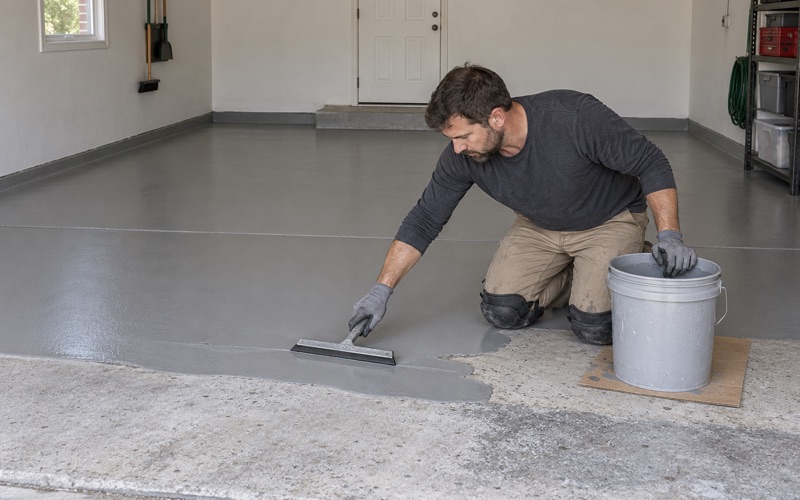
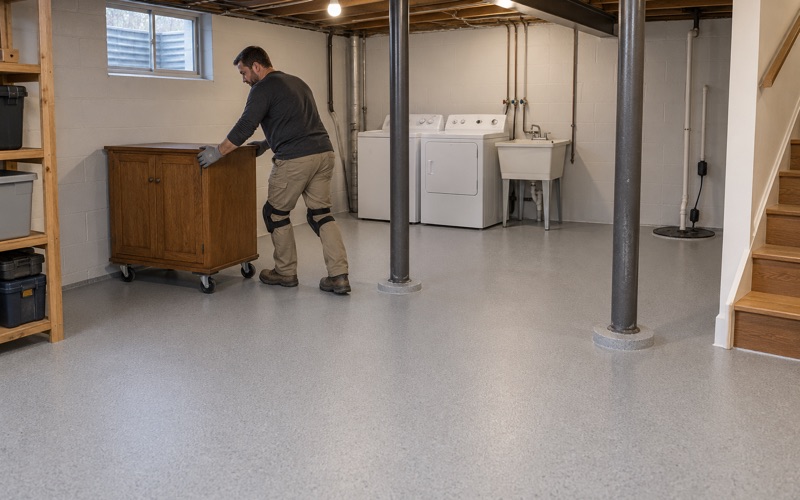
The fix is the same order of work. We map the cracks and any old paint or sealer, repair what is open, grind the slab to a clean profile and then coat it. A vinyl flake broadcast under a clear topcoat gives a basement baking area a surface that wipes down without catching crumbs in its texture.
Moisture comes before color
A basement slab sits against soil, so a moisture test is part of the written scope before we give a final price. If the readings call for a moisture-mitigation primer, the proposal says so and prices it. We also explain before the job is sold what a coating warranty leaves out, and moisture vapor coming up through the slab is the first exclusion we name.
Paperwork for a home job
Home projects above the state threshold get a written contract and the Illinois Home Repair: Know Your Consumer Rights pamphlet before any grinding starts. We also will not sell a basement coating as radon reduction. In Illinois that is licensed mitigation work, and a floor coating is not it.
Working around a village on the Blue Line
Forest Park sits at the western end of the CTA Blue Line, with its terminal on the Eisenhower Expressway at Des Plaines Avenue, and it is one of just two towns on the Chicago L that do not border the city. For a basement job, that mostly means planning parking and equipment drop-off with the household. The grinder and vacuum come in through the most direct door, and the dust stays inside the machine.
- 20+ Years of Floor Work
- Moisture Tested in Writing
- Free Written Quotes