Downers Grove Epoxy Flooring has spent more than 20 years installing coatings, and the epoxy flooring in Evergreen Park we think hardest about is the kind laid for rooms where the most important feet on the floor belong to animals. In an exam room or a treatment area, the patient has bare pads, nails and no idea why the ground just slid. A floor that looks spotless and feels like ice under four paws makes every visit harder for the animal and for the staff holding it.
That changes what we put down. Instead of a high-gloss finish chosen because it photographs well, an animal-care floor gets a fine broadcast texture locked under a matte topcoat. We write that texture into the proposal by naming the aggregate and the topcoat, alongside the product line, the number of coats and the finished thickness, so the owner can hold the finished floor up against the quote.
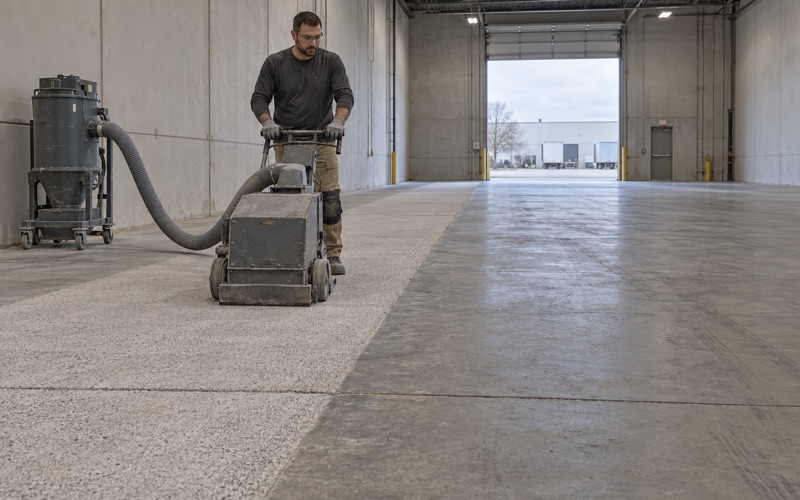
The groundwork is the same on every job. We open the slab with a diamond grinder or a shot blaster, never an acid etch, and capture the dust with a vacuum at the machine. A moisture test sits in the written scope before the price is final, because a slab pushing vapor will lift a coating no matter how well the texture was chosen.
A Full-Service Animal Hospital on 95th Street
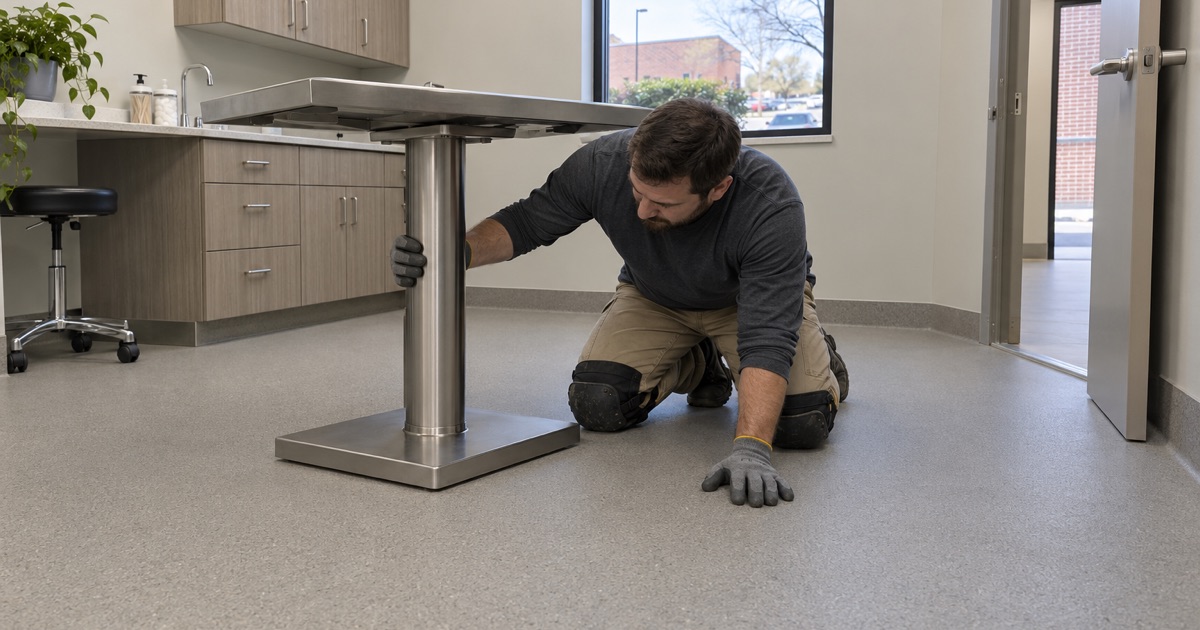
LePar Animal Hospital at 3811 W. 95th Street is listed in the Evergreen Park Chamber directory as a full-service veterinary hospital serving Oak Lawn, Chicago and Evergreen Park, and it is certified by the American Animal Hospital Association. The address geocodes inside the village, in Worth Township, Cook County. We have no relationship with the hospital and have never seen its floors; we name it because it shows exactly the kind of room this page is about.
The hospital’s listings describe dental care, digital radiology, internal medicine, surgery, ultrasound imaging, acupuncture and chiropractic work. The Chamber lists its hours as 8 a.m. to 7 p.m. on weekdays and 8 a.m. to 2 p.m. on Saturdays. A schedule like that means a steady stream of patients crossing the same floor from opening to close, and any coating work in a practice of that kind has to fit around those hours rather than through them.
What a Slip Does to an Exam
Temple Grandin put it plainly in a dvm360 article from March 17, 2024: “I can’t emphasize enough [having a] nonslip floor. Animals panic when they start to slip and fall.” The same piece quotes Marty Becker saying that an animal’s number one fear, from birth, is the fear of falling. Anyone who has watched a dog scrabble on a slick tile floor has seen that fear play out.
A dog whose feet start to go out from under it braces, pulls back toward the door or flattens itself against the floor. A cat looks for the nearest place to wedge itself. Either way the exam takes longer, takes more hands and starts from a worse emotional place, and the next visit begins with the animal remembering the last one.
Why Mats Are Only a Stopgap
The same article suggests that inexpensive bath mats on the floor may help ease an animal’s fear, and nonslip mats on exam tables are common for the same reason. They work, but they slide, curl at the edges, collect hair and have to be lifted for every mopping. A textured coating puts the grip into the floor itself, wall to wall, so there is no edge to trip over and nothing to pick up before cleaning.
Looking for epoxy-flooring closer to Hinsdale? See Epoxy-Flooring in Hinsdale.
Traction Measured Wet and Dry
Low-stress veterinary guidance gives a number to aim for. Fear Free practice-certification guidance, as it is summarized in published search results, describes nonslip flooring as a coefficient of friction of at least 0.5, maintained wet or dry, with a static coefficient of 0.6 or greater described as helpful for pets. AAHA likewise recommends nonslip floors with secure footing for dogs and cats.
Those figures are guidance, not a building code, and we treat them that way. We do not quote a tested friction number for our own systems. What we can do is choose the broadcast, the topcoat and the sheen with that target in mind and put every one of those choices in writing.
Why the Wet Reading Matters as Much as the Dry One
An exam room is wet far more often than it looks. There is mop water, disinfectant left to dwell, a bath, and the accidents that come with a nervous animal on a table. A finish that grips well when dry and turns slick under a thin film of water fails at exactly the moment the animal is most stressed.
That is why we talk about traction wet and dry together rather than quoting how a floor feels on the day it is finished. The texture has to stand proud of the water film, which means it has to survive the topcoat and the first year of mopping rather than being buried on day one.
Where High Gloss Goes Wrong
A high-gloss epoxy or polyaspartic topcoat is popular in showrooms because it reflects light and looks deep. Under a dog’s nails it is a smooth, hard sheet with nothing to catch on, and paw pads find little more grip than nails do. A matte topcoat over a broadcast texture breaks up that surface, and it also hides the fine scratches that animal traffic leaves behind.
How We Specify It
The grip comes from aggregate broadcast into the base coat, usually a fine quartz aggregate on a clinical floor. How much of that texture survives depends on the topcoat: a heavy topcoat floods the grit and smooths the floor back out, while a measured one encapsulates it and leaves a fine tooth. We name the aggregate grade, the topcoat and its sheen in the proposal, because a slip-resistant floor is something we specify, not a slogan we promise.
Fine Texture and Matte Topcoats That Still Mop Clean
There is a real tension in a clinical floor. Coarse grit grips well but holds hair, dander and dried fluids, and it shreds mop heads. The same Fear Free summaries prefer smooth, sealed surfaces in medical areas, so the answer is not the roughest texture available but a fine, fully encapsulated one that still lets a mop glide.
Building the System
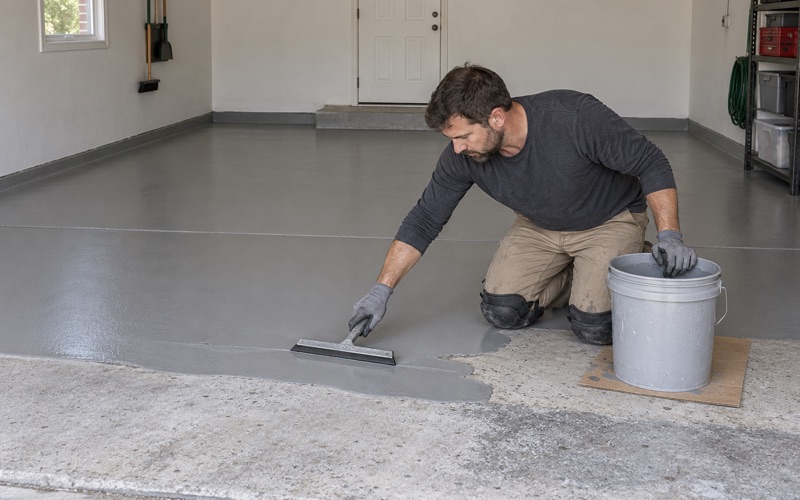
On a ground slab we typically start with a 100% solids epoxy base, broadcast fine quartz aggregate into it, then backroll a matte topcoat that wraps every grain. Where the floor meets the wall, an integral cove base keeps fluids out of the joint where vinyl base usually lets them in. Cracks, spalls and old coatings are mapped before any of this, and we say so when a slab needs repair first.
Cleaning a Textured Floor
A fine textured floor cleans best with a microfiber flat mop or a soft deck brush rather than a string mop that snags. Before we choose a topcoat, we ask which disinfectants the practice uses and check them against the product’s chemical resistance data. A topcoat that dulls or softens under the clinic’s own cleaner will lose its texture faster than any amount of foot traffic would wear it.
Phasing Around a Working Practice
A veterinary practice rarely closes for a week. We phase clinic floors room by room around opening hours, using overnight and weekend windows when a space cannot shut, and we let slab temperature and dew point set the cure schedule rather than the calendar. In Evergreen Park, the Building Department at 9418 S. Kedzie Avenue requires a permit for any alteration, repair or remodel, and a contractor’s village license must be issued and numbered before that permit can be.
Evergreen Park Homes With Senior Dogs on Smooth Floors
The same physics follows an older dog home. Evergreen Park is a village of mostly detached houses, with 6,548 of its 7,538 housing units counted as detached, and many of those homes have basements and garages where a family dog spends part of its day. A painted or sealed concrete floor that was fine for a young dog can become a daily problem for one with stiff hips.
A senior dog on a slick floor splays its back legs, hesitates at the stairs and sometimes refuses to cross the room at all. Owners often lay down runners and rugs, which run into the same problems mats do in a clinic. A coated floor with a fine broadcast and a matte topcoat gives that dog grip everywhere it walks.
What a Home Floor Needs First
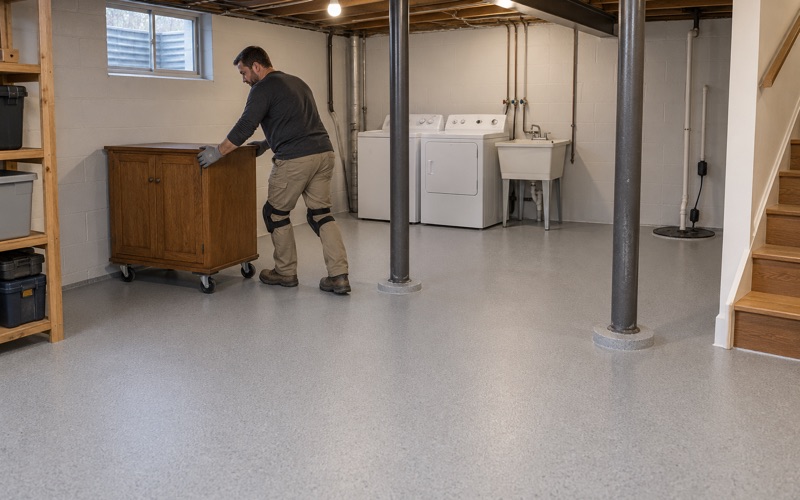
Basement and garage slabs often carry earlier paint, patches or sealer, and none of it stays. Grinding takes the floor back to sound concrete so the new system bonds to the slab rather than to an old coating. The moisture test comes before the price on a basement slab and a garage slab alike, and we explain what the coating warranty leaves out, starting with moisture, before the job is sold.
Matching the Texture to the Dog
A home floor does not need to match a clinic’s, and too aggressive a texture is hard on pads and harder to sweep. We usually show a few sample finishes so the household can feel the difference underfoot and under paw before choosing. Home jobs over the state threshold get a written contract and the Illinois consumer-rights pamphlet before any grinding starts.
Garages That Double as the Dog’s Doorway
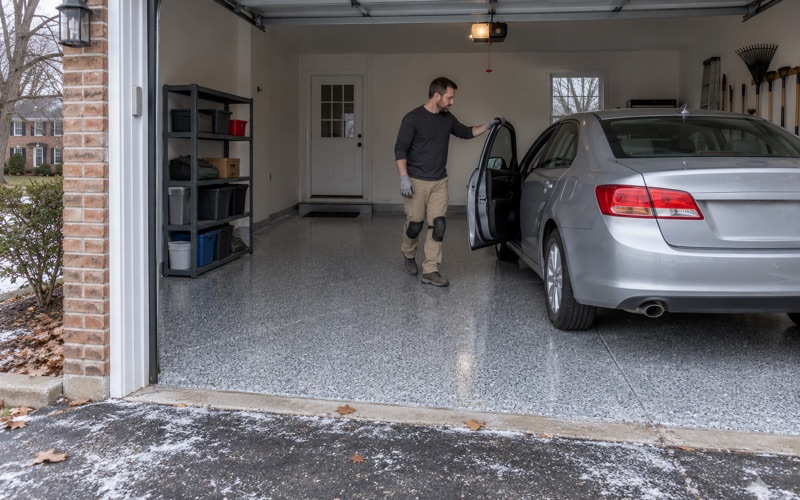
In many homes the garage is the route the dog takes in and out, and in winter the brine and rock salt that ride in on tires end up under its feet. We choose garage systems to stand up to that salt, keep the texture fine enough to rinse clean and finish in a matte sheen, so the floor the dog crosses twice a day stays as sure-footed in February as it was on install day.
- 20+ Years of Floor Work
- Moisture Tested in Writing
- Free Written Quotes