
Downers Grove Epoxy Flooring provides concrete grinding in Downers Grove, IL, serving surrounding cities including Hinsdale, Burr Ridge, Western Springs, La Grange and Westchester. In more than 20 years of floor work, the single biggest difference we have seen between coatings that last and coatings that peel is what happened to the concrete before anything was applied.
That is why every slab we coat is opened with a diamond grinder or a shot blaster rather than an acid etch. Grinding removes the weak surface layer, old sealers, paint and contamination, and leaves a measured texture that a primer or coating can lock into. We also grind slabs as a standalone service for owners and contractors who need a floor stripped, flattened or profiled for the next step.
The sections below cover the surface profile we aim for, the equipment we use, what grinding removes, and how we keep dust out of the building.
Concrete Surface Profile and Why It Matters
Reading the ICRI CSP Scale
The International Concrete Repair Institute publishes a concrete surface profile scale, CSP 1 through CSP 10, from nearly smooth to heavily textured. Each coating system calls for a range on that scale, and thin sealers need a much finer profile than a thick broadcast system or a urethane cement.
We grind to the profile your system calls for, check it against the reference chips, and write it into the scope. A profile that is too smooth leaves a coating nothing to grip, while one that is too rough can show through a thin film or use far more material than planned.
Why Acid Etching Falls Short
Acid etching is the method in most store-bought kits, and it is cheap and easy. It also reacts unevenly, cannot remove sealers, paint or oil, and leaves salts and residue that must be neutralized and rinsed, often toward a drain. On a slab with any existing coating or contamination, etching simply does not reach the concrete that needs to be exposed.
Opening the Slab for Moisture Testing
Grinding also tells us more about the slab. Fresh, open concrete gives truer moisture readings than a sealed or painted surface, and it shows hidden cracks, spalls and patches that need repair before coating. We map those findings and include them in the scope rather than discovering them halfway through the job.
Equipment We Use
Planetary Diamond Grinders
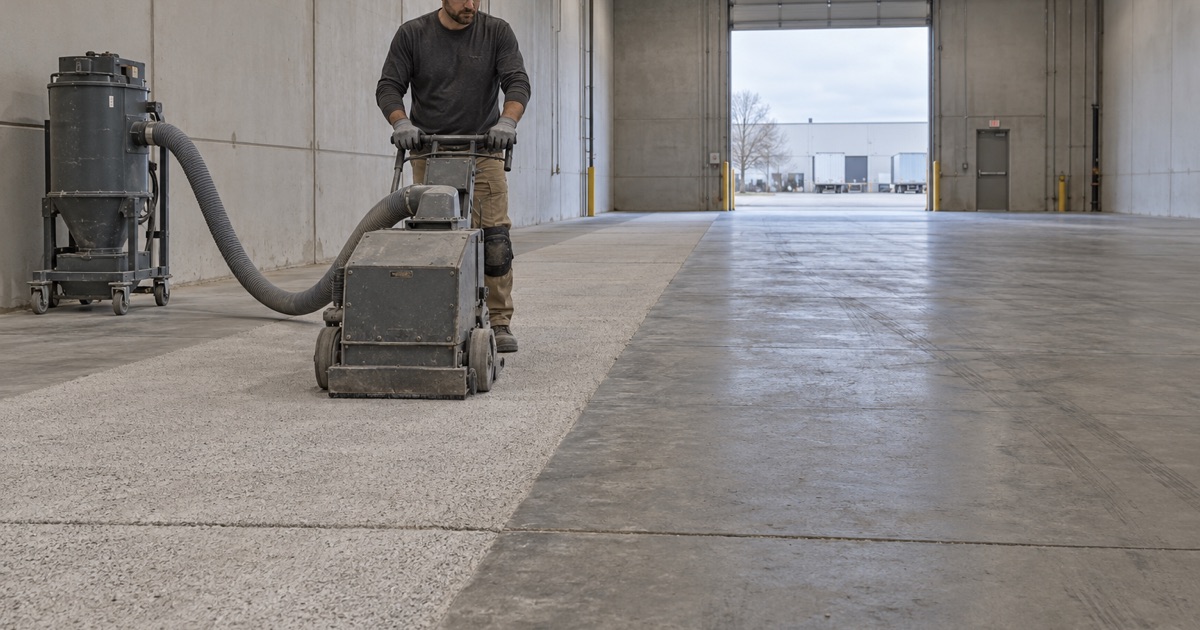
Our main machines are planetary grinders fitted with metal-bond diamond tooling, which cut evenly across the floor and can be matched to the hardness of the slab. Softer slabs need harder bonds and harder slabs need softer bonds, and getting that pairing right is what keeps the grind consistent and efficient.
Shot Blasting for Large and Heavy-Duty Floors
On large warehouse floors and slabs headed for thick industrial systems, shot blasting is often the faster route. A shot blaster throws steel shot at the surface, recovers it, and leaves a uniform, heavier profile in a single pass, with the dust drawn into a collector. Shot blasting suits thick urethane cement and broadcast systems that want a coarser texture, while diamond grinding is the better choice for thin coatings, polished concrete and floors where old adhesive has to come off first.
Edge Grinders and Hand Tools
Walls, columns, steps and corners cannot be reached by a large machine, so edges are ground with smaller hand grinders under vacuum. Skipping the edges is a common shortcut, and it is where many coatings start to peel first. In garages, the strip along the house step and the area under the door seal are ground just as carefully as the middle of the floor, because those are the spots where water, salt and foot traffic hit hardest.
What Grinding Removes
Old Epoxy, Paint and Sealers
Peeling epoxy, garage floor paint, acrylic sealers and failed store kits are ground off down to sound concrete. A new coating applied over a weak old layer is only as strong as that old layer’s bond, so removal is the start of a durable floor rather than an optional extra. Old coatings also hide what is underneath, and stripping them often reveals cracks, spalls or moisture staining that change the plan, which we would rather find before a new system is ordered than after.
Tile Adhesive, Thinset and Carpet Glue
Basements and commercial spaces often carry black mastic, thinset or carpet glue from earlier floors. Different tooling handles soft, gummy adhesives and hard, brittle residues, and we discuss asbestos testing before removing older black mastic.
Weak Cream, Laitance and Contamination
The top layer of many slabs is a weak cream or laitance that dusts and breaks away under load. Grinding removes it along with oil-soaked concrete, rust stains and curing compounds, leaving a sound, clean surface for the coating or polish that follows.
High Spots, Ridges and Lippage
Trowel ridges, high spots and lippage at joints can be ground down so the finished floor is flatter and the coating builds evenly. Where a floor has dips too large for grinding to correct, we recommend a leveling compound before coating.
Dust Control and Clean Job Sites
Vacuum Capture at the Machine
Every grinder and edger we run is connected to an industrial vacuum, so fine concrete dust is captured at the source and bagged. That matters in occupied homes, attached garages, clinics and offices, where dust travels through doorways and HVAC returns. Before we start, we close off doors to living spaces, cover returns and registers near the work area, and stage the vacuum outside or in a garage bay so the collected dust leaves the building in sealed bags.
Keeping Dust Out of Drains and Storm Inlets
We do not rinse grinding dust or slurry toward floor drains, driveways or storm inlets. Captured dust is bagged and removed, which keeps fine concrete particles out of the sewer system and the local creeks rather than washing them away.
Working Around Occupied Buildings
For commercial spaces, we phase grinding around opening hours with overnight and weekend windows when a space cannot close. Sealing off work areas, protecting finished surfaces and capturing dust at the machine let a business keep working in the rest of the building while we prepare the floor.
- 20+ Years of Floor Work
- Moisture Tested in Writing
- Free Written Quotes