
Downers Grove Epoxy Flooring handles concrete floor repair in Downers Grove, IL, serving surrounding cities including Hinsdale, Burr Ridge, Western Springs, La Grange and Westchester. Over more than 20 years of coating floors, we have found that most coating failures blamed on the product really started in the slab, at a crack that was never filled, a spall that was painted over, or salt damage that kept working under a thin film.
Our repair work starts with mapping. Cracks, spalls, scaling, failed joints and old coatings are marked during the estimate and listed in the written scope, so you can see exactly what will be repaired and what it adds to the price. When a slab has gone past repair and needs sections replaced before it should be coated, we say so plainly rather than selling a coating that will crack along with it.
The sections below explain the damage we see most often on local garage, basement and commercial floors, how we repair each type, and how we decide when a slab needs more than a patch.
Cracks in Garage, Basement and Commercial Slabs
Shrinkage and Hairline Cracks
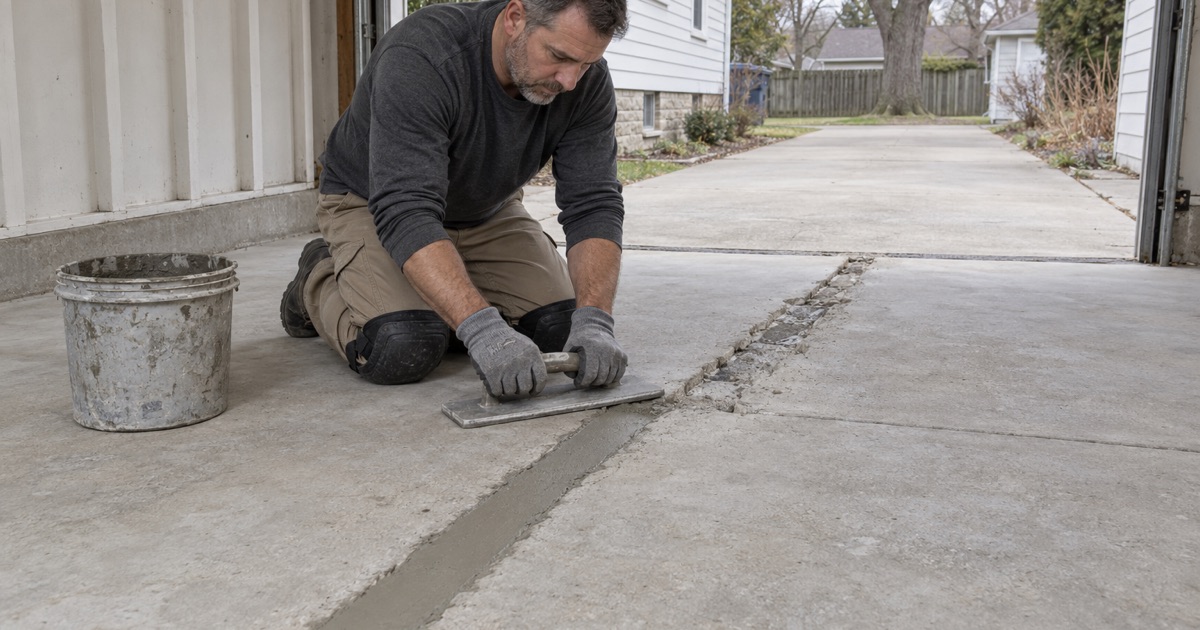
Almost every concrete slab cracks as it cures and shrinks, and fine hairline cracks are rarely a structural concern. They still matter under a coating, because dirt and moisture collect in them and a rigid film laid over an unfilled crack can split along the same line. We open these cracks with a diamond blade or crack chaser so the repair material has room to bond, then fill them and grind them flush with the rest of the floor before coating.
Stable Versus Moving Cracks
The most important question about any crack is whether it is still moving. A stable crack can be filled with a rigid epoxy or polyurea repair material and coated over cleanly, and it usually disappears under a broadcast finish. A crack that opens and closes with the seasons will reflect back through a rigid coating, so we treat it with a flexible material, or recommend keeping a control joint open, and explain how it will look over time before you choose.
Settlement and Heaved Sections
When one side of a crack sits higher than the other, the slab has settled or heaved, often because the soil underneath washed out or froze. Grinding can flatten a small lip, but a slab that keeps moving will break any coating laid over it. These are the floors where we stop and talk about replacement, and if the slab is a garage floor in the village, we point to the local rules for the new pour before anyone quotes a coating on it.
Spalling, Scaling and Salt Damage
Why Garage Slabs Flake Near the Door
The most common damage we repair on local garage floors is scaling and spalling near the overhead door and in the tire lanes. Calcium chloride and rock salt brine drip off cars all winter, soak into the surface and recrystallize as the slab dries, slowly prying off the top layer. Freeze-thaw cycles in an unheated garage speed the process, and the result is pitted, rough concrete with exposed stone that no paint will hide.
Rebuilding Spalled and Pitted Areas
Spalled areas are ground to sound concrete, cleaned and rebuilt with an epoxy mortar or a polymer-modified patching material, then ground flush so the coating goes on over a flat, consistent surface. Wide areas of light scaling are often handled with a skim coat after grinding. Once the floor is coated, the brine stays on the surface where it can be rinsed off, which is what keeps the damage from returning.
Popouts and Exposed Aggregate
Small cone-shaped popouts happen when a piece of aggregate near the surface absorbs water and breaks free. They are usually cosmetic, but a coating will show every one of them as a dimple unless they are filled. We fill popouts during the repair pass so the finished floor reads smooth from wall to wall.
Joints, Edges and Old Coating Failures
Control Joint Repair and Filling
Control joints are cut into slabs to give shrinkage cracks a planned place to form, and their edges often chip and break down under traffic. We clean out failed joint fillers, rebuild broken edges and then either fill the joints and coat over them or re-cut them through the finished floor. Filled joints give a seamless look and are easier to clean, while open joints let the slab move, and we help you choose based on how active the slab is.
Edges at Doors, Drains and Steps
The edges of a slab take a beating at the overhead door, around floor drains and along the step to the house. Broken edges are rebuilt with repair mortar so the coating has a solid surface to terminate against. Around drains, we keep the slope toward the grate so water still flows where it should after the repair.
Peeling Coatings and Delamination
A peeling coating is a repair job in its own right. The failed material has to be ground off completely, and the slab beneath is checked for the moisture, contamination or poor preparation that caused the failure in the first place. A moisture test is part of the written scope before the price is final, because recoating over the same cause only repeats the same failure.
When Repair Is Not Enough
Slabs That Need Replacement
Some floors are simply past saving: widespread heaving, large broken sections, deep deterioration from years of salt, or a slab that sounds hollow across large areas. Coating these floors wastes money, because the coating can only be as stable as the concrete under it. We explain what we see, mark the sections that need replacement and leave the decision with you.
Moisture, Water and Radon Are Separate Problems
Repairing cracks makes a slab stronger and smoother, but it does not waterproof a basement or stop radon. Active leaks and hydrostatic pressure need drainage or waterproofing work, and in Illinois radon mitigation is licensed work, so a floor coating is never sold as radon reduction. We repair and coat the floor once those issues are handled by the right specialists.
- 20+ Years of Floor Work
- Moisture Tested in Writing
- Free Written Quotes