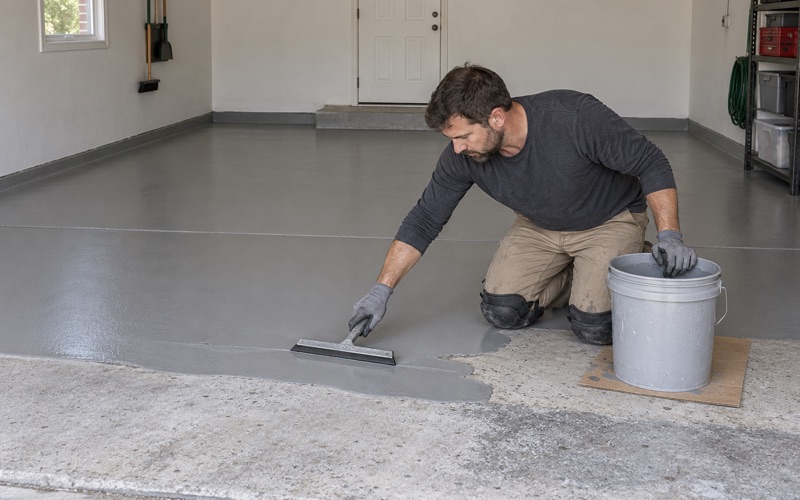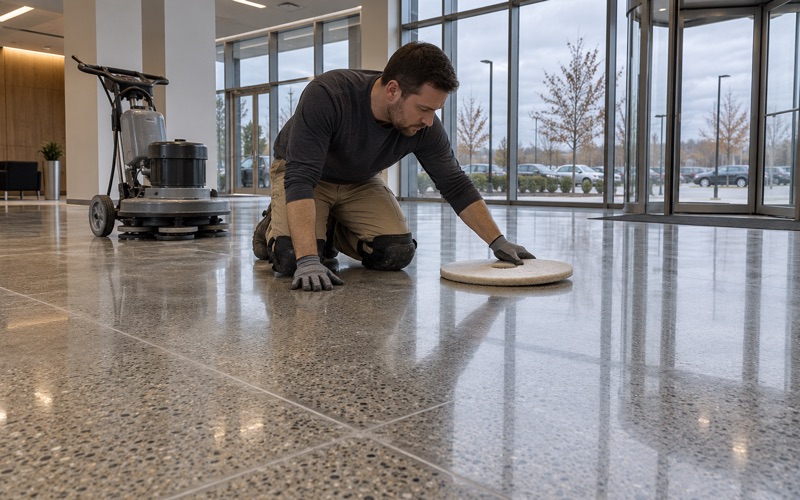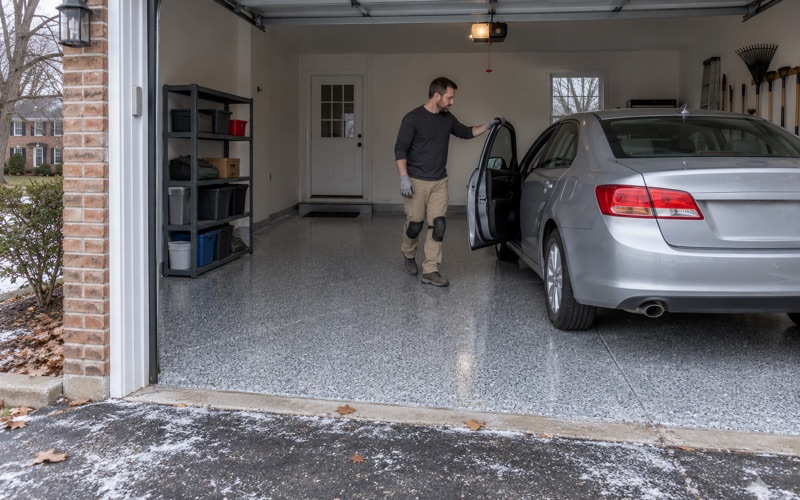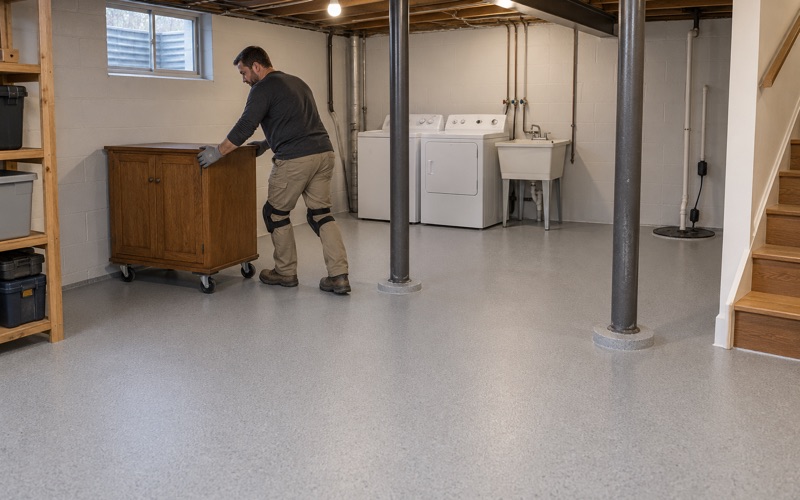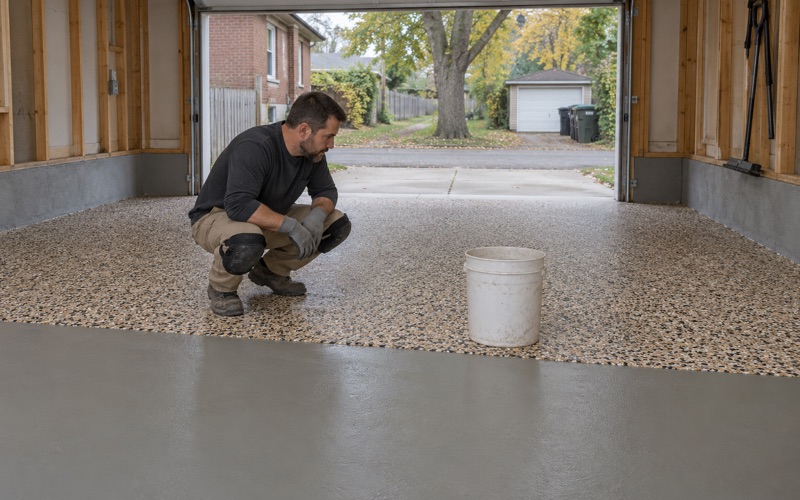
Downers Grove Epoxy Flooring brings more than 20 years of epoxy flooring in Chicago Ridge to garages, basements and commercial rooms where people walk across level changes, not just flat slab. This page stays narrow on purpose. A coated floor that steps up or down has to show each change plainly, and that comes from how the stripe and the edge are built, not from a can of paint rolled on at the end.
We open every slab mechanically, with a diamond grinder or a shot blaster rather than an acid etch. On a step that matters twice, because the flat tread and the vertical riser face both need a real profile before resin goes down. Our proposal names the product line, the number of coats and the finished thickness, so you can check the floor against the paper once it cures.
Moisture testing is written into the scope before the price is final. A slab that pushes vapor will eventually lift a coating at its weakest point, and a step nosing, where the film wraps a corner, is a likely place for that to show. Moisture is also the first exclusion we name when we walk you through what a coating warranty does not cover.
Stepped Aisles in the Dark at the Chicago Ridge Mall Theater
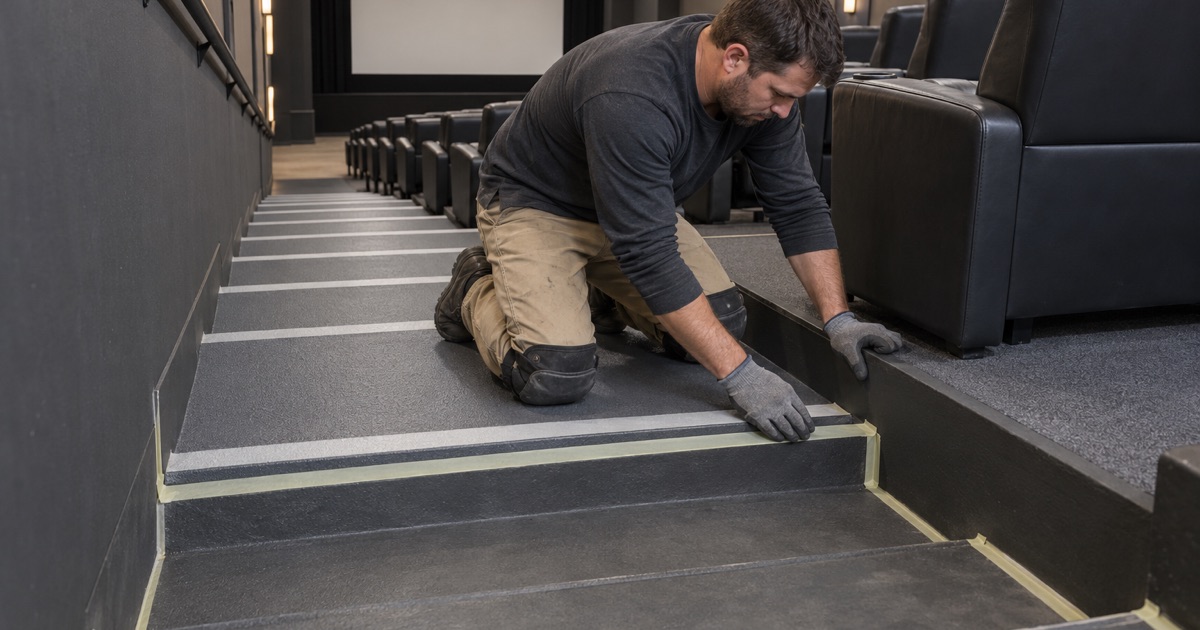
The clearest local example of a floor you walk without seeing it is a movie auditorium. Nothing about it is a residential garage, yet the problem it solves is the same one a homeowner faces at the bottom of a dim basement stair: the floor itself has to tell a walker where each level ends.
Risers and recliners at AMC Chicago Ridge 6
AMC Chicago Ridge 6 sits inside the Chicago Ridge Mall at 95th and Ridgeland and is still operating as a six-screen theater at 500 Chicago Ridge Mall. In 2012 an AMC press release, reported by a cinema trade guide, said the theater had put power reclining seats with footrests into its auditoriums and cut seating capacity in every one to fit them. The same release said risers were added to improve visibility, giving the rooms a stadium-style feel.
That upgrade is more than a decade old, and we have never worked in the building. We have not seen its riser construction or its floor finish, and nothing here describes either one. What the theater offers a Chicago Ridge floor owner is the principle: once a room is built on stepped levels, every edge becomes something a person must find with their feet.
Walking down with the lights at 0.2 foot-candles
A movie only works with the house lights down. A Theatre Consultants Association article notes that building codes generally allow aisle lighting in assembly seating to be reduced to 0.2 foot-candles during a performance. That is a very dim level, and it is the light in which a patron leaving mid-show is expected to find each step down the aisle.
At that light, contrast does most of the work. A walker picks up a change in brightness at the leading edge of a tread before making out the tread itself. That is why the code language turns on whether each tread is readily apparent when viewed in descent, rather than on lighting alone.
Descending is the harder direction. Going up, your toe meets the riser and tells you where the step is. Going down, your heel has to land on a tread you are judging by eye, and in a dark room the only cue may be a line at the edge.
Looking for epoxy-flooring closer to Worth? See Worth Epoxy-Flooring.
The Contrasting Marking Stripe at Each Tread Nosing
The same article, published December 13, 2024, quotes the International Building Code on how that line should work. It is worth reading closely, because the wording sets out what a stripe is for, and that purpose carries into how we would build one into a resin floor.
What the quoted code text says
The article quotes IBC 1030.14.2.3 from the 2024 edition: a contrasting marking stripe shall be provided on each tread at the nosing or leading edge so the location of each tread is readily apparent when viewed in descent. The stripe must be not less than 1 inch wide and not more than 2 inches wide. Earlier editions number the section differently, and there is an exception where the tread surfaces already make each tread readily apparent.
We treat that as a trade reference, not as a statement of local law. Which IBC edition Chicago Ridge enforces is not something we have established, so an owner planning stepped seating or aisle stairs should confirm the governing edition with the Village of Chicago Ridge Building Department before design is settled.
Width, contrast and a stripe on every tread
A band 1 to 2 inches wide is a narrow window. Much thinner and the line vanishes at a glance; much wider and it starts to read as a separate surface. The stripe also has to contrast with the tread around it, so a dark gray floor calls for a light stripe and a pale floor calls for a dark one.
The rule asks for a stripe on each tread, not just the first and last. A walker in a dim room reads the steps by those lines one after another, and a single missing stripe can turn into a missed step.
Where a nosing stripe wears first
The leading edge of a tread takes the heel strike of everyone heading down. That is where any coating sees the most scuffing, and a stripe sitting exactly on that edge wears faster than the middle of the tread. A stripe worn through to bare concrete no longer contrasts with anything, so the build has to plan for wear at that line from the first coat.
Building the Stripe and Step Edge Into a Resin Floor
On a coated floor, the stripe and the edge beneath it are part of the floor system. Treating them as decoration added after the job is how a stepped floor ends up with peeling lines and chipped corners long before the rest of the floor shows wear.
Profile the nosing, not only the tread
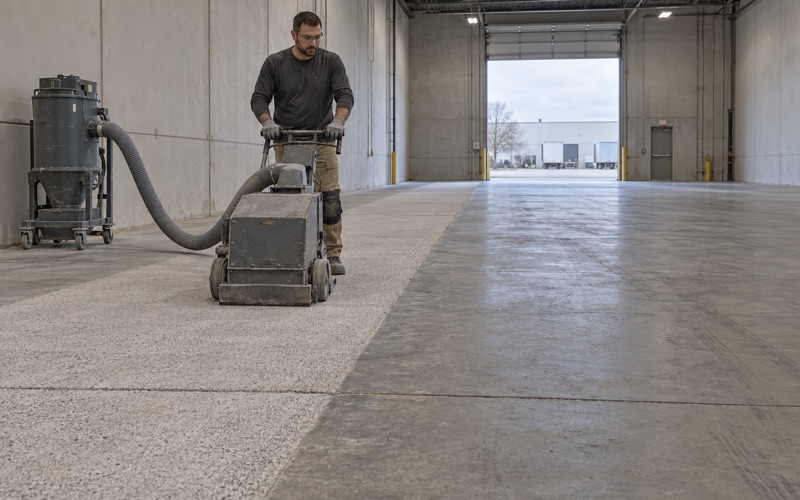
We grind or shot blast the tread, the riser face and the corner between them, and that corner gets hand tooling where a large machine cannot reach. Dust is captured at the machine with a vacuum instead of being rinsed toward a floor drain. Cracks, spalls and old coatings along each edge are mapped before we price anything.
A chipped nosing filled with patch and coated over is still a chipped nosing underneath. When an edge needs repair, we say so and scope that repair before any coating is quoted, because a stripe is only as durable as the concrete corner holding it.
The stripe inside the coating system
We lay the stripe as a pigmented resin coat over the base coat and before the clear topcoat, so the same polyaspartic or polyurea topcoat that protects the tread also protects the line. A stripe painted on top of a finished floor sits exposed to every heel and lifts at the first scuff that gets under its edge.
Contrast is chosen with the full system in mind. A busy vinyl flake broadcast across the tread can muddy a narrow stripe, so on stepped floors we can keep the flake back from the nosing or use a quartz aggregate broadcast for a tighter, more even look at the edge. The base coat itself is typically a 100% solids epoxy, picked inside the Illinois VOC limits that bind the person applying it.
Texture, cure and what a coating cannot promise
Slip resistance at a step edge comes from the broadcast and topcoat we specify, not from a slogan. Cure timing follows slab temperature and the dew point spread at the slab surface, which matters on a riser face where a coat applied to cold, damp concrete can blush. An amine blush left on an epoxy coat weakens the bond of the next layer, so we check for it before recoating.
A coating does not make a stepped aisle code-compliant on its own. That decision belongs to the building official reviewing the work, and our job is to build the stripe and edge the plans call for so they last.
Steps, Landings and Level Changes in Chicago Ridge Homes
Most Chicago Ridge homes will never face an assembly-seating rule, but the logic travels well. Anywhere a coated floor drops a level in poor light, a contrasting edge does the same job at home that a stripe does in a darkened auditorium.
Basement stairs and the last step down
A basement stair lands on a slab, and the last step onto a dim basement floor is where people misjudge the drop. A contrasting band at the nosing of each concrete step, or along the edge of a landing, gives the eye something to catch before the foot commits.
About 58.3 percent of the village’s housing stock was built from 1960 through 1989, so many basement and garage slabs have decades of service behind them and may carry earlier paint or sealer. That layer comes off during grinding before any stripe or coating goes down, because new resin bonded to old paint is only as strong as the old paint.
Garage step-ups and the door to the house
An attached garage often has a step or two up to the house door, and that edge takes wet boots all winter. We choose garage systems built to hold up to the brine and rock salt that ride in on tires. A contrasting stripe at the step edge stays easy to see when you come in from a dark driveway before the overhead light comes on.
The step is also where a coating meets a vertical face, the same detail as a theater riser at a smaller scale. We profile and coat the face and the corner together, so the film wraps the edge in one piece instead of ending in a seam that catches a heel.
Permits and registration before the work
The village permit sheet says all construction or remodeling work on or in any type of building needs a building permit, applied for by the contractor doing the work, and it does not list floor coating as exempt. Every contractor registers at Village Hall first; a general contractor pays a $100 registration fee and provides a current certificate of insurance and a $10,000 surety or performance bond.
On home jobs over the state threshold, you get a written contract and the Illinois Home Repair: Know Your Consumer Rights pamphlet from us before any grinding starts. That paperwork, the moisture result and the named product line together are what let you hold the finished floor to what was promised.
- 20+ Years of Floor Work
- Moisture Tested in Writing
- Free Written Quotes