Downers Grove Epoxy Flooring has spent more than 20 years on epoxy flooring in Burr Ridge and the villages around our home base, and the floors that teach us the most are the ones that get sticky. Syrup, juice, soda and melted sugar do not behave like water on concrete. They soak in, dry into a film and start collecting whatever walks across them.
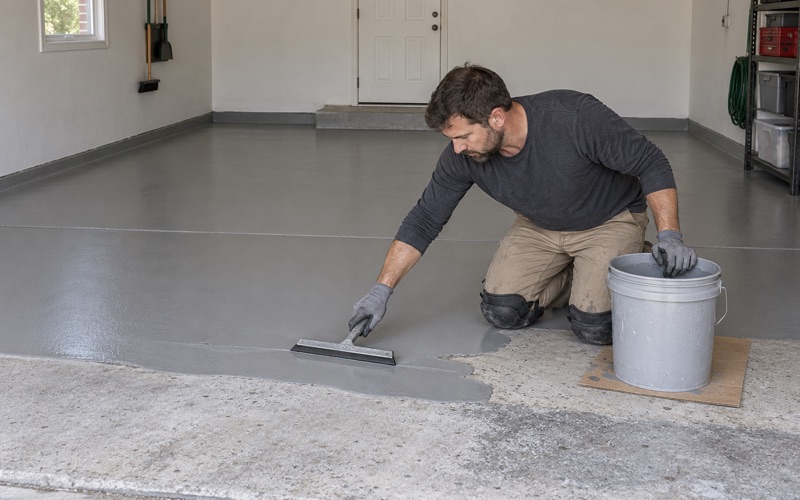
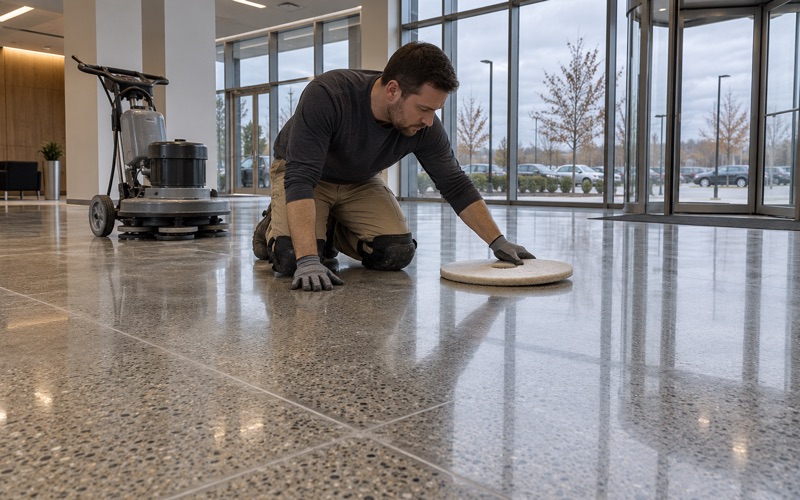
That is why every Burr Ridge job starts with the slab itself rather than a color chart. We open the surface with a diamond grinder or a shot blaster, never an acid etch, and we map cracks, spalls and any old coating before we put a number on paper. If a slab needs repair or replacement before it should be coated, we tell you that first.
The proposal then lists the product line, the coat count and the finished thickness, so you can hold the installed floor up against the quote. A moisture test is written into that scope before the price is final, whether the slab is under a garage, a basement or a storefront.
A Candy Kitchen at 745 Village Center Drive
Burr Ridge Village Center, the retail and restaurant district at Burr Ridge Parkway and County Line Road, picked up a new kind of tenant in 2026. Kilwins, the confectioner, took the storefront at 745 Village Center Drive, which sits in Lyons Township on the Cook County side of the village. Trade reports in February put its targeted opening around late April; we have not been inside, and we have no part in that shop or its floor.
What makes the address interesting to a flooring contractor is what the store says it does on site. A candy counter that only sells boxed product is a retail floor. A shop that cooks is a small production kitchen with a sales counter in front of it.
Fudge Cooled on Marble Tables
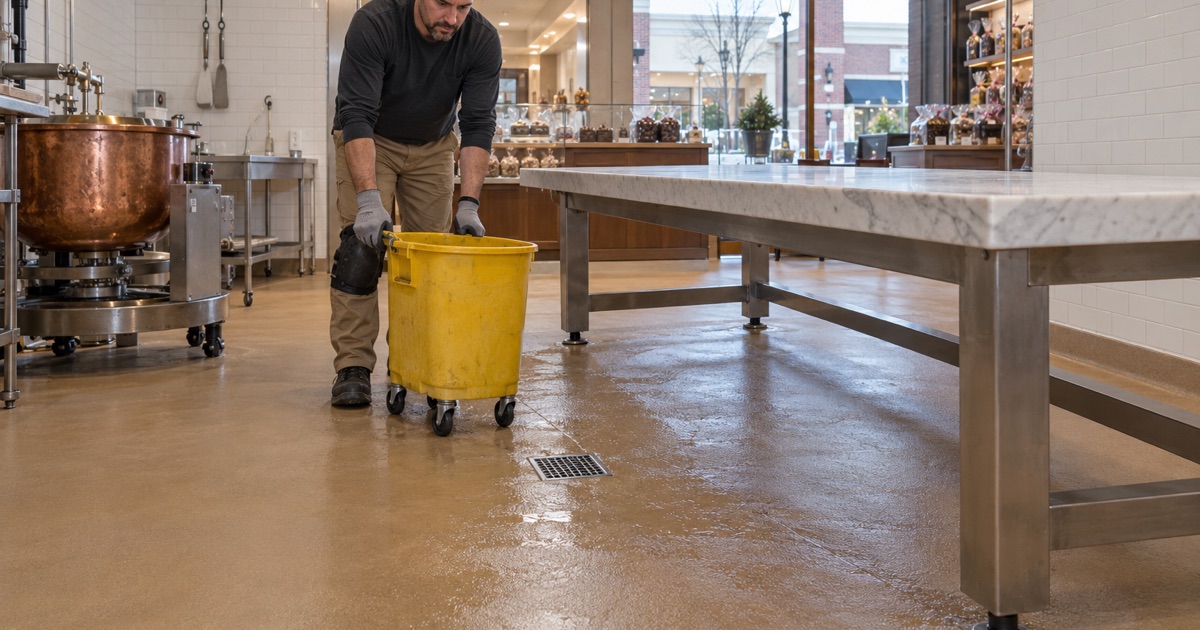
Kilwins’ own page for the Burr Ridge store says its fudge is hand-crafted right in the store and cooled on marble tables. Marble slabs are the traditional surface for working fudge because the stone pulls heat out of the batch evenly while it is folded and shaped.
That work happens at counter height, but it does not stay there. Every time a warm batch is poured, turned and cut, a little sugar finds its way to the hands, the tools, the aprons and eventually the floor around the table.
Caramel Corn and Brittle in Copper Kettles
The same page says the caramel corn and brittle are made in-store in traditional copper kettles, and that the caramel for its caramel apples is made in-store too. Kettle cooking means sugar heated until it flows, then stirred, poured and spread while it is still hot.
A drip of hot caramel that misses the pan lands on whatever surface is below it and sets almost at once. On a sealed floor it can be scraped and washed away. On porous concrete or open grout lines, part of it has already gone where a scraper cannot follow.
Looking for epoxy-flooring closer to Western Springs? See Western Springs Epoxy-Flooring.
Why Sugar Was the Spill That Started Resin Flooring
People tend to think of grease or chemicals as the hard spill on a floor. The resin-flooring trade has a different origin story. Flowcrete, one of the better-known manufacturers of resin floors, traces its start to 1982, when its founder, Peter Gibbins, was asked by a large confectioner to develop a floor that would not erode when exposed to significant quantities of sugar.
According to the company’s history, it was a problem that confectioner ran into often. That request is the reason one of the industry’s major resin-floor makers exists at all, and it says something about how seriously food producers take a sugary floor.
What Sugar and Syrup Do to Bare Concrete
A Sherwin-Williams case study on bakery floors lists sugars and syrups among the things that can eat away at bare concrete and grout. Engineering forums add the observation that sugar dissolved in liquid is the problem, while dry sugar has little effect. That is trade experience, not a lab rate, and we do not put a timeline on it.
The practical point is simpler. A syrup that sits in the pores of an unsealed slab, or in a grout joint between tiles, keeps working at that surface for as long as it stays there, and a mop cannot reach the part that has soaked in.
Seamless Beats Jointed
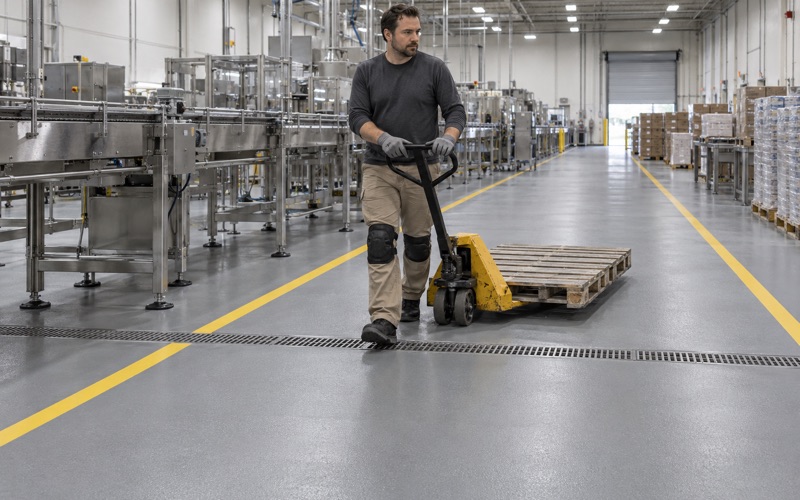
Tile looks clean, but every grout line is a channel. In a kitchen that pours hot sugar, those channels fill first and wear first. A seamless resin system, whether a 100% solids epoxy or a urethane cement where heat and thermal shock are part of the day, removes the joints and leaves one continuous surface to clean.
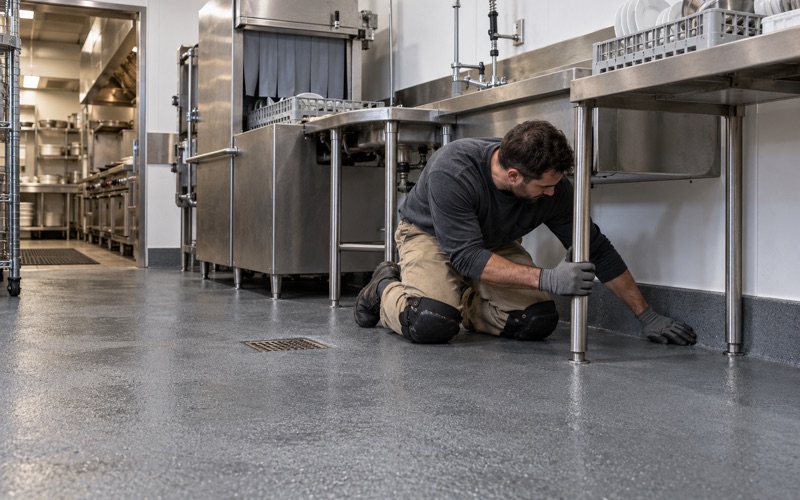
Where a floor meets a wall in a food space, coved floor and wall junctures, the detail FDA Food Code 6-201.13 calls for, carry that seamless surface up the base so spills have no corner to hide in.
Sticky Film, Grit and the Daily Hot-Water Cleanup
Sugar that is not fully removed dries into a thin, tacky layer. Foot traffic presses grit into it, and that grit then acts like sandpaper every time someone walks or wheels a cart across the spot. On an unsealed floor the result is a dull, gray patch that never quite looks clean, plus a slick surface when it gets wet again.
The defense is not a stronger chemical. It is a floor that keeps the sugar on top where the mop can reach it, and a surface that tolerates being washed with hot water every day.
A Surface That Takes Hot Water
Hot water dissolves sugar far better than cold, which is why confectionery and bakery crews rely on it. The floor has to tolerate that routine without softening, clouding or lifting at the edges. Urethane cement is the usual choice where a floor sees repeated hot washdown; a high-build epoxy with a chemical-resistant topcoat can suit lighter duty in a back room or a retail space.
We match the system to how the floor is actually cleaned, and we write that cleaning assumption into the scope so nobody is surprised later.
Texture You Can Still Clean
Every sticky floor is also a slip question. We specify slip resistance by the broadcast and topcoat, typically a quartz aggregate broadcast locked in under the finish, rather than promising it as a slogan. Too coarse a profile traps sugar and grit; too smooth a profile is slick when wet.
The FDA Food Code 6-201.11 antislip exception recognizes that food areas sometimes need a textured surface that is not perfectly smooth, which is exactly the balance a candy-kitchen floor has to strike. For a restaurant, shop or showroom that cannot close, we phase the work around opening hours, with overnight and weekend windows.
What a Warranty Will Not Cover
Before any job is sold, we explain what a coating warranty leaves out. Moisture vapor transmission and hydrostatic pressure from below are the first exclusions we name, because they cause failures no topcoat can prevent. That is why the slab is tested before the price is final, not after the floor fails.
Sugar, Syrup and Soda Spills on Burr Ridge Garage and Basement Floors
The same chemistry shows up at home. Most of Burr Ridge is owner-occupied houses, and a large share of them were built between 1980 and 2009. Their garages and basements catch spilled soda from a second refrigerator, juice boxes, a dropped jar of maple syrup, a leaking case of sports drinks or a sticky cooler set down after a party.
On bare concrete, those spills leave a dark ring that never fully scrubs out and a tacky patch that grabs dirt. On a coated floor, they wipe up.
Garages That Double as Pantries
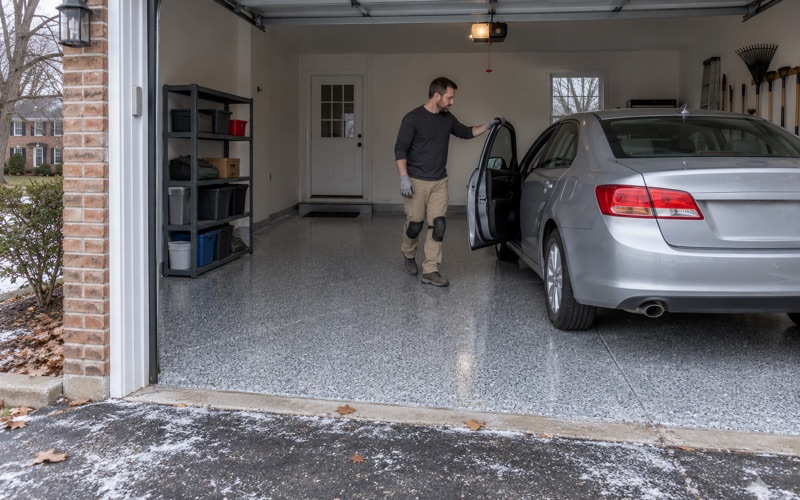
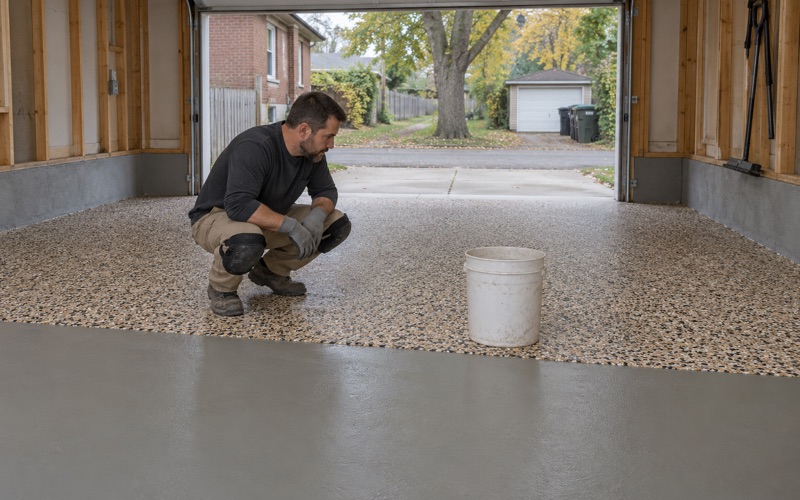
Plenty of garages here hold an extra freezer, a beverage fridge and bulk groceries. A slow drip from a door seal or a split carton runs to the low spot and sits there. A full-broadcast vinyl flake system under a polyaspartic topcoat gives that floor a sealed, cleanable surface, and the flake texture hides minor marks between cleanings.
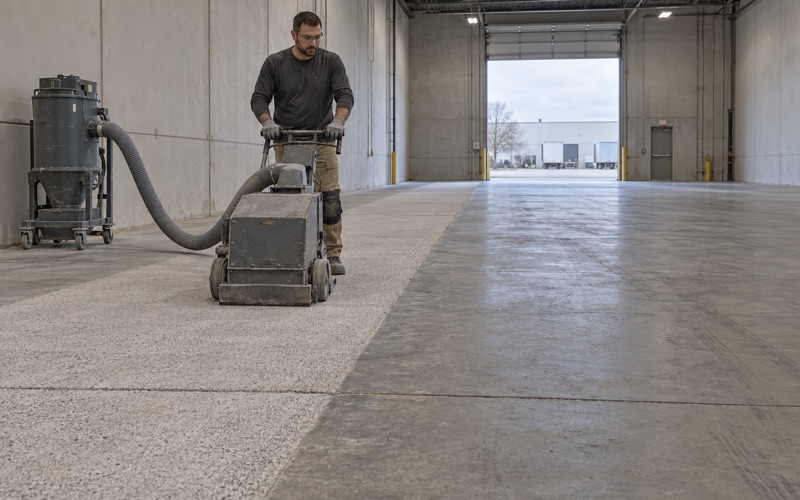
We open the slab by grinding to a proper ICRI concrete surface profile, so the coating has something to bond to. Grinding dust is captured at the machine with a vacuum rather than rinsed toward a floor drain.
Basements and the Moisture Question
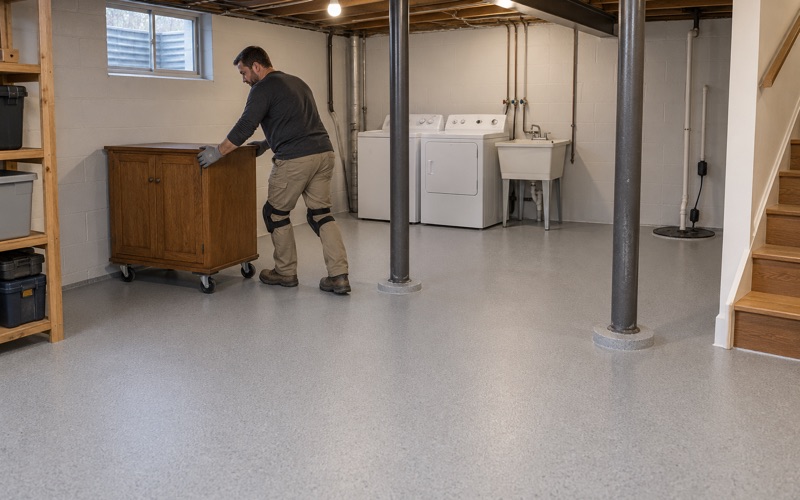
A basement that hosts a bar, a kitchenette or a game room collects sweet spills too. Whether a slab from that 1980-2009 era was poured over a vapor retarder is not recorded anywhere for a given house, so we test rather than assume. Depending on the slab, that may mean an ASTM F2170 in-situ relative humidity probe or an ASTM F1869 calcium chloride test.
If the numbers call for it, a moisture-mitigation primer goes down before the build coats. A coating sealed over a damp slab will fail no matter how clean it stays on top.
Village Rules Before the Work
Finish work such as painting and carpeting does not need a village permit in Burr Ridge, but work that affects foundations, patios, driveways and garages does, and every contractor on a permitted job must carry the Village of Burr Ridge contractor license, bond and insurance. If a garage slab is being replaced rather than coated, we point to the village rules for the new pour before anyone quotes a coating for it. Home jobs over the state threshold get a written contract and the Illinois consumer-rights pamphlet before grinding starts.
- 20+ Years of Floor Work
- Moisture Tested in Writing
- Free Written Quotes