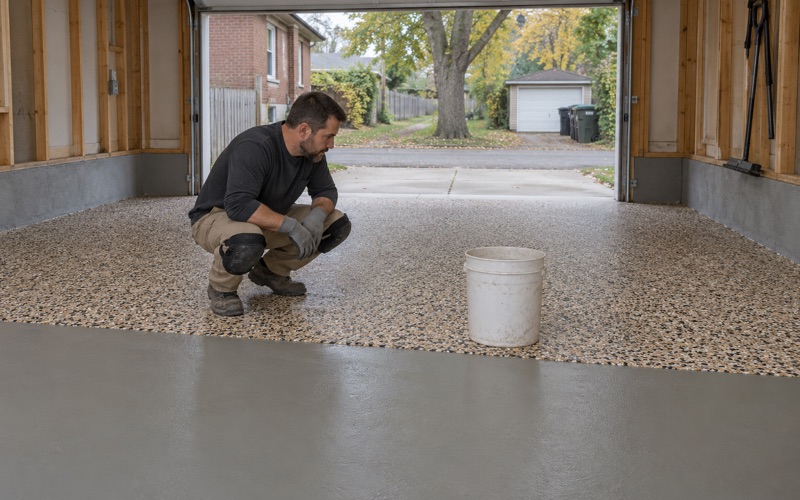
Downers Grove Epoxy Flooring has spent more than 20 years on epoxy flooring in Brookfield and the rest of the near west suburbs, and the question we ask first on any slab is what will happen to it after we leave. Some floors are coated once and left alone for a decade. Others get painted over, scuffed, rolled across and reworked on a schedule, and a coating chosen for the first kind of floor fails on the second.
That difference decides the product, the sheen, the thickness and the prep. A garage floor wants a tough, sealed surface that sheds salt and tire marks. A floor that someone else will paint next season wants a base that accepts paint, and a high-gloss finish can be exactly the wrong answer.
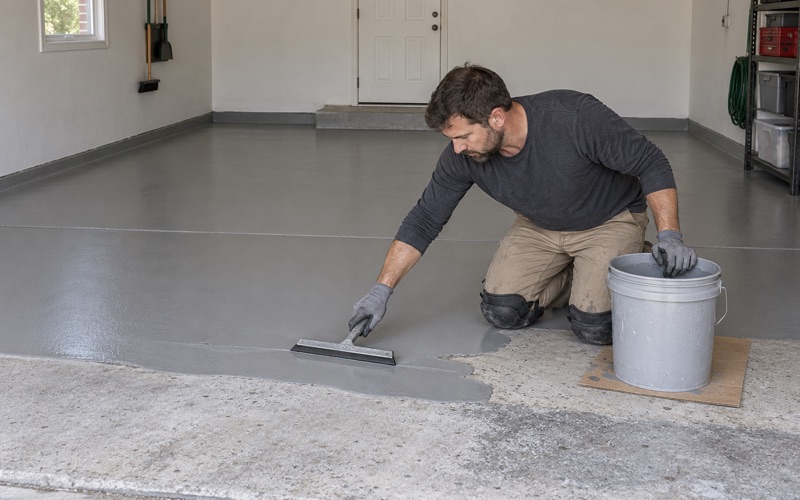
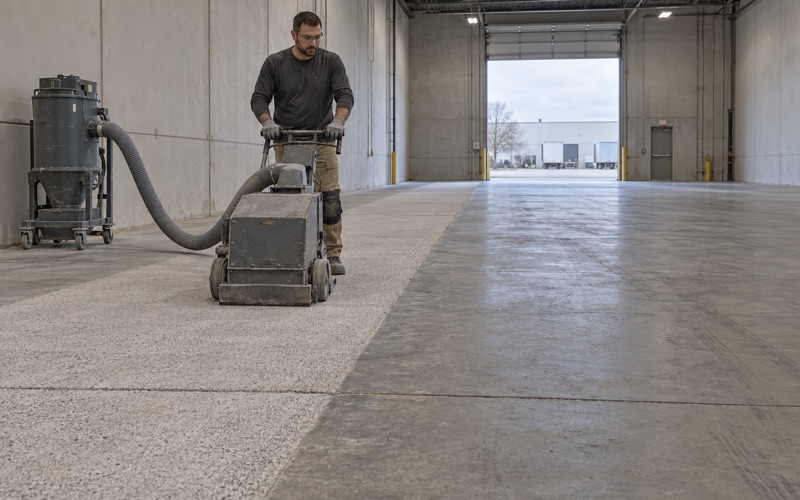
Every job starts the same way: we map cracks, spalls and any old coating, open the concrete with a diamond grinder or a shot blaster instead of an acid etch, and put a moisture test into the written scope before the price is final. What changes from floor to floor is everything that goes on top of that profile.
A black box theater in a former restaurant on Grand Boulevard
Brookfield is about to get a working example of a floor that never stays finished. The nonprofit Brookfield Theater Corporation is buying 3740 and 3742 Grand Boulevard for the Strand Theater, named for the movie and vaudeville house that stood on Grand Boulevard from 1925 to 1952. The building at 3740 was most recently Burger Antics, and its kitchen equipment has already been removed.
What the plan describes
According to the Riverside-Brookfield Landmark and the corporation’s own development plan, 3740 becomes the performance space and 3742 the lobby, box office, concessions and restrooms. The plan calls the performance room a fully modular black box seating about 125, and the corporation says it has already acquired those 125 seats. Grand opening is set for December 4, 2026, with four or more productions planned each year.
The plan names no floor finish, and we have no role in the project. What it does offer is a clear, local picture of a room type that comes with its own floor rules, and those rules apply to any black box, rehearsal studio or multipurpose hall in the area.
A stage floor that is repainted between productions
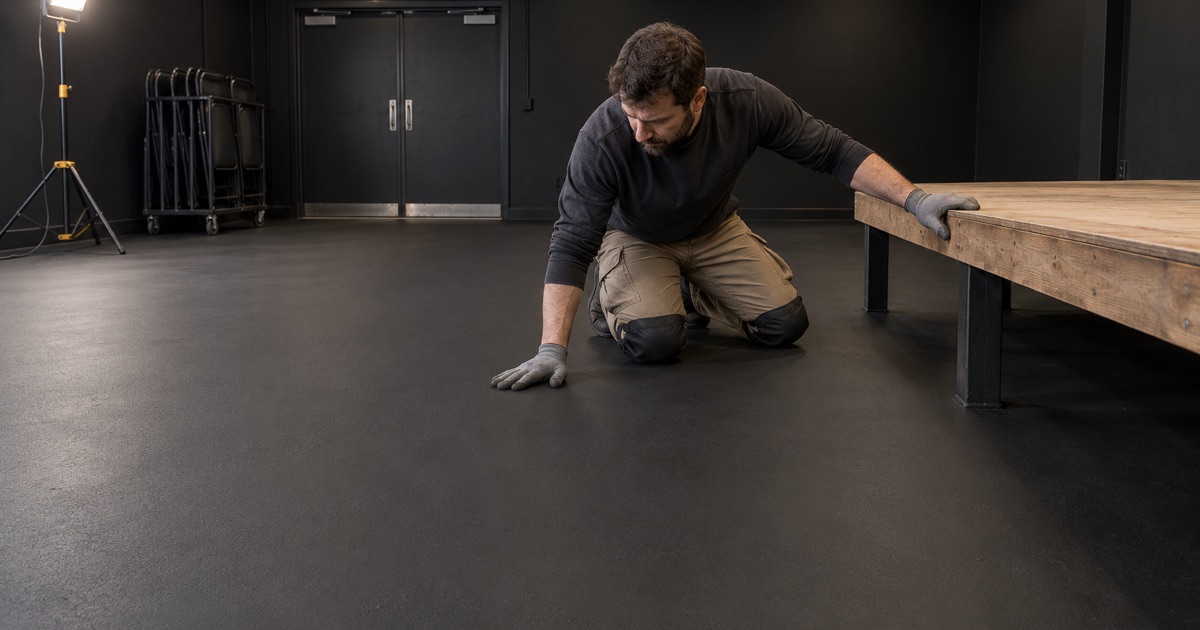
In a black box the floor is the stage. Theater crews describe decks repainted between productions or every semester, usually in flat or low-sheen black so the lighting designer is not fighting reflections off the deck. One crew on a practitioner forum reported repainting a 35 by 45 foot stage in under 2 hours with under 2 gallons, which tells you how routine the job is.
That routine is the whole point. Scenic paint is the wear layer, laid down fresh for each show and taken back to plain black afterward. Whatever sits underneath it is a substrate, and its job is to give that paint something sound to grip, season after season.
Platforms, risers and casters
A fully modular room means seating risers, platforms and set pieces move for every configuration. In a room like that, the loads that matter are riser feet and casters rolling and pivoting across the same slab, often while carrying people. A base layer under a stage floor is judged on how it holds up to that point loading and dragging, not on how it looks in a photo before the first coat of black goes down.
Looking for epoxy-flooring closer to Bellwood? See Epoxy-Flooring Services in Bellwood.
A resin base that will take the next coat of paint
When a venue owner, studio or school asks us about resin under a painted floor, we start by turning the usual goal upside down. Most coatings are designed to be the last thing on the slab. Here the resin has to seal and protect the concrete while staying friendly to the next product someone rolls over it.
Why high gloss works against repainting
Practitioner advice on theater floors carries the same warning again and again: a smooth, glossy coating may not take another coat without primer or scuffing. Gloss is a sign of a closed, hard surface, and paint struggles to bite into it. A theater paint maker’s own article describes its black floor product as both very low sheen and semi-gloss, so we treat sheen as a choice to match to the room, not a rule.
For a floor that will be painted, we usually recommend a finish with enough tooth to accept the scenic coat, or a system whose manufacturer publishes a recoat procedure we can hand to the crew. The finish that photographs best on day one is rarely the one that serves a stage for years.
Sealing the slab without sealing out the paint
A well-built base still does real work. It closes the concrete so spills, stage blood, glue and cleaning water do not soak in, and it keeps dusting concrete from flaking up into fresh paint. A 100% solids epoxy primer and body coat over a ground profile can do that, with the top layer chosen for how it will receive the next coat rather than for maximum shine.
We also talk through what happens at the end of a long run of shows. When years of paint build up, a crew may want to strip back to the base, so the base has to be tough enough to survive a scraper and a floor machine without letting go of the slab.
What goes into the written scope
Our proposal names the product line, the number of coats and the finished thickness, so the floor can be checked against the quote once it is down. For a painted-floor base, it also spells out the recoat method the manufacturer approves, whether that is a scuff-sand and prime, a specific primer, or a time window in which the next coat bonds chemically.
If the room needs some slip resistance under foot traffic, we specify it through the broadcast and topcoat used rather than promising it in a sentence. Commercial rooms like these are often scheduled around rehearsals and events, so we phase work into nights or weekends when the space cannot close.
Old kitchen floors: capped drains, anchor holes and grease
A former restaurant is one of the trickiest slabs to coat, because the old kitchen leaves marks in the concrete long after the equipment is gone. We cannot say what is in the slab at 3740 Grand, since nobody has reported on it, but the pattern in old kitchens is familiar and worth knowing for any restaurant conversion.
Floor sinks, drains and trench lines
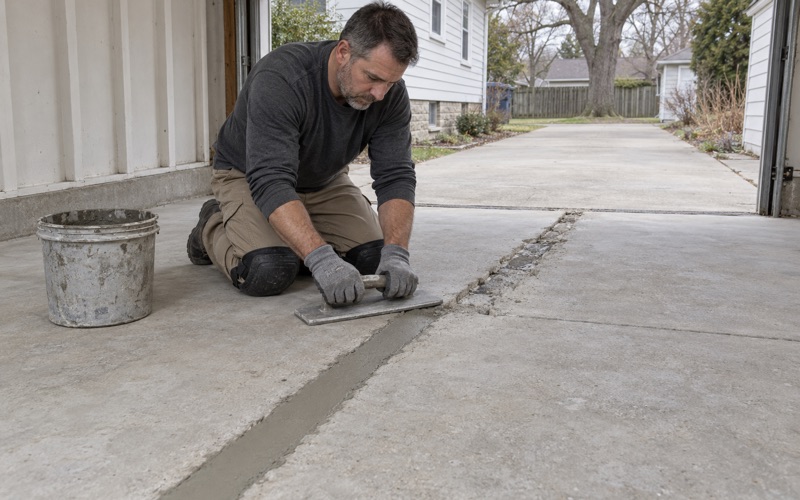
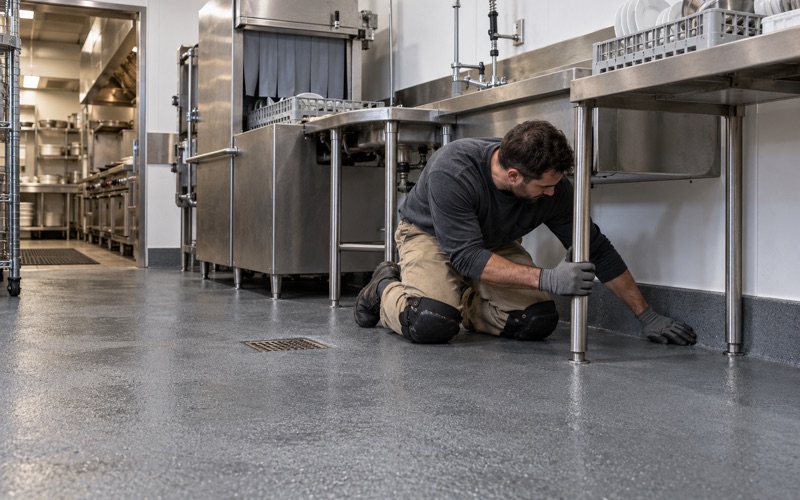
Commercial kitchens usually have floor sinks and drains, and a conversion to a dry room often caps or abandons them. A capped drain is a soft spot in a coating: the patch, the old drain body and the surrounding concrete all move and absorb differently. We cut back to sound material, fill with a compatible repair mortar, and grind the patch flush so the coating crosses it as one continuous film rather than bridging a seam.
Equipment anchors and old bolt holes
Fryers, ranges, walk-in coolers and prep tables are often bolted down. When they come out, they leave anchor holes, sheared bolts and sometimes cored openings for lines. Each one gets cleaned out, cut off below the surface and patched, because a bolt stub telegraphs through a coating and a hollow hole becomes a crater under a riser foot.
Grease before anything bonds
Trade guidance is blunt on this point: a coating installed over grease, oil, paint or wax guarantees a failure. Kitchen grease works its way into the surface around cooking lines, so stained areas are degreased and the surface profiled before any epoxy goes down.
We then test rather than assume. A water-drop check shows whether the cleaned concrete is absorbing again, and a small test patch tells us whether the primer is bonding before we commit the whole room. Our grinders run with vacuum capture at the machine, so the dust goes into a collector instead of being washed toward a floor drain.
Recoating over an existing floor coating at home
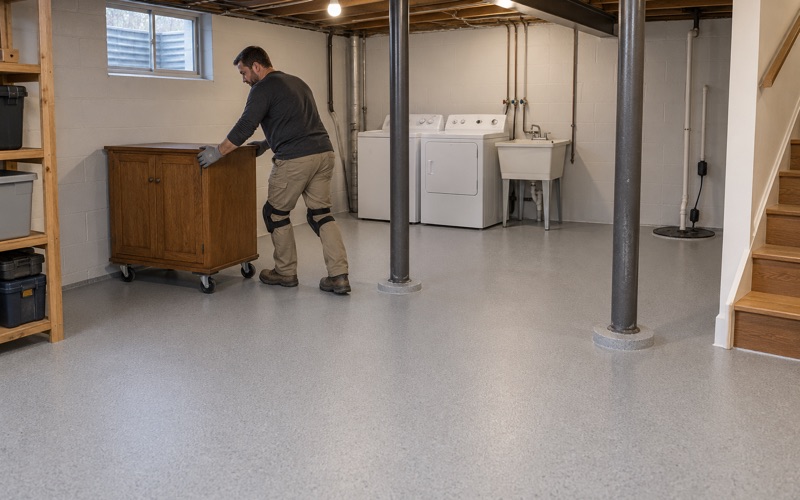
The same logic carries straight into Brookfield garages and basements. Plenty of homeowners have an older coating, a store-bought kit or a painted floor and want something better on top. The question is identical to the theater’s: will the new coat bond to what is already there?
Is the old coating still holding on?
We start by mapping the existing floor. Peeling at the garage door, hot tire pickup under the parking spots, chalky or worn traffic lanes and blisters all tell us where the old film has let go. A coating is only as strong as the layer under it, so if the old film is loose, anything new laid on top inherits that weakness.
Where the old coating is sound and well bonded, a recoat can make sense. Where it is failing in patches, or has never bonded well, we tell you plainly that it should come off, and we say so before you are quoted for a recoat that cannot last.
Scuff and prime, or grind it off
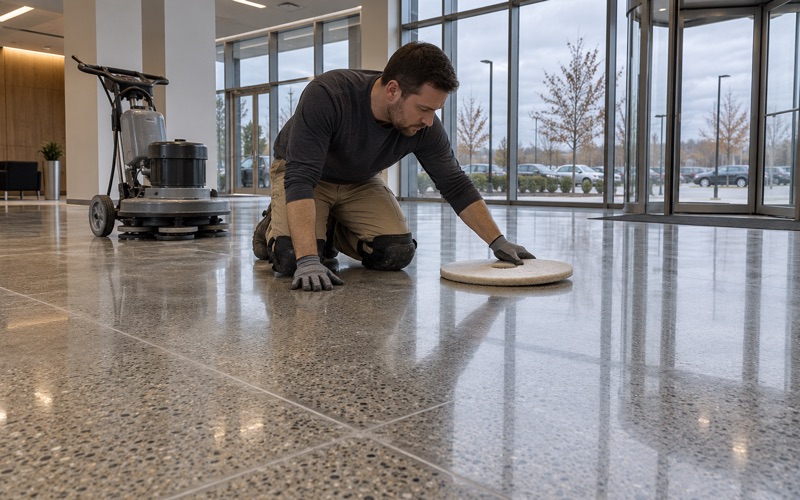
A glossy, intact coating usually needs to be scuffed with abrasive or ground lightly to break the surface, then cleaned and primed with a product the new system’s maker approves over old coatings. This is the same scuff-and-prime step theater crews use between productions, done with heavier equipment and a tougher topcoat.
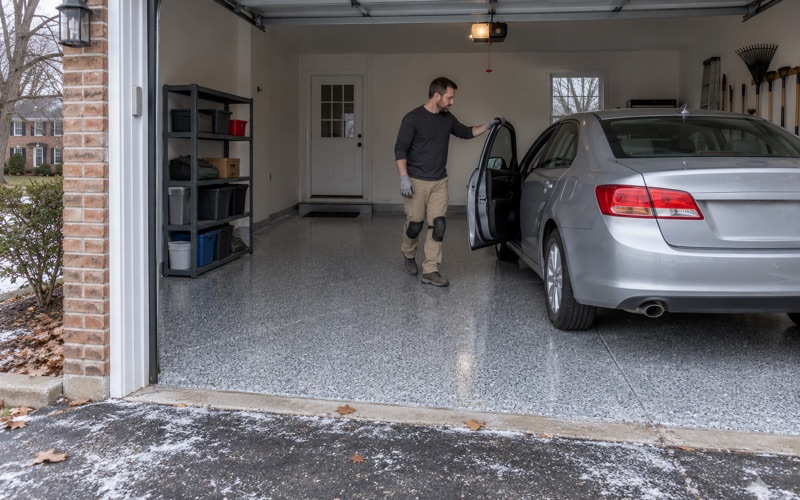
When the old layer is failing, we grind or shot blast down to clean concrete and build a new system from a proper profile. Choices at that point include a 100% solids epoxy body coat with a vinyl flake broadcast and a polyaspartic topcoat, or a quartz aggregate broadcast where more texture is wanted. For a garage, we pick a system that stands up to the brine and rock salt that ride in on tires all winter.
What a recoat quote should tell you
A recoat quote from us states whether the old coating stays or goes, how it will be prepared, and which products, coats and thickness go on top. It also lists what the warranty does not cover, and moisture coming through the slab is the first exclusion we name.
Cure timing follows slab temperature and the dew point spread at the surface rather than the calendar. An unheated Brookfield garage in deep winter is often told to wait for warmer weather, because a coating that cures cold is the floor most likely to come back as the next recoat job.
- 20+ Years of Floor Work
- Moisture Tested in Writing
- Free Written Quotes