Downers Grove Epoxy Flooring has spent more than 20 years putting epoxy flooring in Bridgeview garages, workshops and commercial bays, and a lot of those floors share one complication: somebody on the property cuts or welds steel. A resin floor and a cutting torch can live in the same room, but only when the plan treats the torch as a fire question first and a coating question second.
That order matters because no epoxy, polyaspartic or urethane topcoat is heat-proof, and none of them turns hot slag into a harmless event. What a good floor can do is shrug off the small stuff, resist the chemicals and salt a working space throws at it, and hide the occasional scar instead of advertising it. The rest is handled at the workbench, not in the coating.
So before we price a floor for anyone who welds, we ask where the cutting happens, how high the work sits, and what lands on the slab today. The answers shape the system we propose, the texture we broadcast, and the habits we recommend once the floor is back in service.
A Metal Store on West 90th Street and the Fire Rule Behind Hot Cutting
Bridgeview sits about 15 miles southwest of the Chicago Loop, and its industrial streets carry plenty of shops that shape steel for a living. One of the clearest examples is Metal Supermarkets at 7411 W. 90th Street, in the Palos Township part of the village. The store’s own page lists plasma cutting, flame cutting, laser cutting, waterjet cutting, plate cutting and spot welding among its services, and it keeps weekday hours of 7:30 a.m. to 4:30 p.m.
We have no relationship with that store and have never seen its floor. Its page does not say where on site the plasma and flame cutting is done or what the slab under it is. We mention it because it shows how ordinary hot cutting is in Bridgeview, and because anyone setting up a cutting table, at a business or in a home garage, runs into the same rule we plan floors around.
What hot cutting puts on the floor
Plasma cutting and flame cutting both throw molten metal. Some of it leaves the torch as sparks that cool in the air before they land. Some of it falls as slag, heavier droplets that hit the floor still hot and stay hot for a moment after they stop rolling. Welding adds spatter, small beads of metal flung from the puddle that can travel a surprising distance when the work sits close to the ground.
Why the rule comes before the resin
The federal welding standard does not mention floor coatings at all. It talks about combustibles, sweeping and shields, and that tells you where the protection really lives. A coating is a finish choice made inside that framework, never a substitute for it, and we say so plainly when someone asks whether a particular system makes a cutting area safe.
Looking for epoxy-flooring closer to Forest Park? See Forest Park Epoxy-Flooring.
Sparks, Spatter and Slag: What a Resin Floor Survives
Welders who have coated their own garage and shop floors describe a fairly consistent pattern, and it lines up with how the materials behave. These are practitioner reports gathered from forum discussions, not manufacturer tests, but they are the most direct accounts available and they agree with each other on the main points.
Sparks are usually tolerated
The light shower of sparks from grinding or a torch tends to land cool enough that a cured epoxy or similar resin floor carries on without visible marks. Sparks are brief and small, and most of their heat is gone by the time they reach the slab. That is the part of the job a coated floor handles well.
Slag that lands and sits is the problem
Hot slag is a different matter. Practitioners report that a droplet which lands and stays put can pop out a small divot in the coating, leaving a crater where the resin softened or let go around the hot metal. Spatter that reaches the floor from welding done low to the ground burns and mars the finish, while work done at waist height or higher mostly spares it, because the droplets cool on the way down. Plasma is the exception that catches people out: one user reported plasma cutting burning through a coating even with the work at bench height. Nobody in those accounts claimed a coating that was fully slag-proof.
Loose slag wears the floor too
Even cold slag causes trouble. The beads are hard and sharp, and when they are left on the floor and walked over they grind into the topcoat like gravel under a shoe. Over months that shows up as dull, scratched traffic lanes around the cutting table. Sweeping slag up promptly protects the finish as much as anything done at the moment of the cut.
OSHA’s 35-Foot Sweep, Fire-Resistant Shields and Blankets at the Cut
For workplaces, OSHA’s welding, cutting and brazing standard at 29 CFR 1910.252(a)(2)(v) sets the floor rule. Where combustible materials such as paper clippings, wood shavings or textile fibers are on the floor, it requires the floor to be swept clean for a radius of 35 feet (10.7 m). Combustible floors must be kept wet, covered with damp sand, or protected by fire-resistant shields, and operators working on floors that have been wet down must be protected from possible shock. A related paragraph covers floor openings or cracks that cannot be closed, so that sparks dropping through do not reach combustible material on the floor below.
What that rule means for a coated slab
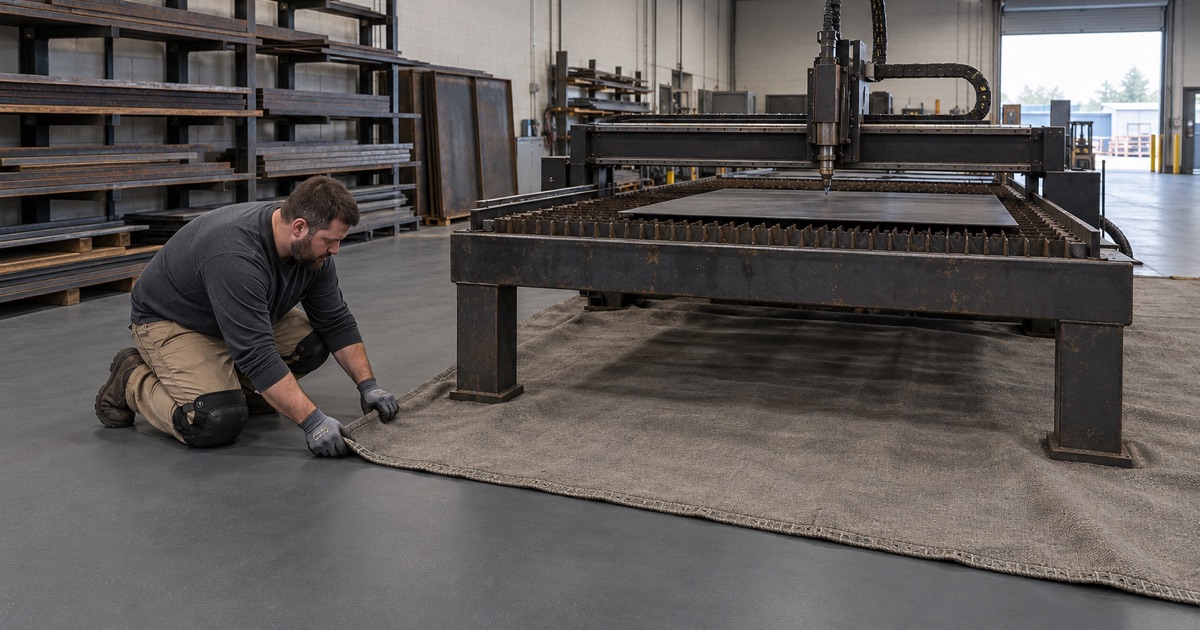
Notice what the standard asks for: a clean floor and fire-resistant shields. It does not ask for a special coating, and no coating satisfies it on its own. We keep a cutting area coated, because the coating still does its everyday job against oil, salt and dust, and we plan for the floor to be protected at the work with shields or blankets exactly as the rule describes. The coating and the shields do separate jobs.
Blankets and steel sheet under the work
The practical version of a fire-resistant shield in most shops is a welding blanket laid under and around the work, or a sheet of steel set down where the slag falls. Practitioners describe these as the usual protection, and they work because they catch the hot droplets before the resin ever sees them. A blanket also gives the slag one place to collect, which makes the cleanup faster and keeps beads from scattering into the rest of the room.
Sweeping before anyone walks through
We recommend a simple habit for every cutting area we coat: sweep the slag up when the cut is done, before the zone is walked in. A dedicated broom and dustpan kept by the table makes that easy. It keeps hot beads from being tracked across the finish, and it removes the abrasive grit that otherwise wears dull paths into an otherwise sound topcoat.
Welding and Plasma Cutting in a Bridgeview Home Garage
Plenty of Bridgeview homeowners weld for fun or for repairs, and a plasma cutter on a rolling cart has become a common sight in two-car garages. The village counts 3,322 detached houses in its housing stock, and a garage on one of those lots often doubles as a workshop on weekends. These floors get the same physics as a commercial shop, just on a smaller scale and usually with the car parked a few feet away.
Choosing a finish that forgives small burns
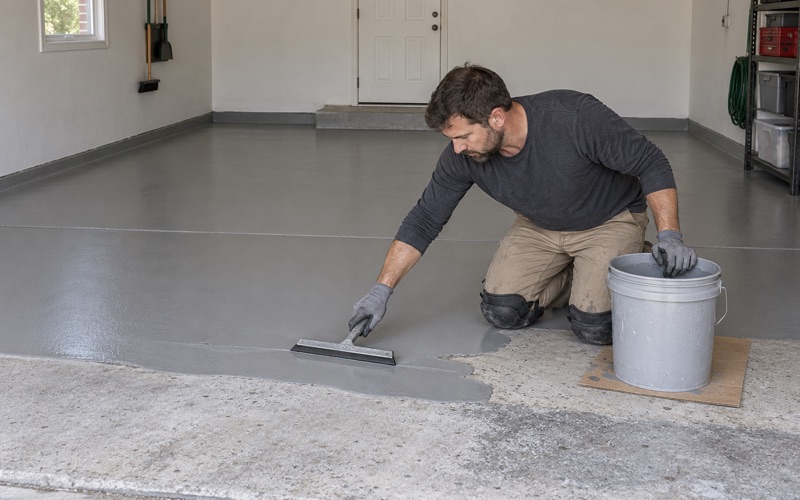
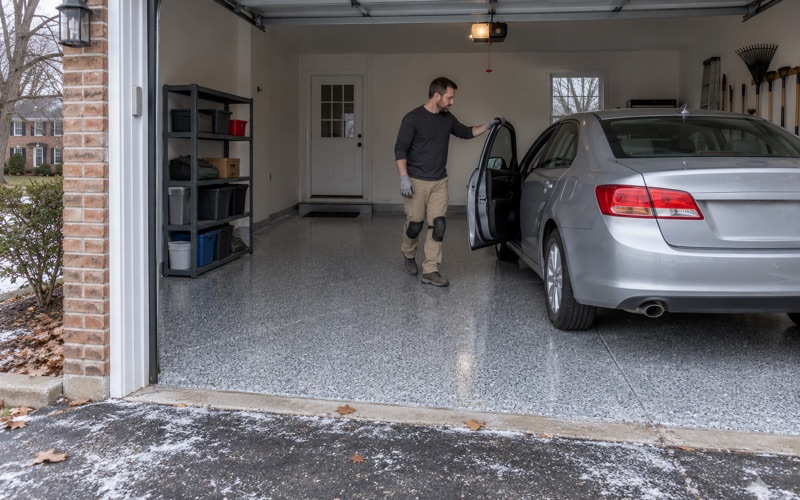
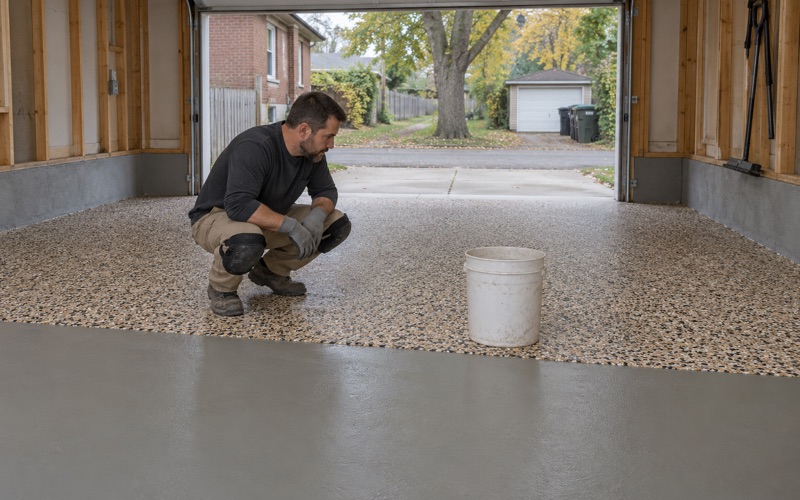
For a garage where cutting happens, we usually steer toward a vinyl flake broadcast or a quartz aggregate broadcast rather than a solid, glossy color. A busy flake pattern hides the small burn marks and tiny divots that still happen despite good habits, where a plain surface would show every one. A broadcast texture also adds grip, and we specify slip resistance by the broadcast and topcoat we actually use, not as a slogan.
Preparing the slab properly underneath
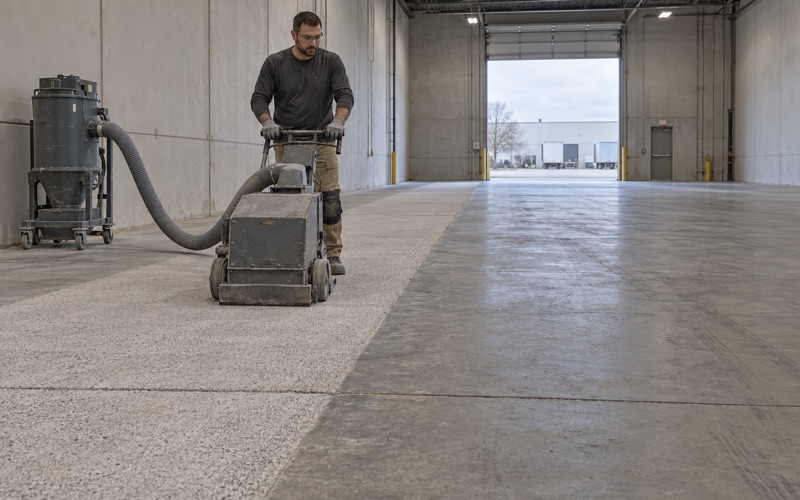
A floor that will take occasional abuse needs a strong bond. We open every slab with diamond grinding or shot blasting, never an acid etch, so the coating grips a real profile measured on the ICRI CSP scale. Before the price is final we test for moisture, using methods such as the ASTM F1869 calcium chloride test or ASTM F2170 in-situ relative humidity probes, and we map cracks, spalls and old coatings so you know what the slab needs first. The proposal names the product line, the number of coats and the finished thickness, so you can hold the floor up against the quote.
Salt, cure timing and the paperwork
A Bridgeview garage also has to survive the rock salt and brine that ride in on tires every winter, so the system we choose for a welding garage still has to stand up to calcium chloride deicers. We schedule the cure around slab temperature and the dew point spread at the surface rather than the calendar, and we tell an unheated garage in deep winter to wait. Home jobs over the state threshold get a written contract under the Illinois Home Repair and Remodeling Act along with the Home Repair: Know Your Consumer Rights pamphlet before any grinding starts, and grinding dust is captured at the machine with a vacuum rather than washed toward a drain.
Where the village fits in
Bridgeview runs its own Building Department at 7500 S. Oketo Avenue. A permit there requires drawings, a contractor’s license, a $10,000 surety bond and a certificate of insurance, and the village has adopted the 2021 International Building Code and its companion codes. If your project goes beyond a coating, such as a new slab or a reworked garage, we point you to those village requirements before anyone quotes a finish on fresh concrete.
Whether you run a cutting table for a living or fire up a plasma cutter on Saturdays, the floor plan is the same: shields and blankets at the work, slag swept before it is walked in, and a ground, tested, properly cured coating with a finish that forgives the marks no plan can fully prevent.
- 20+ Years of Floor Work
- Moisture Tested in Writing
- Free Written Quotes