Downers Grove Epoxy Flooring approaches epoxy-flooring in Bellwood with more than 20 years behind us, and the first question we ask about any floor that gets wet on purpose is not how it looks on day one. It is how it grips when water, soap and wax are all on it at once. A glossy coating that cleans beautifully can be the worst choice in a room where people stand in suds all shift.
That is why our proposals spell out traction the same way they spell out everything else. The broadcast, the topcoat, the product line, the number of coats and the finished thickness are written down, so the floor that goes in can be checked against the quote rather than against a promise. Slip resistance comes from those choices, not from a word on a brochure.
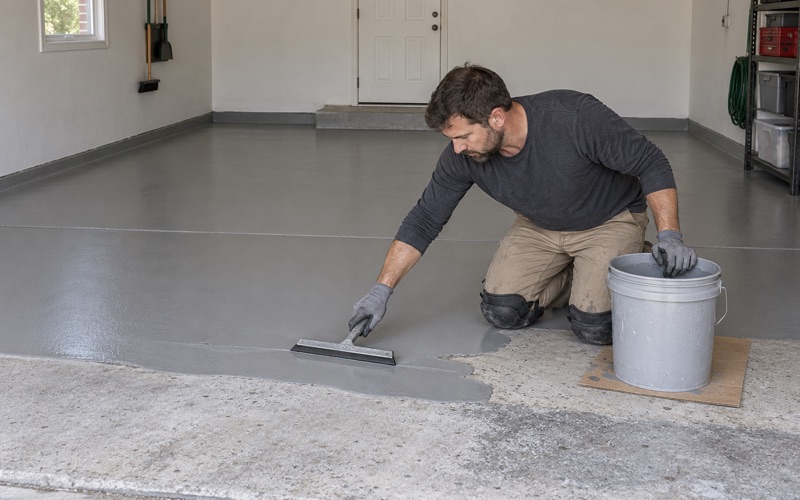
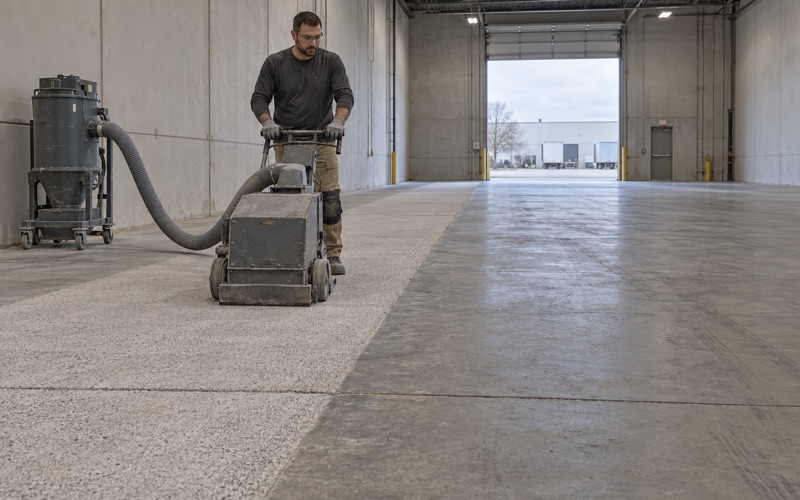
We open every slab with a diamond grinder or a shot blaster before any primer goes down, never an acid etch. On a floor that will spend its life wet, a coating that lets go at the edges becomes a trip hazard of its own, so the bond is where the job starts.
A Car Wash on Mannheim Road and the Rule for Wet Processes
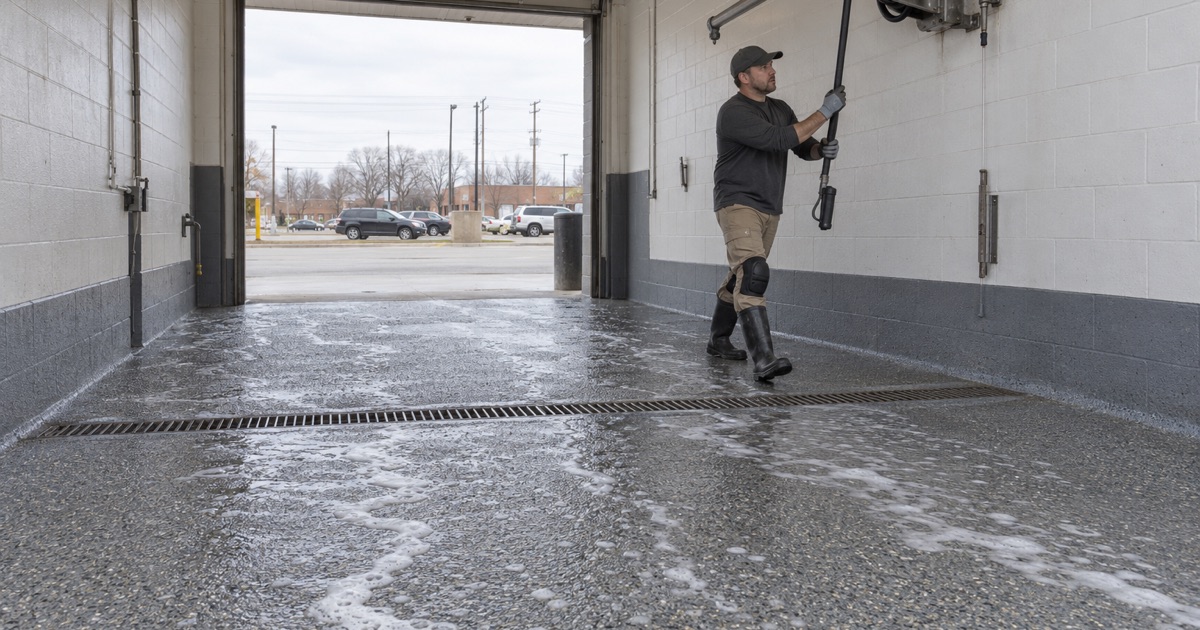
Bellwood is a village in Proviso Township, Cook County, about 13 miles west of Chicago’s downtown Loop, bounded by the Eisenhower Expressway on the south and the Union Pacific Proviso yards on the north. Its commercial floors are as varied as any suburb’s, but one business on Mannheim Road makes the clearest case for how a wet floor should be judged.
What a wash menu says about the floor
Buddy Bear Car Wash lists a Bellwood location at 1059 Mannheim Road, one of about 20 locations in a chain that began in 1972 on Chicago’s West Side. Its posted packages name Lava Foam, double soap, a Simoniz carnauba hot wax, a ceramic treatment, an under flush, heat dry and tire shine. We have no relationship with the business and have not seen its floor, its wash type or its staffing; the menu is simply a public list of what a modern wash puts into the water.
Every item on that list ends up on the ground at some point. Foam and soap are meant to cling, wax is meant to leave a film, and a ceramic treatment is meant to make water bead and run off a surface. Those are exactly the properties a car owner pays for, and exactly the ones a floor has to fight.
What OSHA actually requires
Federal workplace rules address this kind of room directly. Under 29 CFR 1910.22(a)(2), the floor of each workroom is to be kept clean and, to the extent feasible, dry. “When wet processes are used, drainage must be maintained and, to the extent feasible, dry standing places, such as false floors, platforms, and mats must be provided.”
A car wash is about as plain an example of wet processes as exists. The rule names no floor material at all, which matters for anyone shopping for a coating. No coating satisfies the section by itself; drainage and dry standing places do. What a resin floor can do is support both, by carrying water to the drains and by giving mats and platforms a sound, cleanable surface to sit on.
Where our work starts and stops
Our part of that picture is the slab and its finish. We map cracks, spalls and failed old coatings before we price anything, and we say so when a wash or detail bay needs concrete repair before it should be coated at all. Drainage design, mat programs and staff footwear belong to the owner, and we write the scope so nobody confuses the two.
Looking for epoxy-flooring closer to Northlake? See Northlake Epoxy-Flooring.
Why Soap and Wax Make a Wet Floor Slicker Than Water
Most slip-resistance talk assumes clean water. A wash bay rarely has clean water on it for long, and that changes what counts as enough texture.
Detergent films and wax residue
One car wash operator, writing on a practitioner forum in October 2008, put it plainly: the floors “aren’t merely wet with water, but often have high lubricity detergents and surfactants.” Surfactants are built to slip between surfaces and lift grime, and they do the same between a shoe sole and a floor. Add carnauba wax overspray or a ceramic product made to shed water, and a thin film sits on top of whatever texture the floor has.
That film fills shallow texture first. A floor that feels grippy when you test it with a wet hand from a hose can feel very different once foam has been running across it for an hour, because the fine peaks of the finish now sit under a lubricating layer.
One operator’s warning about epoxy
The same forum post warned that “an epoxy floor, even with anti-skid additives, would risk becoming a virtual ice skating rink,” and that “even some concrete sealers have proven too risky for car wash staff.” The writer added that many employees wear flimsy sneakers that slip more easily when wet, and that history had taught them to routinely recommend a rough broom finish on car wash concrete.
That is one operator’s opinion from 2008, not test data, and we treat it that way. It is still worth taking seriously, because the failure it describes is real: a smooth coating with a light sprinkle of grit, sealed under a thick glossy topcoat, leaves very little texture above the film. Resin flooring vendors answer the same problem with an aggregate broadcast or a slip-resistant topcoat, and the difference between the two outcomes lies in how the texture is built, not in the word epoxy.
Gloss is the wrong goal here
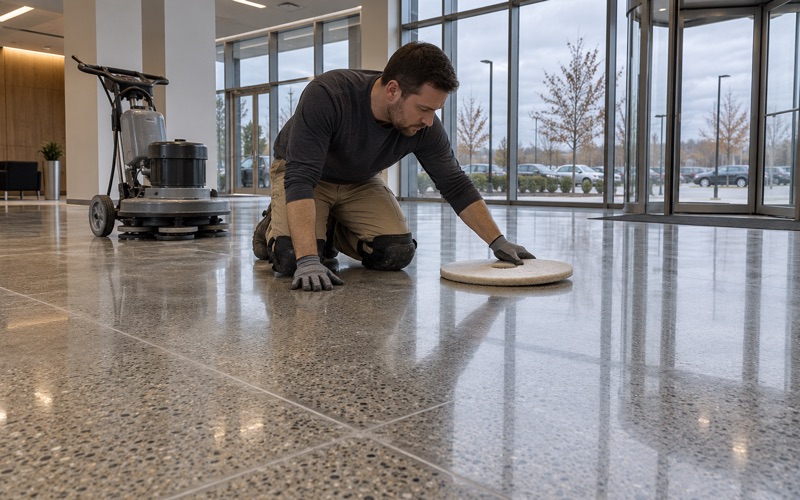
In a showroom, a mirror finish is the point. In a wash or detail bay it is a liability, however easily it rinses clean. We steer owners away from high-gloss systems in these rooms even when they ask for them, and we explain why before the job is sold rather than after.
Texture That Survives the Topcoat, Falls to Drains and Mats Where People Stand
When a wet-process floor is coated, three things decide whether it works: texture, slope and standing places. We specify all three in writing.
A broadcast sized for soapy water
A quartz aggregate broadcast into the body coat gives the floor its grip. The grade of aggregate and the number of topcoat passes over it are chosen together, because a heavy topcoat can bury a fine broadcast and leave a surface only slightly rougher than bare gloss. For a floor that will carry detergent and wax films, the texture has to stand proud of the final coat, not merely exist somewhere beneath it.
Our proposals name the aggregate, the topcoat chemistry, whether that is a polyaspartic, a polyurea or a urethane cement system, and how many coats go over the broadcast. That lets an owner hold the finished floor up against the paper. A slip-resistant texture is something we specify by materials and sequence; it is never a slogan, and no floor is slip-proof.
Falls to trench drains
Texture helps, but standing water defeats it. In a wash or detail bay the slab should fall toward trench drains or floor drains so nothing pools, and the coating has to follow that slope rather than fill the low spots. We look at the existing falls before we quote, and where water already sits in a bay we tell the owner plainly that a coating will not fix a slope problem. Sometimes the right first step is concrete work.
The edges of drain grates and the joints beside them are where a wet floor usually fails first. We detail those transitions so the coating ends cleanly instead of feathering into a thin edge that water can lift.
Mats and platforms where people stand
OSHA’s rule calls for dry standing places where feasible, and in a wash that usually means mats or raised platforms at the spots where an attendant stands for long stretches. A coated floor makes those mats easier to manage, because the surface underneath can be rinsed and dried without soaking into raw concrete. We would rather see a mat where someone works all day than chase extra grip with a coarser texture that is hard to clean.
Washing and Waxing a Car on a Bellwood Garage Floor
The same physics shows up at home on a smaller scale. Bellwood’s 6,340 housing units include 4,669 single-family detached houses, and plenty of owners wash, wax or detail a car in the garage or on the pad right outside it.
Why a home garage needs the same thinking
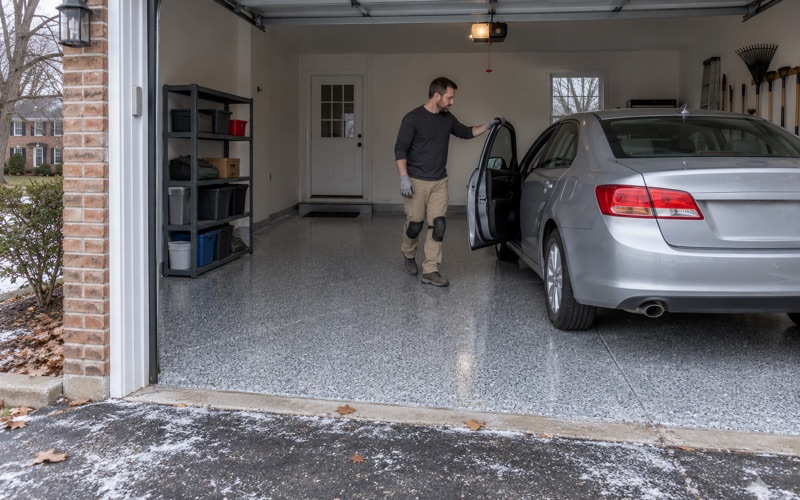
A bucket of car-wash soap tipped over a glossy flake floor behaves just like a commercial bay, only with sandals or bare feet instead of work shoes. Wax drips, tire shine overspray and quick-detailer mist land on the floor and stay there. If you plan to wash cars inside, tell us, because it changes the topcoat and broadcast we recommend, often toward a finer quartz or a textured clear coat over the vinyl flake broadcast.
Moisture testing before the price is final
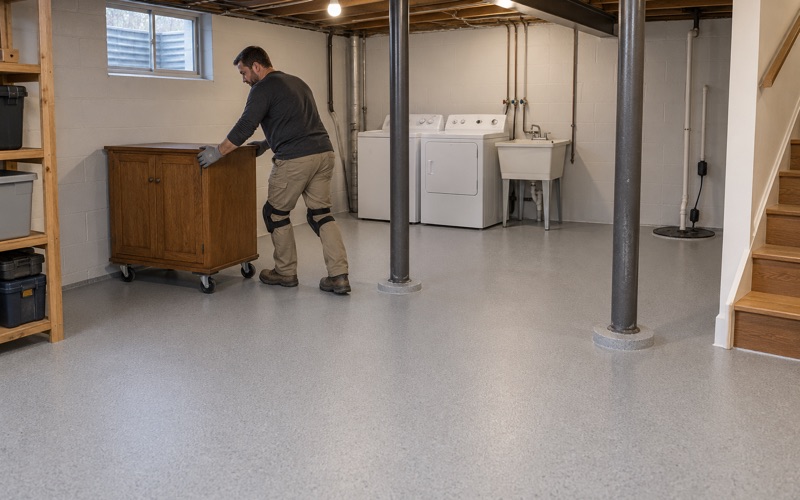
Most garage slabs in the village are far from new, so a moisture test is part of our written scope before the price is final. We use methods such as the ASTM D4263 plastic sheet test or ASTM F2170 in-situ relative humidity probes, depending on the slab, and we explain before the job is sold that moisture is the first exclusion in any coating warranty. A garage floor that gets wet from above and is also pushing vapor from below is one we want to understand before we coat it.
Dust, cure and the paperwork
Grinding dust is captured at the machine with a vacuum, never rinsed toward a floor drain or out to the street. Cure schedules follow slab temperature and dew point rather than the calendar, so a cold, unheated garage may be told to wait. Home jobs over the state threshold get a written contract and the Home Repair: Know Your Consumer Rights pamphlet before any grinding starts, and the products we choose fall inside the Illinois VOC limits for floor coatings.
- 20+ Years of Floor Work
- Moisture Tested in Writing
- Free Written Quotes