
Downers Grove Epoxy Flooring installs basement floor epoxy in Downers Grove, IL, serving surrounding cities including Hinsdale, Burr Ridge, Western Springs, La Grange and Westchester. For more than 20 years we have coated basement slabs in homes of every age, and the lesson they all teach is the same: a basement floor is only as good as the moisture test that came before it.
A basement slab sits in damp soil on every side, often with no vapor retarder underneath, and much of the local housing stock was built between 1950 and 1979, when under-slab plastic was not standard practice. That is why a moisture test is part of our written scope before the price is final, and why the proposal names the primer, the product line, the number of coats and the finished thickness.
The sections below cover how we test and prepare a basement slab, how we handle sump pits, drains and past water problems, which systems suit which rooms, and what a coating can and cannot do in a basement.
Testing a Basement Slab Before We Coat It
Why Moisture Comes First
Moisture vapor moves up through concrete from the soil below, and when a sealed coating traps it, pressure builds under the film until the coating blisters or lets go. Moisture vapor transmission is also the first exclusion in most coating warranties, so a basement floor coated without testing puts the risk entirely on the homeowner.
We would rather know the answer before the job is sold. If the readings are high, the system changes, and if the slab has liquid water coming through it, we say so plainly and point you to the right trade before any coating is discussed.
The Three Moisture Tests We Use
The ASTM D4263 plastic sheet test is a quick screen: a sheet taped to the slab shows whether moisture collects underneath. When the slab or the system calls for numbers, we move to ASTM F1869 calcium chloride testing, which measures the moisture vapor emission rate at the surface, or ASTM F2170 in-situ relative humidity probes set into holes drilled in the slab.
Each test answers a different question, and the thresholds they are judged against come from ASTM F710 and the coating maker’s data, not from the test methods themselves. We record the results in the scope so you can see why we chose the system we did.
Efflorescence and Other Warning Signs
White, powdery salt on the slab, called efflorescence, is a sign that water is moving through the concrete and evaporating at the surface. Dark damp patches, a musty smell, rust on metal shelving legs and peeling old paint tell the same story. We treat every one of these as information about the slab rather than cosmetic issues to cover up.
Preparing Mid-Century Basement Floors
Grinding Off Paint, Patches and Mastic
Older basements often carry several generations of floor finishes: painted concrete, patching compound, peel-and-stick tiles and the black mastic that held down older tile. A new coating bonded to any of those layers fails when that layer fails, so we grind everything down to sound concrete.
Black mastic in some older homes can contain asbestos, which is a reason to pause and test before grinding rather than a reason to grind faster. When we see it, we discuss testing and the options before scheduling the work.
Diamond Grinding With Dust Capture Indoors
Grinding in a basement means grinding under the living space, so dust control is not optional. Our grinders run with vacuums attached at the machine, capturing fine concrete dust as it is made, and we seal stairways and HVAC returns so dust does not travel through the house.
The grind opens the slab to a measured ICRI concrete surface profile, which gives the primer and epoxy real texture to bond into. Acid etching, the method in most store kits, cannot reliably remove old paint or mastic and leaves residue behind.
Cracks, Spalls and Uneven Slabs
Basement slabs crack as they shrink and settle, and older floors may have spalls, low spots around drains or heaved sections. We map them during the estimate and repair them after grinding, using rigid fillers for stable cracks and flexible material where a crack is still moving. If a section has heaved or broken up badly enough that it needs replacement, we tell you before quoting a coating over it.
Sump Pits, Drains and Past Water Problems
Coating Around Sump Basins and Floor Drains
Sump pits, floor drains and perimeter drain tile are where water management meets the floor, so the coating has to stop cleanly at each one. We detail the edges around sump basins and drain grates so the lid still lifts, the pump can be serviced and water still reaches the drain rather than pooling at a raised edge.
Overhead Sewers and Backflow Devices First
If a basement has taken a sewer backup, the fix often involves an overhead sewer conversion or a backflow device, and that work usually means cutting into the slab. The Downers Grove Sanitary District runs a reimbursement program for those installations, and doing that plumbing first avoids trenching through a brand-new epoxy floor.
Floodplain Homes and Flood-Resistant Materials
Homes near St. Joseph Creek and the East Branch DuPage River floodplain face a different question. FEMA Technical Bulletin 2 describes flood damage-resistant materials for spaces below the flood elevation, and a coated concrete floor can be part of a basement that recovers well after water. We talk through that context with owners whose homes sit in or near those areas.
Coating After a Flood or Backup
After water gets in, the slab has to be cleaned, disinfected and dried before it can be coated, and concrete dries far more slowly than the air around it. We test after cleanup, not before, so we are coating a slab that is actually ready rather than one that only looks dry.
Basement Floor Systems and Where They Fit
Moisture-Mitigation Primers
When vapor readings are above what a standard epoxy tolerates, a moisture-mitigation primer goes down first. It is formulated to reduce vapor transmission and give the coating a stable base, and it is the single most important line item on a damp basement quote.
Laundry Rooms and Utility Areas
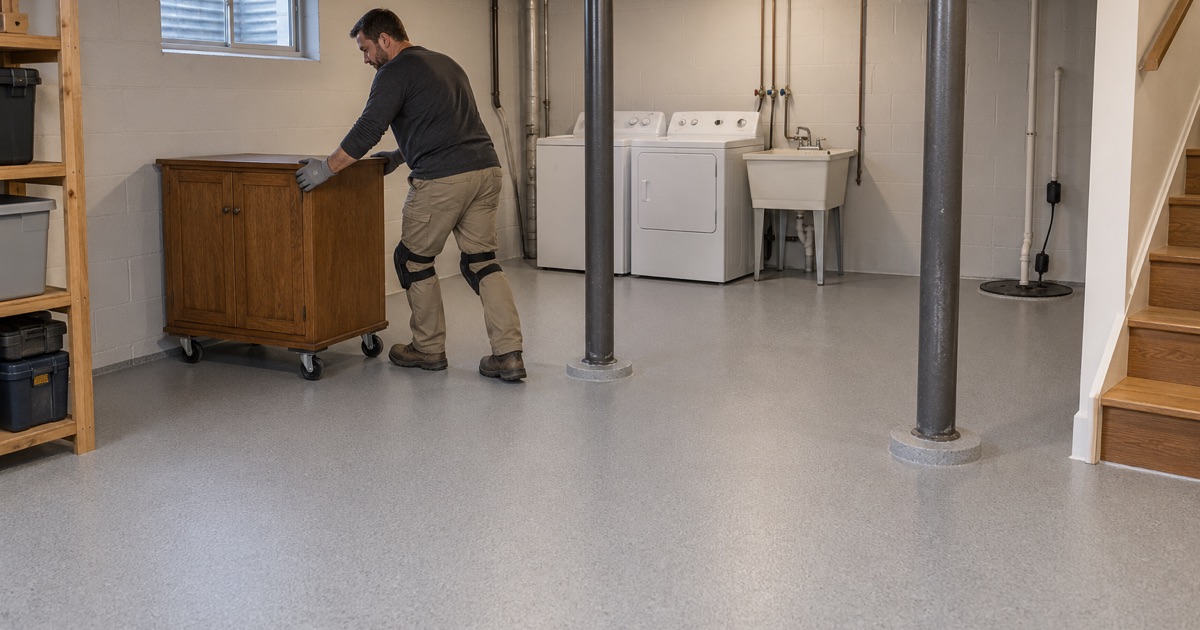
Laundry rooms see water, detergent and the occasional overflow, and utility rooms hold the water heater, furnace and softener. A seamless coated floor with a light broadcast cleans easily and shows leaks quickly, which helps you catch a dripping appliance before it becomes a bigger problem.
Workshops and Storage
A basement workshop needs a floor that handles dropped tools, oil, paint and rolling tool chests. A thicker epoxy system with a quartz or flake broadcast resists impact and abrasion, and a solid color keeps small parts easy to find on the floor.
Home Gyms and Playrooms
Home gyms take dropped weights and sweat, while playrooms take toys, spills and constant cleaning. We build these floors with texture for grip and a topcoat suited to the cleaners you will use, and many owners add rubber mats in lifting areas.
What a Basement Coating Is Not
A floor coating is never sold as radon reduction, because in Illinois radon mitigation is licensed work under IEMA, and it is not waterproofing for walls or cracks. We are clear about those limits up front, so you invest in the right solution for each problem and the floor coating does the job it is actually designed to do.
- 20+ Years of Floor Work
- Moisture Tested in Writing
- Free Written Quotes